Hindu community threatened as Muslim terrorist calls for mass genocide of Hindus in the name of Kashmir
 Pakistan Occupied Kashmir, Pakistan
  13 January, 2026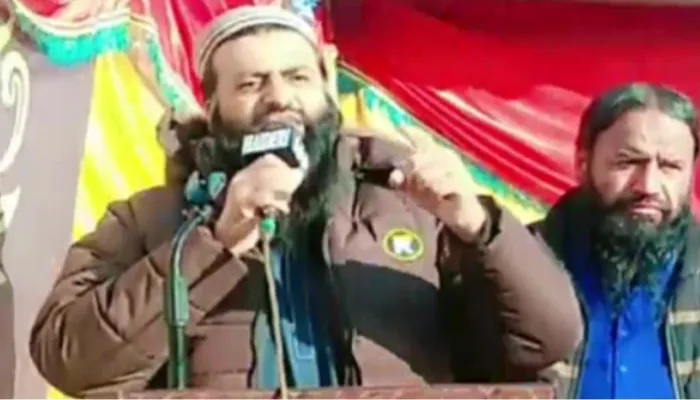
Case Summary
The Hindu community faced a direct threat from Abu Musa Kashmiri, a top commander of the Pakistan-based terrorist organisation Lashkar-e-Taiba (LeT), who delivered a public speech glorifying violence against Hindus near the Line of Control (LOC) in Pakistan-occupied Jammu and Kashmir. In a video released on social media, Abu Musa Kashmiri stated that Kashmir could not be won by begging, but only by slitting the throats of Hindus. He emphasised that jihad and terrorism were the only means to achieve freedom in the region. He said he had informed the Wazir-e-Azam, the Prime Minister of Pakistan, that the Kashmir issue could only be resolved through jihad and terrorism. The speech was delivered at a rally near the LOC in Tatrinote, Hajira Tehsil, Rawalakot district, and was widely circulated on social media platforms. The timing of the speech was significant as Abu Musa Kashmiri had delivered a similar address shortly before the Pahalgam terror attack on 22 April 2025, in which several Hindus were killed in Anantnag district after being identified on the basis of their faith. The latest speech coincided with visuals from another gathering in Bahawalpur, a known Jaish-e-Mohammed stronghold, where senior LeT commanders were seen regrouping. Security sources noted that these orchestrated outbursts closely mirrored the narrative being amplified by the Pakistan Army chief. The remarks came a day after Indian Army Chief General Upendra Dwivedi issued a warning that India would respond firmly to terrorism. General Dwivedi stated that counter-terror operations such as Operation Sindoor, launched on 7 May 2025 following the Pahalgam attack, demonstrated India’s ability to respond swiftly to provocations. He highlighted that the operation targeted terror infrastructure and air bases across Pakistan and Pakistan-occupied Jammu and Kashmir. General Dwivedi reiterated that talks with Pakistan could not resume alongside terror and that terrorists and their supporters would be treated in the same manner. Operation Sindoor, which lasted eighty-eight hours, provided lessons in faster decision-making across command levels, stronger integration among the Army, Navy, Air Force, Central Armed Police Forces, and preparedness for long-duration conflicts. While the operation was paused following diplomatic engagement by Pakistan’s Director General of Military Operations, New Delhi maintained that it remained active and warned that any future terror attack would be treated as an act of war. Hindu community remains under threat as Abu Musa Kashmiri’s statements reinforce a pattern of extremist rhetoric translating into targeted attacks, with Indian security agencies monitoring militant propaganda and movements along the Line of Control.
Why it is Hate Crime ?
This case has been documented under the selected primary category: Hate speech against Hindus. Under this, the selected secondary category is: Violent threats. Violent threats, explicit, implicit or implied, is the most dangerous form of hate speech since it goes beyond discriminatory and prejudicial language to express the intent of causing harm to an individual or a group of people based on their religious identity and faith. There could be several different kinds of threats that are issued to Hindus based on religious animosity. An explicit threat would mean the direct threat of violence towards an individual Hindu, a group of Hindus or Hindus at large. Physical violence, death threats, threats of destruction of property belonging to Hindus and threats of genocide would mean explicit threats against Hindus for their religious identity. Implicit threats may not be a direct threat but implied through the use of symbols of actions – for example – in the Nupur Sharma case, other than explicit threats, there were also implicit threats when Islamists took to the streets to burn and beat her effigies. It implies that they want to do the same to Nupur Sharma – thereby is considered an implicit threat. Violent threats can be delivered in person, through letters, phone calls, graffiti, or increasingly through social media and other online platforms. It would be important to understand that a threat – explicit or implicit, online or offline – to an individual who happens to be a Hindu does not qualify as a religiously motivated threat. Such a threat, while vile and dangerous, could be owing to non-religious reasons and/or personal animosity. To qualify as a religiously motivated threat, it would need to exhibit an indication that the individual is being targeted for religious reasons and/or owing to his/her religious identity as a Hindu. Another selected secondary category is: Call for genocide/violence against Hindus/specific sects of Hindus. Hate speech is defined as any speech, gesture, conduct, writing, or display that is prejudicial against a specific individual and/or group of people, which is leading to or may lead to violence, prejudicial action or hate against that individual and/or group. Often, animosity against Hindus or a specific panth/sampradaya/group of Hindus or a specific ideology they hold manifests itself into hate speech and calls for genocide/violence against that specific section of Hindus. For example, it has often been seen that those who hold animosity against the Hindu faith use specific sects/sampradaya/pant of Hindus as a proxy to express hate against Hindus as a whole. It has been seen that the word ‘Hindutva’ has been used to call for violence against those who say they believe in ‘Hindutva’. It is observed that ‘Hindutva’ is only used as a proxy to call for violence against Hindus as a whole, as seen in the Dismantling Global Hindutva conference where speakers admitted that ‘Hindutva’ cannot be eradicated till ‘Hinduism’ is eradicated. The eradication of an entire faith, in turn, is a genocidal call against the entire community that practices that faith. Further, it is also observed that violence against a specific section of Hindus is made, justifying these calls by weaving exaggerated tales of historical injustices. Often, those who hold animosity towards Hindus and their faith attempt to make their animosity more palatable by justifying their hate for a specific section, claiming that they are against that particular section because of their faith in the broader community and the religion they process. Such calls for violence against specific sections of Hindus, as mentioned, is a proxy for their animosity against the entire community and the faith they profess, and therefore, would be considered hate speech under this category. This incident carries clear hate crime markers because the threat is explicitly directed at Hindus as a religious community, and it calls for mass, faith-based violence. First, the language used is openly genocidal. Abu Musa Kashmiri does not speak about a military target or a political dispute alone. He calls for victory through killing Hindus, using brutal phrasing about slitting throats. This is not ideological critique or battlefield rhetoric. It is an incitement to mass murder aimed at a specific religious group. Second, the victim group is unambiguous. The target is not “India” in general terms, but “Hindus” by name. That selection is the key indicator of bias. When a perpetrator identifies a community by religion and advocates exterminatory violence against it, the intent is communal hatred, not a generic security threat. Third, the setting and platform reinforce organised hostility. The speech is delivered publicly at a rally near the Line of Control and then circulated widely on social media, indicating it was meant to mobilise supporters, normalise violence, and provoke fear among Hindus. The public nature of the address renders it propaganda, designed to encourage further attacks. Fourth, the reference point is a known pattern of faith-targeted terrorism, including the Pahalgam attack on 22 April 2025. The significance here is that similar rhetoric preceded that attack, in which victims were identified by faith and Hindus were killed. When someone repeats the same eliminationist framing around the same conflict narrative, it strengthens the inference that the speech is not abstract posturing but part of a pipeline that can translate into targeted violence. For these reasons, this should be treated as a hate-driven threat. It is a direct call for mass violence against Hindus, as Hindus, reinforced by a recent precedent where faith identification preceded killings. The Hinduphobia Tracker records incident dates based on when the crime occurred, rather than when the media reports it. In this case, media reports have not specified the exact date when the victim’s ordeal began. Therefore, for documentation purposes, 14th January, 2026, the date of media reporting, has been selected as the indicative incident date.


Case Status
Unknown


Perpetrators Details
Perpetrators
Muslim Extremists
Perpetrators Range
One Person
Perpetrators Gender
male
 Sources




