Hindu youth faced assault by Muslim men for a trivial issue while travelling in a bus to Khargone district, Madhya Pradesh.
 Khargone, Madhya Pradesh, India
  11 January, 2026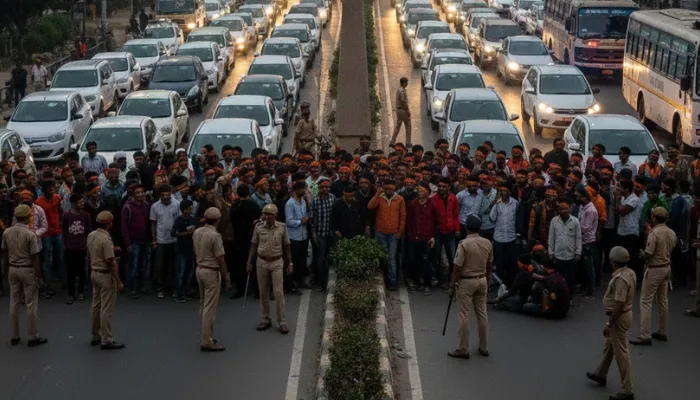
Case Summary
Hindu youth faced assault by four Muslim individuals following a dispute with other bus passengers during a journey on an Indore–Khargone bus, triggering tension and prolonged protests in Kasrawad town of Khargone district, Madhya Pradesh. The incident occurred late on 12th January, 2026, when the youth accidentally stepped on a Muslim woman's foot while getting down from the bus at a hotel in the Khalghat area of Dhar district. An argument followed between the passengers. After the argument, four individuals assaulted the Hindu youth when he objected during the altercation. The injured youth informed his acquaintances over the phone about the assault. When the bus later reached Arihant Nagar in Khargone district, it was stopped by villagers. Anticipating tension, Kasrawad Police Station in-charge Rajendra Barman, along with police personnel, escorted the bus to the police station. Two accused involved in the assault, identified as Sultan and Arabaz Ali, were taken into custody and later handed over to Dhamnod police. Two other individuals involved in the assault fled from the spot. The situation escalated further when Hindu organisations accused the police of misconduct while handling the matter. The Hindu outfit stated that the Kasrawad police had misbehaved, lathi-charged, and assaulted two individuals. The organisations staged a protest and blocked traffic at Jay Stambh Square in Kasrawad. The protest led to a complete halt of traffic on the Indore–Khargone highway for nearly five hours, with long queues of vehicles forming on both sides of the road. As the protest intensified, additional police forces were deployed from Khargone, Kasrawad, Mandleshwar, Maheshwar, and Mengaon police stations. The blockade was called off after Superintendent of Police Ravindra Verma ordered a probe by a gazetted officer into the entire episode.
Why it is Hate Crime ?
In this case, a Hindu youth was assaulted by four Muslim individuals following a minor dispute during a bus journey. The trigger was an accidental incident where the youth stepped on a Muslim woman’s foot while getting down. There was no indication of intentional misconduct, yet the response escalated into a group assault, which appears disproportionate to the immediacy of the provocation. In a number of communal flashpoints across India, minor everyday frictions have sometimes been used as the immediate pretext for far more violent action against Hindus. The stated trigger may be trivial, such as a casual argument, a misunderstanding in a public place, or an accidental touch, yet the response becomes excessive and punitive. When the retaliation is wildly disproportionate to the provocation, it suggests the dispute may not be the real driver, but rather a convenient opening for aggression that already exists beneath the surface. This concern becomes sharper when the violence is collective. A single person reacting in anger can still be read as a spontaneous scuffle. But when several individuals act together, it can indicate a readiness to dominate, punish, and publicly assert control, especially if the victim is isolated and outnumbered. Group assaults in such contexts often function as a message to the wider community that even small incidents can invite severe consequences, and that the victim’s side must learn to stay “in line.” That is why an incident like this raises red flags. The immediate cause may look minor, but the disproportionate, group-based violence and the speed with which the situation spirals can reflect deeper fault lines in the area, where identity and community dominance can shape how conflict plays out even when the original trigger appears mundane. At the same time, hate crime classification requires more than identity labels of the victim and the accused. It needs indicators that the victim was attacked because of their Hindu identity or for expressing their Hindu faith. In the details available so far, there are no reported religious slurs, no threats invoking Hindu faith, no demand to conceal religious markers, and no conduct aimed at a Hindu religious practice or place. There is also no information suggesting prior animosity, coordination, or premeditation tied to religion. Because the current record does not establish a religious motive beyond the parties’ identities, this case is best placed in the Undecided category at this stage. If further reporting or investigation reveals clear religious markers, for example, anti-Hindu abuse, threats referencing Hindu faith, statements asserting religious dominance, or evidence that the assault was triggered by the victim’s Hindu identity, the classification should be revisited and updated accordingly. Disclaimer: The number of perpetrators is mentioned as four in this case, based on the Hindu youth victim’s complaint. However, the villagers who stopped the bus at Arihant Nagar station were also potential participants in the incident. Additionally, a formal complaint was filed against two men, while the other two individuals involved in the assault fled and remain unaccounted for.
Victim Details
Total Victim
1
Deceased
0
Gender
- Male 1
- Female 0
- Third Gender 0
- Unknown 0
Caste
- SC/ST 0
- OBC 0
- General 0
- Unknown 1
Age Group
- Minor 0
- Adult 1
- Senior Citizen 0
- Unknown 0


Case Status
Case sub-judice


Perpetrators Details
Perpetrators
Muslim Extremists
Perpetrators Range
From 2 To 5
Perpetrators Gender
male
 Sources




