Hindu faith mocked: Government school class IV exam paper names a dog after "Ram"
 Mahasamund, Chhattisgarh, India
  7 January, 2026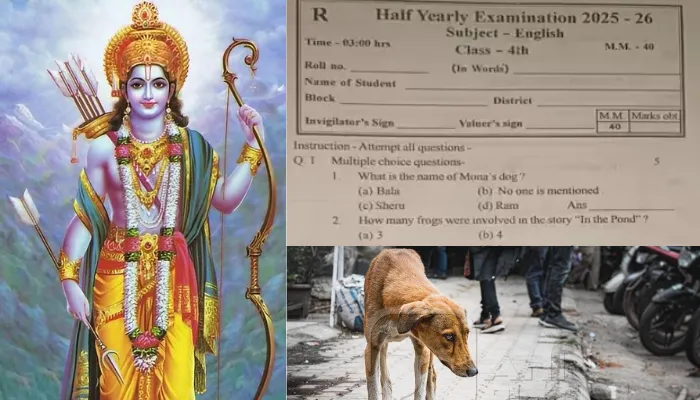
Case Summary
Hindu community members faced religious hurt and public disorder following the inclusion of the name “Ram” as a dog’s name in a Class IV English examination paper conducted in government schools in Mahasamund district, Chhattisgarh. The controversy arose from a multiple-choice question in the half-yearly English examination for the 2025–26 academic session, held on Wednesday, January 7 2026, which asked students to identify the name of Mona’s dog. The four options printed in the question paper were Bala, Sheru, No One, and Ram. The matter came to light after the sealed examination paper was opened at the examination centres. Protests erupted on Thursday, January 8, after Hindu organisations objected to the inclusion of the name Ram in the context of a dog. Members of the Vishwa Hindu Parishad, Bajrang Dal, and Akhil Bharatiya Vidyarthi Parishad staged demonstrations outside the office of the District Education Officer in Mahasamund. Protesters raised slogans, burnt an effigy on the office premises, and submitted memorandums to the District Collector and the Superintendent of Police. Vishwa Hindu Parishad district head Harshwardhan Chandrakar demanded the arrest and dismissal of all persons involved in preparing, approving, and printing the question paper. The organisations described the incident as an insult to religious faith and demanded criminal action against the responsible officials and staff. They warned of a district-wide agitation if strict action was not taken within seven days. A parent and Ward 21 resident, Vijay Mahato, lodged a complaint at the Mahasamund police station regarding the objectionable question. Police were deployed at the District Education Office as a large number of Akhil Bharatiya Vidyarthi Parishad workers gathered at the site. Following the backlash, District Education Officer Vijay Kumar Lahre expressed regret over the incident and claimed that the question paper that appeared in the examination was not the one approved by his office. He stated that the selected question sent for printing was different and that the issue surfaced only after the sealed paper was opened, due to confidentiality protocols governing examinations. He stated that the objectionable option was removed immediately after the matter came to notice. Following the incident, the District Education Office issued written instructions cancelling option D of Question Number One and officially replacing it with the option “Tommy.” The education department sought an explanation from the printing vendor and demanded the original manuscript to determine how the alteration occurred. The Directorate of Public Instruction issued a show-cause notice to District Education Officer Vijay Kumar Lahre, citing gross negligence and indifference in the discharge of official duties. A four-member inquiry team from the Joint Director’s office visited the District Education Office on Thursday evening. The team included Sanjeev Shrivastava and Satish Nair. Teacher organisations also protested against the incident. Representatives, including Tekram Sen, Umesh Bharti Goswami, Avinash Lal, and Rajesh Sharma, met the District Education Officer and submitted a memorandum, raising concerns regarding the printed Portable Document Format version of the question paper. A related incident was identified at a government primary school in Nakati village, Tilda block, Raipur district, where a Class IV English question paper also included “Ram” as the name of a dog. In that case, the headmistress stated that she had intended to write “Ramu” but omitted the letter “u.” The examination had been held the previous week. After the question paper from Nakati village circulated on social media, members of the Vishwa Hindu Parishad and Bajrang Dal submitted written complaints to the District Magistrate and Superintendent of Police, Mahasamund. Superintendent of Police Prabhat Kumar confirmed that a first information report was registered against unknown persons under Section 299 of the Indian Penal Code, a non-bailable offence. An investigation established that the question paper in the Nakati village case was prepared by the headmistress of the government primary school. She was suspended on Saturday, January 10, 2026. The District Education Officer issued a warning to the Tilda Block Education Officer, and the school principal was served a warning letter for failing to select the correct moderator. The district administration ordered investigations into both incidents to identify those responsible for drafting, proofreading, moderating, and printing the examination papers.
Why it is Hate Crime ?
This case has been documented under the selected primary category: Hate speech against Hindus. Under this, the selected secondary category is: Anti-Hindu slurs, mocking faith. Anti-Hindu slurs and the deliberate mocking of the Hindu faith owing to religious animosity involve the usage of derogatory terms, stereotypes, or offensive references to religious practices, symbols, or figures. One of the common anti-Hindu slurs used against Hindus is “cow-worshipper” and “cow piss drinker”. The intention of using this term is to demean and mock Hindus as a group and their religious beliefs since Hindus consider the cow holy. Additionally, some symbols and the slurs attached to them have a historical context that exacerbates the insult, hate, stereotyping, dehumanisation and oppression against Hindus. Cow worship has been used for centuries to denigrate Hindus, insult their faith and oppress Hindus specifically as a religious group. There has been overwhelming documentation about how cow slaughter has been used to persecute Hindus with cow meat being thrown in temples and places of worship. There has also been overwhelming documentation where cow meat (beef) has been force-fed to Hindus to either forcefully convert them to Islam or denigrate their faith. Apart from cow worship, the Swastika – which holds deep religious significance for the Hindus – has also been misinterpreted and distorted to use as a slur against Hindus. Similarly, the worship of the Shivling has been used by supremacist ideologies and religions to denigrate Hindus owing to religious animosity. Such slurs and denigration stem out of inherent animosity and hate towards Hindus and their faith, therefore, it is categorised as hate speech targeted at Hindus specifically owing to their religious identity. Another selected secondary category is: Predatory proselytisation. Under this, the selected secondary category is: Proselytisation by grooming, brainwashing, manipulation or subtle indoctrination. Under this, the selected tertiary category is: Family claims grooming. Religious brainwashing essentially means the often subtle and forcible indoctrination to induce someone to give up their religious beliefs to accept contrasting regimented ideas. Religious grooming or brainwashing also involves propaganda and manipulation. It involves the systematic effort, driven by religious malice and indoctrination, to persuade “non-believers’ to accept allegiance, command, or doctrine to and of a contrasting faith. Cases of such grooming or brainwashing are far more nuanced than direct threats, coercion, inducement and violence. In such cases, it is often seen that there is repeated, subtle and continual manipulation of the victim to induce disaffection towards their own faith and acceptance of the contrasting faith of the perpetrator. While subtle indoctrination is widely acknowledged as predatory, an element which is often understated in such conversions or the attempts of such conversion is the role of loyalty and trust which might develop between the perpetrator and the victim. Fiduciary relationships are often abused to affect such religious conversion. For example, an educator transmitting religious doctrine of a competing faith to a Hindu student. The Hindu student is likely to accept what the teacher is transmitting owing to existence of the fiduciary relationship. The exploitation of the fiduciary relationship to religiously indoctrinate victims would also be included in this category. Since the underlying animosity towards the victim’s faith forms the basis of predatory proselytization, such cases are considered religiously motivated hate crimes. This is a fit case for a religiously motivated hate crime considering the following observations: Firstly, Hindu community members were subjected to direct religious injury through a state-linked examination process that used the name “Ram” as a dog’s name in a Class IV question paper. The examination was conducted in government schools, and the offensive content appeared in a compulsory academic assessment for children. The use of a sacred Hindu name in this context constituted a clear act of religious degradation. The injury was not symbolic or abstract; it resulted in immediate outrage, public protest, police deployment, and formal legal action, demonstrating real and measurable harm to the Hindu community. Secondly, the offence was delivered through an institutional mechanism that exercised authority and legitimacy. The question paper passed through drafting, printing, sealing, and official distribution before reaching students. The fact that the content surfaced only after the sealed paper was opened at the examination centres confirmed that the religious injury was inflicted through the state education system itself. This institutional channel amplified the seriousness of the act and transformed it from an individual lapse into a systemic religious violation. Thirdly, the victims were minors. The affected students were Class IV children who encountered the offensive content at a formative and vulnerable age. Minors lacked the capacity to consent to or shield themselves from religious insult imposed through compulsory examinations. The exposure of Hindu children to the degradation of a revered religious name within their examination paper constituted an imposed and unavoidable religious harm. The targeting of children in this manner intensified the gravity of the offence. Fourthly, the incident amounted to collective religious targeting. Hindu organisations, parents, and teachers were compelled to mobilise in defence of religious dignity. Memorandums were submitted to senior civil and police authorities, and a first information report was registered under Section 299 of the Indian Penal Code, a non-bailable offence concerning acts intended to outrage religious feelings. The invocation of this provision demonstrated that the act crossed the threshold from error to punishable religious injury. Fifthly, the consequences produced public disorder and fear within the Hindu community. Protests, effigy burning, police deployment, suspensions, warning notices, and departmental inquiries followed. Hindu community members were forced to seek state intervention to prevent the normalisation of religious insult in public education. The sequence of events established that the act inflicted targeted religious harm, thereby constituting a hate crime rooted in injury to Hindu religious identity. It is thus added to the tracker.


Case Status
Complaint filed


Perpetrators Details
Perpetrators
Unknown
Perpetrators Range
Unknown
Perpetrators Gender
unknown
 Sources




