Attack on Hindu sentiments: Muslim men dump cow remains near Hindu temple in Kanpur
 Kanpur, Uttar Pradesh, India
  11 January, 2026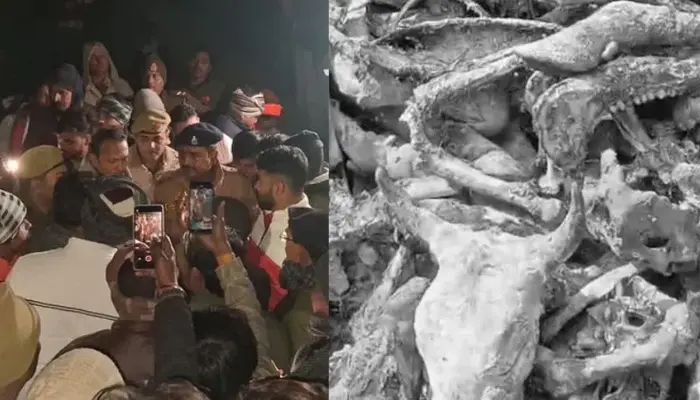
Case Summary
In the Gadhanpur area of Kanpur district, Uttar Pradesh, Hindu religious customs were defiled when large quantities of cow remains were dumped near a Hindu temple on the farm of a Muslim man named Mohammad Shakir. Several Muslim men carried out the dumping. The discovery sparked religious tensions in the area. According to reports, on the night of 12 January 2026, severed cattle heads, bones and skins numbering over one hundred were found concealed behind a tin enclosure in a field adjoining a graveyard, located a short distance from the Durga (Singhvahini) Temple. The information quickly spread across the area and triggered intense public anger, particularly among local Hindus who viewed the placement of cattle remains near a temple as a deliberate provocation. Hindu activists from the Vishwa Hindu Parishad and Bajrang Dal reached the spot in large numbers, raised slogans, and confronted police personnel, leading to a tense law-and-order situation. Police inspection confirmed that the remains had been systematically stored and dumped within the field near the Hindu temple. The land, where the cattle remains were found, was linked to a local Muslim man named Mohammad Shakir, while subsequent police action also resulted in the arrest of two other Muslim individuals, Nadir and Qadir. An FIR was registered on the complaint of Sub-Inspector Shubham Jaiswal, naming 20 to 25 individuals, including municipal figures and local residents such as Ikhlaq Khan, Shadab Khan, Achchu Khan, Rehman Qureshi, Nasir and Qadir, under provisions of the Prevention of Cruelty to Animals Act and other relevant sections. A state veterinarian was called to examine the remains, and an adjoining warehouse was sealed as part of the investigation. The scale of the recovered remains indicated prolonged and organised illegal activity, intensifying public outrage. As protests escalated, accusations of police complicity also surfaced, with demonstrators stating that the activity had continued unchecked due to local-level collusion. Following a preliminary inquiry, Joint Commissioner of Police Ashutosh Kumar suspended four police personnel with immediate effect, including Bilhaur Station House Officer Ashok Kumar Saroj, outpost in-charge Premveer Singh, constable Aftab Alam and head constable Dilip Gangwar. Senior officers, including the Additional Deputy Commissioner of Police (West), Assistant Commissioner of Police (Bilhaur), and Sub-Divisional Magistrate (Bilhaur), were forced to intervene repeatedly to restore order and ensure strict action. Bharatiya Janata Party Member of Legislative Assembly Rahul Bachcha Sonkar arrived at Bilhaur police station, issued a 48-hour ultimatum to the police administration to arrest those involved, and publicly warned of retaliatory consequences if action was delayed, further heightening communal tensions. Lawyers and local residents also staged demonstrations, demanding exemplary punishment for those responsible. Police teams continued raids to trace the remaining accused, while heavy security remained in place to prevent further escalation in the communally sensitive area.
Why it is Hate Crime ?
This case has been added to the tracker under the primary category- Attack on Hindu Religious Representations. The subcategory selected is- Defiling Religious Customs. Sanatan Dharma is not a religion of one book, which is to say that while it has religious scriptures that form the central tenets of the faith, there are several traditions followed through thousands of years, mostly passed from generation to generation orally. There are several such customs and traditions that are followed by various Hindus and Hindu sects. Defiling of these traditions and customs is a breach of an individual or group’s religious practices. Such practices can range from dietary restrictions like not eating non-vegetarian food for a certain period of the year, not eating non-vegetarian food at all, not eating beef since the cow is considered holy in Hinduism, the sanctity of religious customs followed in the house (like many ISCKON devotees), etc. Any malicious action leading to the breach of such traditions or defilement of these traditions owing to animosity towards the faith or for the sake of activism stems not only from the lack of faith in the religion itself but also from disregard for the faith of the devotees who follow the customs/traditions and implicit bias against the faith, the tradition itself. Since these specific traditions are central to the faith of the devotees of that specific sect of Hindus, any non-compliance with these traditional rules would be considered a religiously motivated hate crime. The other subcategory selected is- Desecration of Hindu religious symbol. Icons and symbols or a religious representation of a spiritual ideal are widely revered in Hinduism. Iconography is of vital significance in the Hindu milieu. It helps connect people’s spiritual beliefs with the real world. Iconography within the Hindu faith takes several shapes and forms. Murtis are of most significance to Hindus, to which daily rituals, prayers and offerings are done. Besides the murtis, there are several other symbols which have deep significance in the Hindu faith – the Om and Swastika for example. Since these Hindu religious symbols hold paramount importance in Hinduism, any desecration of symbols, icons, murtis, religious representations and manifestations, is driven by animosity towards the faith itself which manifests itself through these murtis, icons and symbols. Therefore, any desecration of these Hindu religious symbols and representations is considered religiously motivated hate crimes under this category. This case has been added to the tracker because large quantities of cow remains were deliberately dumped near a Hindu temple in an effort to defile Hindu religious customs by the Muslim perpetrators. This was a religiously motivated hate crime because the accused deliberately carried out cow slaughter and concealed a large quantity of cattle remains near the Hindu temple, fully aware of the deep cultural sensitivity and religious reverence associated with the cow in Hinduism. In Hindu belief, the cow is regarded as sacred and symbolises life, sustenance and purity, while temples are considered the living abodes of deities whose sanctity must be preserved at all times. The deliberate placement and storage of cow heads, bones and skins near the Durga (Singhvahini) Temple was not a neutral or incidental act but a conscious violation of Hindu religious norms and temple purity. This act was a direct assault on that belief system and reflects a clear intent to dishonour Hindu faith and customs. Such an act went beyond illegal slaughter or animal cruelty and amounted to a targeted affront to Hindu religious sentiments, designed to provoke outrage and intimidate the local Hindu community. The choice of location, adjacent to a temple, demonstrated an intention to defile and desecrate a sacred space and humiliate the religious beliefs of Hindus. This conduct reflected hostility towards Hindu religious practices and constituted an act of communal intimidation rooted in religious animosity. The intention was to defile and desecrate a Hindu place of worship. Therefore, this incident was classified as a religiously motivated hate crime and included in the Hinduphobia Tracker within the hate crime database.


Case Status
Case sub-judice


Perpetrators Details
Perpetrators
Muslim Extremists
Perpetrators Range
From 10 to 100
Perpetrators Gender
male
 Sources




