Hindu MBBS students exposed to jihadi indoctrination by Muslim clerics inside Basti Medical College, Uttar Pradesh
 Basti, Uttar Pradesh, India
  12 January, 2026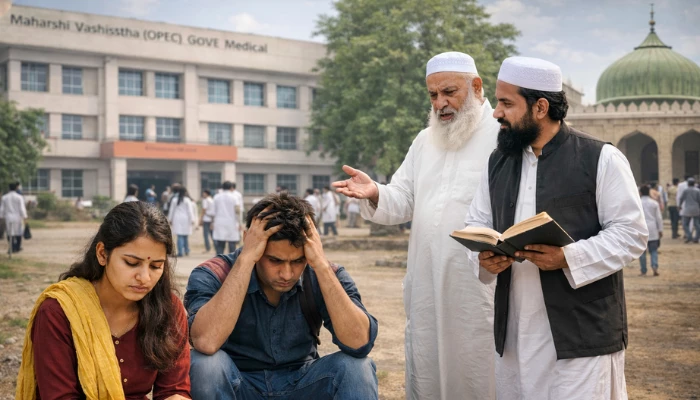
Case Summary
In Basti district, Uttar Pradesh, Hindu MBBS students at Maharshi Vashishtha Autonomous State Medical College and OPEC Hospital were targeted for religious conversion by Muslim clerics. The matter came to light on 13 January 2026 after Hindu Yuva Vahini and other Hindu organisations documented the incident. A written memorandum was submitted to the Superintendent of Police and the District Magistrate, seeking action under the Uttar Pradesh Prohibition of Unlawful Conversion of Religion Act, 2021. According to the memorandum, students were taken to a madarsa to offer prayers with local clerics, and outside clerics were brought into hostel rooms to influence students to convert to Islam. The complaint also stated that students were taught jihadi literature and that inducements were used to lure Hindu students. Vinay Singh, the outgoing district general secretary of Hindu Yuva Vahini Basti, said similar complaints had emerged at medical institutions in Lucknow, Agra, and Basti, and questioned the role of intelligence agencies such as the LIU and IB. After the incident became public, protests were held, with Hindu organisations accusing those involved of misusing a government medical institution for conversion activity. They demanded a prompt, impartial investigation and strict legal action against the doctors, officials, and clerics linked to the racket.
Why it is Hate Crime ?
The primary category selected is Predatory Proselytisation. The sub- category selected is: Proselytisation by grooming, brainwashing, manipulation or subtle indoctrination. The tertiary category is: Pattern of targeting Hindus. Religious brainwashing essentially means the often subtle and forcible indoctrination to induce someone to give up their religious beliefs to accept contrasting, regimented ideas. Religious grooming or brainwashing also involves propaganda and manipulation. It involves the systematic effort, driven by religious malice and indoctrination, to persuade “non-believers’ to accept allegiance, command, or doctrine to and of a contrasting faith. Cases of such grooming or brainwashing are far more nuanced than direct threats, coercion, inducement and violence. In such cases, it is often seen that there is repeated, subtle and continual manipulation of the victim to induce disaffection towards their own faith and acceptance of the contrasting faith of the perpetrator. While subtle indoctrination is widely acknowledged as predatory, an element which is often understated in such conversions or the attempts of such conversion is the role of loyalty and trust which might develop between the perpetrator and the victim. Fiduciary relationships are often abused to affect such religious conversion. For example, an educator transmitting religious doctrine of a competing faith to a Hindu student. The Hindu student is likely to accept what the teacher is transmitting owing to the existence of the fiduciary relationship. The exploitation of the fiduciary relationship to religiously indoctrinate victims would also be included in this category. Since the underlying animosity towards the victim’s faith forms the basis of predatory proselytisation, such cases are considered religiously motivated hate crimes. The other sub-category selected is- Conversion/ attempts to convert by inducement. Predatory Proselytisation is not just limited to threat, harassment, force and violence, but it also has contours of stealth. In several cases, the Hindu victim is exploited to convert, with non-Hindus taking advantage of their poverty. In such cases, the Hindu victim who is suffering financially is offered monetary benefits, including lucrative offers for jobs, health treatment, education, etc, to induce the victim into changing his/her religion. In such cases, the religious identity of the victim and the aim to disenfranchise him from his faith form the heart of the crime. Also, taking advantage of and exploiting an individual’s economic vulnerabilities is widely acknowledged as exploitation, forms of which are often penalised by law. Such cases, therefore, are considered religiously motivated hate crimes since the victim’s religious identity forms the very heart of the crime itself. This case qualifies as a hate crime against Hindus because the religious activity was directed specifically at Hindu students, with the intention of converting them through manipulation and institutional access rather than voluntary religious choice. Predatory proselytisation includes covert influence, misuse of authority, and exploitation of vulnerability, all of which were present in this case. It has multiple religious markers indicating that Hindu students were singled out within an educational setting for religious interference and pressured identity change. Targeting of Hindu identity in a campus environment: The victims are identified as Hindu MBBS students, and the activity described is directed at them as a religious group. When students are approached because of their faith identity, the harm is not limited to individual persuasion, it becomes discriminatory targeting of a community within a public institution. Use of madarsa visits as a conversion pathway: Taking students to a madarsa to offer prayers with clerics is a religious marker because it is not part of medical education or voluntary worship in a private capacity. It functions as structured religious exposure designed to normalise Islamic practice and create pressure to participate, which is especially coercive in a student setting where peer influence and authority dynamics are strong. Clerics entering hostel rooms: Bringing outside clerics into hostel rooms to influence students is a marker of organised proselytisation. Hostels are private living spaces attached to a state institution. Using them for religious influence efforts turns a neutral campus into a religious conversion zone and undermines the students’ right to live and study without targeted religious pressure. Inducements to lure conversion: The use of inducements is a clear marker of unlawful and coercive conversion activity because it seeks to obtain religious change through material leverage rather than free belief. This is particularly grave when directed at students who may be financially dependent and vulnerable to promised benefits. Teaching jihadi literature: Introducing jihadi literature to students in the context of religious influence adds an ideological marker. It suggests an attempt to shape worldview and identity through extremist or supremacist narratives, intensifying the threat beyond ordinary religious outreach and raising concerns about radicalisation and hostility toward non-Muslims. Misuse of a government medical institution: The setting matters. A government medical college and hospital are meant to be religiously neutral spaces. Using institutional proximity, campus access, and student accommodations to facilitate conversion activity violates that neutrality and creates an intimidating environment for Hindu students, who may fear retaliation, isolation, or academic consequences if they resist. Together, these markers show more than casual religious discussion. They indicate organised, targeted pressure on Hindu students to abandon their faith and adopt Islam, using structured religious participation, access to private student spaces, inducements, and ideological material. This supports hate crime classification because the conduct is aimed at undermining Hindu religious identity in a public institution through coercive and discriminatory conversion practices.


Case Status
Complaint filed


Perpetrators Details
Perpetrators
Muslim Extremists
Perpetrators Range
Unknown
Perpetrators Gender
unknown
 Sources




