Hindu soldier restricted from wearing tilak, threatened with deportation during army training in United States
 United States
  21 December, 2025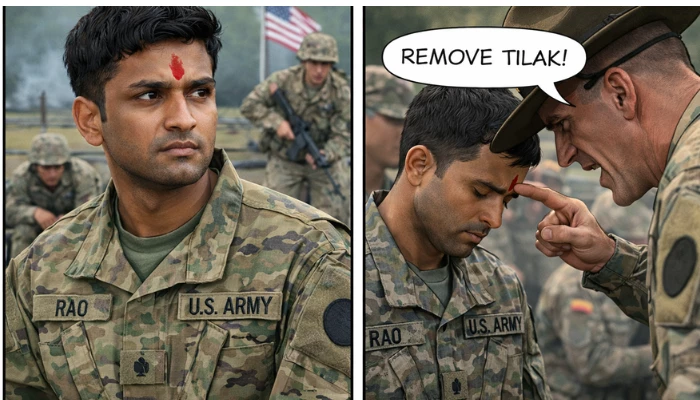
Case Summary
In the United States of America, a Hindu soldier, Second Lieutenant Harish Rao, enrolled in the United States Army training, faced restrictions on wearing a tilak, a sacred Hindu religious symbol applied to the forehead, and threats of deportation from authorities when he refused to comply. This incident came to light when the victim revealed his ordeal. He stated that he faced institutional pressure and threats of deportation for wearing a tilak in accordance with his Hindu religious beliefs while undergoing official military training. The training authorities objected to the visible Hindu religious symbol and directed him to remove the tilak. When Rao refused to abandon the religious practice, he was threatened with removal from the training programme and deportation to India, placing his military career and immigration status at risk. During this period, Rao was isolated from fellow trainees and sidelined, creating an environment of intimidation and uncertainty. The matter escalated until a United States Army chaplain intervened. Following this intervention, Rao was granted formal religious accommodation, allowing him to continue his training while wearing the tilak. He subsequently completed his training and received his commission.
Why it is Hate Crime ?
This case has been added to the tracker under the primary category: Restriction/ban on Hindu religious practice. Within this, the subcategory selected is- Restriction on expression of Hindu identity. An example of the state-affected prejudicial and targeted orders against the Hindu community would be a government denying the right of a Hindu or a group of Hindus to hold a religious procession owing to the animosity of non-Hindu groups. Denial of the religious right of the Hindus to assuage the non-Hindu group, which harbours animosity to a point where it could lead to violence against Hindus, is not only a failure of law and order but is a prejudicial order against Hindus, denying them their fundamental rights to express their religious identity. An example of a hate crime against Hindus by a non-Hindu would be a non-Hindu institution forcing its Hindu employees to abandon religious symbols that a Hindu would wear as an expression of faith owing to inherent prejudice against the faith professed by the victim or a non-Hindu group of people restricting a Hindu group from constructing a place of worship simply because the demography of the area in which the temple is being built is dominated by non-Hindus. Such actions are driven by religious animosity and/or prejudice against Hindus and their faith and would therefore be categorised as a hate crime. Another primary category selected is- Attack not resulting in death. The subcategory selected is- Attacked for Hindu identity. In several cases, Hindus are attacked merely for their Hindu identity without any perceived provocation. A classic example of this category of religiously motivated hate crime is a murder in 2016. 7 ISIS terrorists were convicted for shooting a school principal in Kanpur because they got ‘triggered’ seeing the Kalava on his wrist and tilak that he had put. In this, the Hindu victim had offered no provocation except for his Hindu religious identity. The motivation for the murder was purely religious, driven by religious supremacy. Such cases where Hindus are targeted merely for their religious identity would be documented as a hate crime under this category. In this case, a Hindu soldier, Second Lieutenant Harish Rao, enrolled in the United States Army training, faced coercive pressure to remove his tilak and threats of deportation, a clear example of religious intolerance and a potential hate crime driven by his Hindu identity. This went beyond uniform enforcement, entering targeted hostility against a Hindu soldier for expressing his faith through a sacred symbol, raising concerns about religious protections in military institutions. The tilak is not merely a decorative mark; it holds profound spiritual and cultural significance for Hindus. It serves as an emblem of Hindu religious identity, applied during prayers, rituals, and as a daily affirmation of faith. By forcibly demanding its removal, the United States Army training authorities did not simply target a physical mark but symbolically sought to erase Second Lieutenant Harish Rao's religious identity and expression. Such an act proved deeply disrespectful and constituted an attack on the core values and practices of Hinduism. Moreover, this incident represented a clear restriction on the expression of Rao's Hindu identity. The authorities' actions sent a chilling message that Hindu symbols were unwelcome and that Hindu soldiers might face punishment or harassment for displaying them. This not only infringed upon Rao's fundamental right to religious expression but also set a dangerous precedent for other Hindu personnel who might feel compelled to hide their faith to avoid similar mistreatment. The targeting of Rao specifically because of his Hindu identity further underscored the gravity of the incident. The authorities' actions were not random or based on a general policy prohibiting all religious symbols; rather, they directed their enforcement specifically at this Hindu soldier for wearing a tilak, a visible marker of his faith. By targeting this visible marker of faith, United States Army authorities symbolically sought to erase his religious expression. Such suppression echoes patterns where Hindu practices face curbs under the pretext of supposed neutrality. Rao's refusal led to threats of expulsion and deportation to India, endangering his career and immigration status. Isolated and sidelined from fellow trainees, he endured intimidation mirroring hate crime coercion against him due to his Hindu identity. The Christian chaplain's intervention secured formal religious accommodation, but the initial actions by training authorities, abusing power to penalise Hindu expression, fostered exclusion. According to Rao, this stemmed from bias against his tilak as a "disruptive" symbol. This targeting of Rao's Hindu identity, threat of punishment, and erasure attempt mark religious hostility. This showcases a clear case where a Hindu individual faced targeting not for any other reason but solely due to his Hindu identity. Such targeting and discrimination against Hindus for their religious identity constitute a religiously motivated offence. Since this case meets the parameters of a religiously motivated offence, it is being added to the tracker's hate crime database. Disclaimer: The Hinduphobia Tracker records dates of crimes based on when they occur, rather than when media reports them. However, in this case, media reports did not state the exact date when the victim's ordeal began. Hence, we recorded the date of the incident as 22 December 2025, the date of media reporting. This serves as an estimated date for documentation purposes only.
Victim Details
Total Victim
1
Deceased
0
Gender
- Male 1
- Female 0
- Third Gender 0
- Unknown 0
Caste
- SC/ST 0
- OBC 0
- General 0
- Unknown 1
Age Group
- Minor 0
- Adult 1
- Senior Citizen 0
- Unknown 0


Case Status
Unknown


Perpetrators Details
Perpetrators
State and Establishment
Perpetrators Range
Unknown
Perpetrators Gender
unknown
 Sources




