Hindu women forced to remove religious marital symbols by Muslim vice-principal during exams at school in Ghaziabad, Uttar Pradesh
 Ghaziabad, Uttar Pradesh, India
  10 January, 2026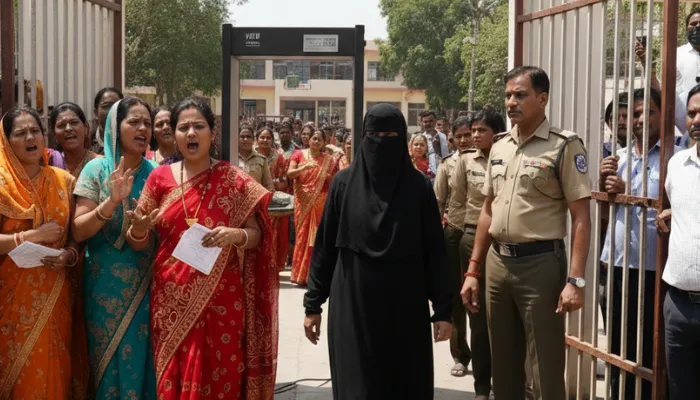
Case Summary
Hindu women appearing for examinations at PM Shri Kendriya Vidyalaya in Kamla Nehru Nagar, Ghaziabad, Uttar Pradesh faced demands from school authorities to remove their mangalsutra (necklace) and bichhiya (toe rings). The vice-principal of the school, Iqbal Nasir, enforced the rule. The women protested at the school gates, stating that the mangalsutra symbolised their marital honour and religious faith. They declared that they would not remove it under any circumstances, even if it meant forfeiting their examinations or risking their employment. Video footage captured the visible anger of the women outside the school. One participant noted that previous examinations had been conducted with tape to bypass metal detectors, whereas entry was completely blocked on this occasion. The incident prompted discussions on social media, with users calling for uniform rules for all religions. Comparisons were drawn with exemptions reportedly granted to students wearing the hijab. Observers noted that some people allowed the wearing of fully face-covered hijabs but objected to Hindu women wearing the mangalsutra, a sacred symbol of marriage.
Why it is Hate Crime ?
This case is documented under the selected primary category: Attack not resulting in death. Under this, the selected secondary category is: Attacked for Hindu identity. In several cases, Hindus were attacked merely for their Hindu identity without any perceived provocation. A classic example of this category of religiously motivated hate crime is a murder in 2016. Seven terrorists affiliated with the Islamic State of Iraq and Syria were convicted for shooting a school principal in Kanpur because they were “triggered” by the Kalava on his wrist and the tilak on his forehead. In this case, the Hindu victim had offered no provocation other than his religious identity. The motivation for the murder was purely religious, driven by religious supremacy. Such cases, where Hindus were targeted solely for their faith, are documented as hate crimes. Incidents under this category that resulted in the death of the Hindu victim are reported separately. This case can be understood as a religiously motivated hate crime because Hindu women were singled out and coerced into compromising their religious faith to access a public examination. Institutional authority forced them to choose between their education or employment and their religious honour, causing visible distress, humiliation, and exclusion. The mangalsutra and bichhiya were sacred Hindu religious symbols that embodied marital dignity and faith. Compelling women to remove them directly interfered with their religious practice and reduced deeply held beliefs to negotiable conditions. The demand was not neutral, as it imposed a burden specifically on Hindu women. The enforcement lacked consistency and a rational basis. In previous examinations, practical measures such as taping jewellery to pass through metal detectors had been permitted. The refusal to apply the same accommodation on this occasion demonstrated selective enforcement, not a genuine security concern. Equality before the rules was also undermined. Religious attire from other faiths had been permitted in examination settings, including garments involving far greater coverage. When Hindu symbols were treated as disposable while other religious expressions were accommodated, the rules became discriminatory in effect. Taken together, the targeted restriction of Hindu religious symbols, selective enforcement, and coercive use of authority demonstrated clear religious bias. On both principle and impact, this incident was added to the tracker. Disclaimer: The Hinduphobia Tracker records incident dates based on when the crime occurred, rather than when the media reports it. In this case, media reports did not specify the exact date when the ordeal began. For documentation purposes, 11th January 2026, the date of media reporting, has been selected as the indicative incident date.


Case Status
Unknown


Perpetrators Details
Perpetrators
Muslim Extremists
Perpetrators Range
One Person
Perpetrators Gender
male
 Sources




