Hindus threatened and restricted from celebrating Sankranti by Muslims in Bangladesh amidst ongoing persecution of Hindus
 Bangladesh
  8 January, 2026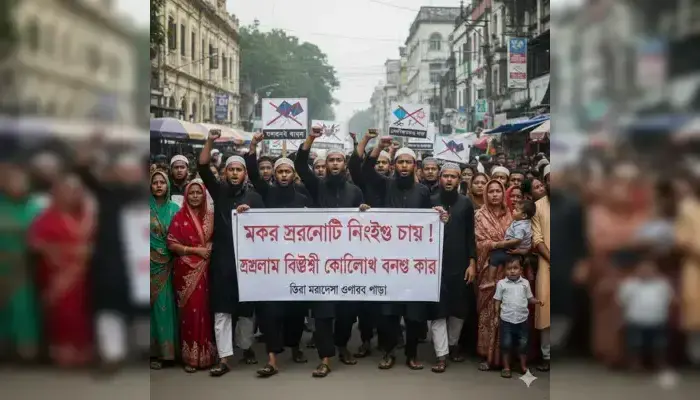
Case Summary
In Bangladesh, Hindus were threatened, and Makar Sankranti celebrations, a Hindu religious festival, were restricted by Muslims belonging to Jamaat-e-Islami, a radical Islamic organisation. The accused called the celebration of Sankranti 'haram' and 'un-Islamic' and warned Hindus not to celebrate the festival. The perpetrators also threatened Hindus by saying that if they celebrated, they would face severe consequences. According to reports, Jamaat-e-Islami (JI) openly warned against celebrating Makar Sankranti, known as Shakrain in Bangladesh. The organisation stated that playing music, flying kites, and public celebrations were “un-Islamic” and if violated, there would be serious consequences against Hindus. These warnings spread through social media, local advertisements, and word of mouth. Feelings of insecurity heightened among Hindu families living in cities like Dhaka, Chittagong, and Sylhet. Many families avoided public celebrations and chose to observe the festival simply indoors. Reports also confirmed that in Bangladesh, Sankranti/ Shakrain is a centuries-old festival celebrated every year on 14 January. Kite flying, sesame-jaggery sweets, and cultural programmes formed an integral part of the festival. But in the last few years, Muslim extremist groups targeted the Sankarnati celebrations. Even in 2024, attacks occurred during celebrations in many places, which heightened religious tensions. A fresh wave of anti-Hindu violence prevailed across Bangladesh following the death of Sharif Osman Bin Hadi. This escalation occurred against the backdrop of ongoing anti-Hindu violence that had persisted since the ouster of the Sheikh Hasina government in August 2024, during which Hindu homes, temples, and religious spaces were repeatedly attacked, and the Hindu community faced intimidation, arson, and mob attacks. In the aftermath of Hadi’s death, Hindu homes were selectively targeted and set ablaze in multiple localities by Muslim mobs, forcing families to flee and rendering many homeless. The violence was not sporadic but patterned, with Muslim mobs targeting Hindu neighbourhoods, properties, and religious symbols with impunity. One of the many victims of this wave of violence was a Hindu man named Dipu Chandra Das, who was brutally lynched by a Muslim mob over false allegations of blasphemy. Such targeting of innocent Hindus over fabricated charges illustrated the vulnerability of the Hindu minority under conditions of rising communal hostility. Posters and written materials calling for the extermination of Hindus were displayed in public spaces, signalling an alarming normalisation of genocidal rhetoric. Combined with acts of physical violence, arson, and vandalism, these developments demonstrated a coordinated campaign designed to terrorise the Hindu community and assert Islamic dominance. Notably, Sharif Osman Bin Hadi was a Muslim political activist and student leader known for his anti-Hindu and anti-India stance. He was actively involved in the political unrest that followed the fall of Sheikh Hasina’s government and was killed in Dhaka in December 2025 during clashes, after which Hindus were blamed and subsequently targeted.
Why it is Hate Crime ?
The primary category selected in this case is- Restriction/ban on Hindu practices. The subcategory selected is- Restriction on expression of Hindu identity. An example of the state-affected prejudicial and targeted orders against the Hindu community would be a government denying the right of a Hindu or a group of Hindus to hold a religious procession owing to the animosity of non-Hindu groups. Denial of the religious right of the Hindus to assuage the non-Hindu group which harbours animosity to a point where it could lead to violence against Hindus is not only a failure of law and order but is a prejudicial order against Hindus, denying them their fundamental rights to express their religious identity. An example of a hate crime against Hindus by a non-Hindu would be a non-Hindu institution forcing its Hindu employees to abandon religious symbols that a Hindu would wear as an expression of faith owing to inherent prejudice against the faith professed by the victim or a non-Hindu group of people restricting a Hindu group from constructing a place of worship simply because the demography of the area in which the temple is being built is dominated by non-Hindus. Such actions are driven by religious animosity and/or prejudice against Hindus and their faith and would therefore be categorized as a hate crime. Another primary category selected in this case is- Hate Speech against Hindus. The subcategory selected is- Violent Threats. Violent threats, explicit, implicit or implied, is the most dangerous form of hate speech since it goes beyond discriminatory and prejudicial language to express the intent of causing harm to an individual or a group of people based on their religious identity and faith. There could be several different kinds of threats that are issued to Hindus based on religious animosity. An explicit threat would mean the direct threat of violence towards an individual Hindu, a group of Hindus or Hindus at large. Physical violence, death threats, threats of destruction of property belonging to Hindus and threats of genocide would mean explicit threats against Hindus for their religious identity. Implicit threats may not be a direct threat but implied through the use of symbols of actions – for example – in the Nupur Sharma case, other than explicit threats, there were also implicit threats when Islamists took to the streets to burn and beat her effigies. It implies that they want to do the same to Nupur Sharma – thereby is considered an implicit threat. Violent threats can be delivered in person, through letters, phone calls, graffiti, or increasingly through social media and other online platforms. It would be important to understand that a threat – explicit or implicit, online or offline – to an individual who happens to be a Hindu does not qualify as a religiously motivated threat. Such a threat, while vile and dangerous, could be owing to non-religious reasons and/or personal animosity. To qualify as a religiously motivated threat, it would need to exhibit an indication that the individual is being targeted for religious reasons and/or owing to his/her religious identity as a Hindu. In this case, the Muslim perpetrators from Jamaat-e-Islami unleashed a brazen religiously motivated hate crime by attempting to stop Makar Sankranti celebrations, the sacred Hindu festival where Hindu families rejoice in the sun's life-affirming northward journey, bountiful harvests, and spiritual renewal through kite-flying, sesame sweets, holy baths, and heartfelt devotion. The perpetrators used street power, mob intimidation, and social media threats to smash this gentle expression of Hindu joy. Their haram edicts laid bare deep hatred for the Hindu faith and identity, condemning even peaceful rituals as an insult to Islam. By threatening Hindus with severe consequences for simply celebrating Sankranti, the perpetrators aimed to erase the expression of Hindu identity in public life, terrorising devoted families and crushing their cherished heritage in Bangladesh. This hate crime solidified as the perpetrators controlled Hindu expression with ruthless force, calling the festival un-Islamic and vowing brutal punishment for any shared kite string or sweet. Such vicious suppression robbed Hindu families of their religious and cultural life, sowing raw terror in Hindus who wanted only to honour and celebrate their faith and festivals. By using mob fear to remove Sankranti from Bangladesh's streets, the Muslim perpetrators choked Hindu visibility, revealing religious hatred as the motivating factor behind the act. This was not a mere discord, but a deliberate crusade to humiliate and enslave innocent Hindu devotees in their own homeland. Such threats from Muslim extremists are no empty words; they often explode into violence against Hindus. Jamaat-e-Islami, previously banned as a terrorist group under Sheikh Hasina, gained free rein under Muhammad Yunus's interim government, which revoked the ban to gain Muslim votes and bolster Islamic extremism in Bangladesh. Despite ties to 90% of Bangladeshi terrorists, Yunus's regime offered tacit support, enabling anti-Hindu crackdowns. This state-enabled Islamic radicalism orchestrated systemic persecution of Hindus, like in this case, weaponising festival bans against vulnerable Hindus. Even though the state did not ban Sankranti celebrations outright, its indirect support for Jamaat-e-Islami demonstrated clear anti-Hindu prejudice and hatred, amounting to state-sanctioned persecution of Hindus. Hindus endure relentless persecution in Bangladesh, surging after Sheikh Hasina's exile when Muslim extremists rampaged nationwide: desecrating temples, launching mob violence, raping Hindu women, forcing conversions, and torching Hindu homes, shops, and shrines. A second wave of anti-Hindu violence began after the death of an anti-Hindu and anti-India activist, Osman Hadi, highlighted by the brutal lynching and incineration of a Hindu man, Dipu Chandra Das, on 18 November 2025 in Bhaluka town over false blasphemy claims. Waves of anti-Hindu attacks followed: Hindu individuals attacked, homes vandalised and set ablaze, temples desecrated, lives shattered by brutal violence. Several Hindus were killed as a result of this targeted crackdown and selective violence against the Hindu community. This particular case mirrors that relentless pattern of targeted atrocities against Bangladesh's Hindu community due to their religious identity. In summary, this case met all parameters of a religiously motivated offence against Hindus, so it was added to the hate crime database of the Hinduphobia Tracker. Disclaimer: The Hinduphobia Tracker records dates of incidents based on when the crimes occurred, rather than when the media reported them. However, in this case, media reports did not state the exact date of the crime. Therefore, for documentation purposes, 9 January 2026, the earliest date when the media reported this incident, served as the indicative incident date.


Case Status
Unknown


Perpetrators Details
Perpetrators
Muslim Extremists
Perpetrators Range
Unknown
Perpetrators Gender
unknown
 Sources




