Hindu temple set ablaze, sacred idols desecrated by miscreants in Meerut, Uttar Pradesh
 Meerut, Uttar Pradesh, India
  8 January, 2026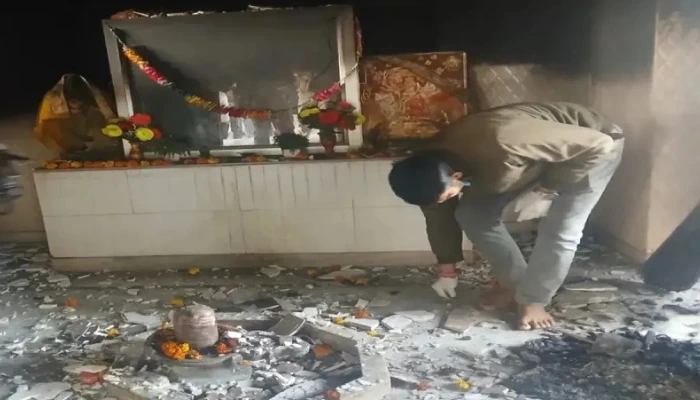
Case Summary
In Meerut, Uttar Pradesh, a Hindu temple dedicated to Lord Shiva was set ablaze and sacred idols of Hindu deities were desecrated by a few unidentified miscreants. According to reports, the entire incident took place in Mahalka village, under the Mawana Falavada police station area, where miscreants vandalised the Shivalinga and idols of the Shiva family in an ancient Shiva temple on the morning of 9 January 2026, and set the temple on fire. Due to this, the temple's doors, donation boxes, music system, puja materials, and other items were burned to ashes. After the incident came to light, local villagers created a huge uproar. The villagers even had an altercation with the police inspector. Following this, Circle Officer (CO) Mawana calmed the situation by assuring the arrest of the accused, and the forensic team collected evidence. Police were deployed in the area due to the tension. Villagers said the temple was maintained by village resident Pramod Kumar. On the day of the incident at 5:30 am, Pramod Kumar went home after cleaning the temple and performing puja. After the devotees finished worshipping, the temple gate closed at around 8:30 a.m. Miscreants then arrived, vandalised the Shivalinga and idols of the Shiva family, and set the temple on fire. Sandeep, an employee of Jain Inter College, who was passing by, saw the temple on fire and informed the committee members and Pramod Kumar. The villagers somehow managed to control the fire. When the outpost in charge, Inspector Indresh Vikram Singh, arrived at the scene, people booed him. As the commotion escalated, Mawana CO Pankaj Lavania arrived. Meanwhile, the villagers insisted on arresting the accused and imposing the National Security Act (NSA) on them. The CO then asked village head Aslam Qureshi to install new idols in place of the broken ones. However, the villagers became enraged again and insisted on not installing new idols until the accused were arrested. The police registered a case and began investigating it based on the CCTV footage from nearby areas. A forensic team collected evidence and sent it to the laboratory. The case remained under investigation.
Why it is Hate Crime ?
This case has been added to the tracker under the primary category- Attack on Hindu religious representations. The subcategory selected is- Attack on Temples. In Hinduism, a temple is the abode of the Deity. The Deity in the Temple is consecrated, thereby, making it a real, breathing entity. Hindus believe that not just the Deity but the temple premises itself are sacred to Hindus since Hindus hold the faith that the entire Temple space is an amalgamation of the divine energy of the deity. Given the central significance of Temples in Hindu Dharma, any attack against a Hindu Temple or its peripheral premises is an attack on the faith itself and is born out of animosity towards the faith, of which, the Temple is a central tenet. Any manner of attack against a Temple and/or its premises would therefore be considered a religiously motivated hate crime. The other subcategory selected is- Desecration of Hindu religious symbol. Icons and symbols or a religious representation of a spiritual ideal are widely revered in Hinduism. Iconography is of vital significance in the Hindu milieu. It helps connect people’s spiritual beliefs with the real world. Iconography within the Hindu faith takes several shapes and forms. Murtis are of most significance to Hindus, to which daily rituals, prayers and offerings are done. Besides the murtis, there are several other symbols which have deep significance in the Hindu faith – the Om and Swastika for example. Since these Hindu religious symbols hold paramount importance in Hinduism, any desecration of symbols, icons, murtis, religious representations and manifestations, is driven by animosity towards the faith itself which manifests itself through these murtis, icons and symbols. Therefore, any desecration of these Hindu religious symbols and representations is considered religiously motivated hate crimes under this category. This incident stands as a blatant instance of a religiously motivated hate crime against Hindus and their sacred places of worship. The miscreants in Meerut deliberately targeted a Hindu temple, setting it ablaze and desecrating its idols, shattering the spiritual haven of innocent devotees who cherish the temple as a divine place. For Hindus, a temple is a revered institution brimming with deep religious significance in Hinduism. Hindu temples serve as divine abodes where Hindus believe their revered deities reside, offering spiritual solace and profound peace to worshippers seeking connection with the divine. In this case, the perpetrators torched an entire Hindu temple, destroying religious materials and reducing it to ashes, which clearly demonstrates religious animosity towards the Hindu community. They singled out this sacred Hindu worship site, cementing it as a clear case of a religiously motivated crime. Perpetrators also desecrated the sacred Shivalinga, a potent religious symbol representing Lord Shiva, along with idols (Murtis) of other deities. These idols, including the Shivalinga, hold immense significance for Hindus as manifestations of the divine, serving as cherished instruments for worship, offerings, and devotion. Hindus pour their hearts into honouring deities through these sacred idols. Targeting and desecrating the Shivalinga and idols showcases a vicious assault and affront to Hindu faith and sentiments, marking it as a stark anti-Hindu hate crime. The ferocious intensity of the attack, where perpetrators stormed the temple, desecrated idols, and burned the entire structure, lays bare their seething religious animosity. This premeditated rampage is no isolated act but exemplifies a disturbing pattern of hatred against Hindus. Even though the perpetrators remain unidentified, the deliberate nature of the act clearly demonstrates religious hatred towards Hindus and Hinduism. Therefore, this case is being added to the hate crime database of the Hinduphobia Tracker.


Case Status
Complaint registered


Perpetrators Details
Perpetrators
Unknown
Perpetrators Range
Unknown
Perpetrators Gender
unknown
 Sources




