Sacred premises of revered Hindu temple desecrated as Muslim man caught red handed defecating inside
 Hyderabad, Telangana, India
  9 January, 2026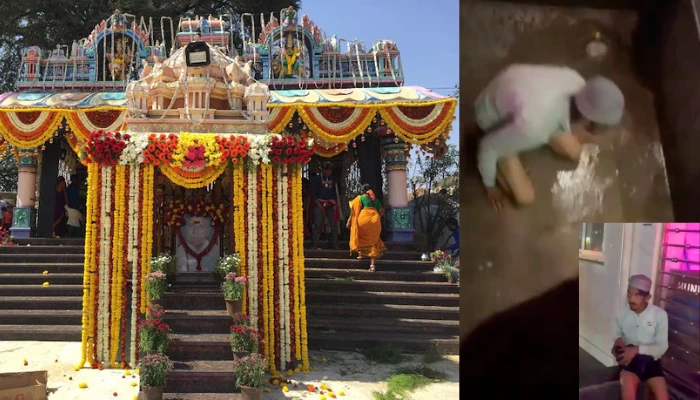
Case Summary
In the Malkajgiri area of Hyderabad, a Muslim man, Altaf, was caught defecating inside the premises of the revered Hindu temple, Kattamaisamma (Ammavaru) Temple at Safilguda on 10 January 2026. As per reports, on the night of January 10, the accused, Altaf (26), had unlawfully entered the temple premises of the revered Kattamaisamma (Ammavaru) Temple at Safilguda. He was noticed by passersby defecating inside the premises. The accused was caught while committing the act within the temple compound. Following this, tensions prevailed in Hyderabad’s Malkajgiri area. The incident triggered outrage among local Hindu residents and devotees. Hindu devotees gathered at the spot soon after and performed purification rituals. The devotees were aggravated as the sanctity of the shrine had been violated. Angry crowds assembled outside the temple, raising slogans and demanding immediate action. The situation briefly turned volatile before police intervened. Police identified the accused as Altaf (26), son of Alla Bakash, a resident of Hugeri in Bidar district, Karnataka. A case was registered under Sections 333, 196(2), 298, and 299 of the Bharatiya Nyaya Sanhita (BNS) in CR No. 41/2026, relating to unlawful entry and acts intended to insult religious beliefs. The accused was produced before a magistrate on January 11, 2026, following which he was remanded to judicial custody. Police said further investigation is underway, including verification of his background and examination of CCTV footage from the area. Officials stressed that the probe would be conducted strictly as per the law. Subsequently, the law enforcement authorities of the state claimed that the accused was 'mentally unsound'.
Why it is Hate Crime ?
This has been added to the tracker under the category- Attack on Hindu religious representations, and within this, the sub-category selected is- Desecration of Hindu religious symbol. Icons and symbols, or a religious representation of a spiritual ideal, are widely revered in Hinduism. Iconography is of vital significance in the Hindu milieu. It helps connect people’s spiritual beliefs with the real world. Iconography within the Hindu faith takes several shapes and forms. Murtis are of most significance to Hindus, to which daily rituals, prayers and offerings are done. Besides the murtis, there are several other symbols which have deep significance in the Hindu faith – the Om and Swastika, for example. Since these Hindu religious symbols hold paramount importance in Hinduism, any desecration of symbols, icons, murtis, religious representations and manifestations, is driven by animosity towards the faith itself, which manifests itself through these murtis, icons and symbols. Therefore, any desecration of these Hindu religious symbols and representations is considered a religiously motivated hate crime under this category. The second sub-category selected is- Defiling religious customs. Sanatan Dharma is not a religion of one book, which is to say that while it has religious scriptures that form the central tenets of the faith, there are several traditions followed through thousands of years, mostly passed from generation to generation orally. There are several such customs and traditions that are followed by various Hindus and Hindu sects. Defiling of these traditions and customs is a breach of an individual or group’s religious practices. Such practices can range from dietary restrictions like not eating non-vegetarian food for a certain period of the year, not eating non-vegetarian food at all, not eating beef since the cow is considered holy in Hinduism, the sanctity of religious customs followed in the house (like many ISCKON devotees), etc. Any malicious action leading to the breach of such traditions or defilement of these traditions owing to animosity towards the faith or for the sake of activism stems not only from the lack of faith in the religion itself but also from disregard for the faith of the devotees who follow the customs/traditions and implicit bias against the faith, the tradition itself. Since these specific traditions are central to the faith of the devotees of that specific sect of Hindus, any non-compliance with these traditional rules would be considered a religiously motivated hate crime. The other significant sub-category is- Attack on Temples. In Hinduism, a temple is the abode of the Deity. The Deity in the Temple is consecrated, thereby, making it a real, breathing entity. Hindus believe that not just the Deity but the temple premises itself are sacred to Hindus since Hindus hold the faith that the entire Temple space is an amalgamation of the divine energy of the deity. Given the central significance of Temples in Hindu Dharma, any attack against a Hindu Temple or its peripheral premises is an attack on the faith itself and is born out of animosity towards the faith, of which, the Temple is a central tenet. Any manner of attack against a Temple and/or its premises would therefore be considered a religiously motivated hate crime. This case is being included in the Hate Crime database because the act was clearly intentional, not accidental or impulsive. The accused was fully aware that a Hindu temple is a sacred space and that defecation inside its premises represents one of the most degrading and humiliating forms of defilement. Such an act is universally understood as a profound religious insult, particularly in a faith where purity, sanctity, and reverence are central. The choice of location and the nature of the act show conscious awareness of its offensive impact. It is important to understand here that the accused had the option of committing the act anywhere else, like inside a mosque or a church, yet he consciously chose a Hindu temple. This underscores deliberate targeting. This selective targeting demonstrates that the act was not born out of ignorance or mental lapse, but out of calculated disrespect. It reflects an understanding of religious boundaries and a deliberate decision to violate those associated with Hinduism. This conduct reveals a mindset rooted in contempt for the Hindu religion and its sacred symbols. By intentionally desecrating a place of worship in the most degrading manner, the accused displayed hostility toward the Hindu faith and sought to humiliate its followers. The intent is clear from both the act itself and the choice of target. It is also critical to address the police claim that the perpetrator was 'mentally unstable'. This claim represents a common trope used to deflect attention from the religious motivations behind hate crimes against Hindu places of worship, portraying the act as stemming from mental illness rather than religious animosity. Authorities often downplay such communal crimes and often attribute the offence to the accused's mental health. This narrative has appeared repeatedly in cases targeting Hindus and their religious symbols, obscuring the true intent of religious hatred. Many times, police minimise incidents of low-level communal crime to protect their jurisdiction from scrutiny. They frequently cite the accused's mental instability as the cause, aiming to prevent any flare-up in the area following the initial offence. However, this explanation rang hollow in this instance. If the accused was truly mentally unstable, why did he target only a Hindu temple for defecation and not a mosque or other non-Hindu places of worship? This selective targeting and defilement of a Hindu temple exposed deep-seated hatred for Hinduism and its sacred spaces, confirming the religiously motivated nature of the offence. Such deliberate religious humiliation cannot be dismissed as ordinary misconduct. It constitutes a targeted attack on Hindu religious identity, making it necessary to document this incident as a hate crime within the Hinduphobia Tracker. Disclaimer: The Hinduphobia Tracker records the dates of incidents based on when the crime occurs rather than when it is reported by the media. Hence, for documentation purposes, the date, 10 January 2026, is being considered as the date of the incident.


Case Status
Arrested


Perpetrators Details
Perpetrators
Muslim Extremists
Perpetrators Range
One Person
Perpetrators Gender
male
 Sources




