Hindu residents targeted for religious conversion under guise of skill development in Kanpur, Uttar Pradesh
 Kanpur Dehat, Uttar Pradesh, India
  11 January, 2026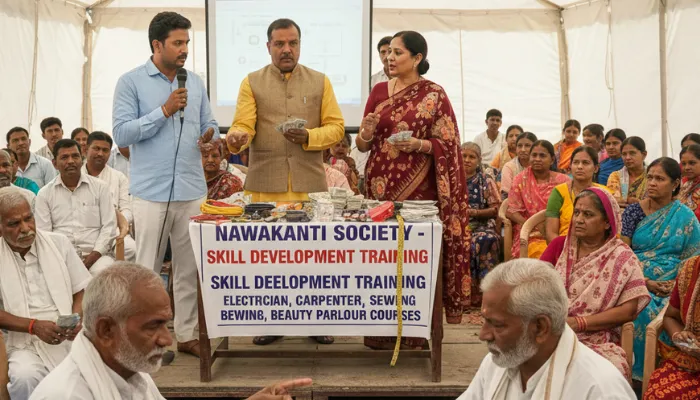
Case Summary
Hindu residents faced religious conversion under the guise of skill development training in Akbarpur, Kanpur Dehat district, Uttar Pradesh. The incident emerged near Badhapur in the Akbarpur Police Station area, where an organisation called Nawakanti Society conducted vocational training sessions. These sessions included courses in electrician, carpentry, sewing, and beauty parlour. Hindu residents were first invited to participate in the training and then subjected to religious conversion through monetary inducements. Ram Bharose, a resident of Nibouli village, filed a written complaint with Akbarpur Police, stating that the organisers exploited economic incentives to change the religion of participants. Individuals involved included Daniel Sharad Singh, manager of Nawakanti Society and resident of Jhansi, Hariom Tyagi, principal, Savitrī Sharma, wife of Ashok Sharma and resident of Nehru Nagar, Akbarpur, and one unidentified person. Hindu residents Ram Krishna and Ramautar from Dudouli Derapur, and Rampal from Anantapur Musanagar were among those converted. Participants were given between Rs 6000 and Rs 10,000 rupees per month and were encouraged to bring others to prayer meetings with promises of two hundred rupees and other benefits. External persons also attended the gatherings. Akbarpur Police Station officer-in-charge Harrmeet Singh stated that a case was registered against the four individuals and investigations were ongoing. Crime Inspector Jitendra Kumar led a team to conduct raids and take action regarding the incident.
Why it is Hate Crime ?
This case is documented under the selected primary category: Predatory proselytisation. Under this, the selected secondary category is: Proselytisation by grooming, brainwashing, manipulation and subtle indoctrination. Religious brainwashing essentially means the often subtle and forcible indoctrination to induce someone to give up their religious beliefs to accept contrasting regimented ideas. Religious grooming or brainwashing also involves propaganda and manipulation. It involves the systematic effort, driven by religious malice and indoctrination, to persuade “non-believers’ to accept allegiance, command, or doctrine to and of a contrasting faith. Cases of such grooming or brainwashing are far more nuanced than direct threats, coercion, inducement and violence. In such cases, it is often seen that there is repeated, subtle and continual manipulation of the victim to induce disaffection towards their own faith and acceptance of the contrasting faith of the perpetrator. While subtle indoctrination is widely acknowledged as predatory, an element which is often understated in such conversions or the attempts of such conversion is the role of loyalty and trust which might develop between the perpetrator and the victim. Fiduciary relationships are often abused to affect such religious conversion. For example, an educator transmitting religious doctrine of a competing faith to a Hindu student. The Hindu student is likely to accept what the teacher is transmitting owing to existence of the fiduciary relationship. The exploitation of the fiduciary relationship to religiously indoctrinate victims would also be included in this category. Since the underlying animosity towards the victim’s faith forms the basis of predatory proselytization, such cases are considered religiously motivated hate crimes. Another selected secondary category is: Conversion/attempts to convert by inducement. Predatory Proselytisation is not just limited to threat, harassment, force and violence, but it also has contours of stealth. In several cases, the Hindu victim is exploited to convert, with non-Hindus taking advantage of their poverty. In such cases, the Hindu victim who is suffering financially is offered monetary benefits, including lucrative offers for jobs, health treatment, education, etc, to induce the victim into changing his/her religion. In such cases, the religious identity of the victim and the aim to disenfranchise him from his faith form the heart of the crime. Also, taking advantage of and exploiting an individual’s economic vulnerabilities is widely acknowledged as exploitation, forms of which are often penalised by law. Such cases, therefore, are considered religiously motivated hate crimes since the victim’s religious identity forms the very heart of the crime itself. This case qualifies for inclusion in the hate crime database because it demonstrates deliberate and structured religious targeting of Hindu residents through inducement-based conversion, using economic vulnerability as the primary tool of coercion. The most significant religious marker in this case is conversion through monetary inducements disguised as skill development. Hindu residents were first drawn into vocational training programmes under the pretext of livelihood support. Once engaged, financial incentives were explicitly linked to religious change. Monthly payments, additional cash rewards, and promises of continued benefits were used to pressure participants to abandon their Hindu faith. When economic survival is tied to religious conversion, consent is no longer free but coerced, making the act inherently religiously hostile. A second key marker is targeting based on religious identity. The individuals recruited and influenced were Hindu residents, many from economically weaker backgrounds. The objective was not general welfare or neutral skill training, but the religious transformation of Hindus as a group. The fact that participants were encouraged to bring additional people to prayer meetings in exchange for money shows an organised attempt to expand religious conversion within the Hindu community itself. Another important marker is the use of deception and misrepresentation. Skill development and employment training were used as cover to introduce religious influence and conversion pressure. This tactic conceals religious intent until participants are financially or socially dependent, at which point inducement is applied. Such deception directly interferes with religious autonomy and reflects contempt for the existing faith of the targeted group. The presence of external individuals and organised facilitators further reinforces religious motivation. The involvement of multiple coordinators and outsiders indicates planning and coordination rather than spontaneous religious expression. This structured approach shows that the activity was designed to systematically alter the religious identity of Hindu participants. The fact that some Hindu residents were already converted through this method establishes that the coercive strategy was effective and ongoing. However, even without completed conversions, the attempt itself meets the threshold for religious hostility. Hate crime classification does not depend on success, but on intent and method. In conclusion, this case qualifies as a religiously motivated hate crime because it involved targeted conversion of Hindus through monetary inducements, exploitation of economic vulnerability, deception through non-religious fronts, and organised efforts to weaken Hindu religious identity. These elements together establish clear religious animus and justify inclusion in the hate crime database.


Case Status
Complaint filed


Perpetrators Details
Perpetrators
Christian Extremists
Perpetrators Range
From 2 To 5
Perpetrators Gender
both
 Sources




