Hindu residents targeted by Christian individuals for religious conversion in Gorakhpur, Uttar Pradesh
 Gorakhpur, Uttar Pradesh, India
  9 January, 2026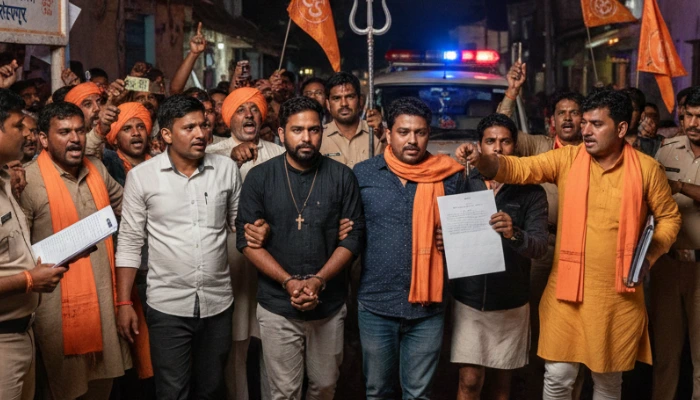
Case Summary
Hindu residents faced religious conversion activity by Christian individuals in Mahdeva Adai village under the Chauri Chaura police station area of Gorakhpur district, Uttar Pradesh. Christian individuals carried out religious conversion activities in the village by offering inducements, including money, employment, and assurances of curing illnesses. Hindu residents were targeted, and villagers were persuaded to change their religion. Information about the activities reached the Vishva Hindu Parishad, which sent leaders and workers to the village on Friday night. Upon arrival, the Vishva Hindu Parishad members protested against the illegal conversion activities. Following the events in the village, a written complaint was submitted to the police by Amit Verma, city president of the Vishva Hindu Parishad. The complaint described the conversion activities and identified individuals involved in persuading Hindu residents to adopt another religion. Police reached the location after the Vishva Hindu Parishad protest and took five to six individuals into custody for questioning. Among those detained was a pastor who was identified as being involved in the conversion activities. The first information report filed by the police named Jaydev George, Abhishek Kumar, Suraj Masih, Sunny Anand, and Kireesh Paswan, along with several unidentified individuals. Police registered the case under provisions of the Uttar Pradesh Prohibition of Unlawful Religious Conversion Act and other relevant sections of the Indian Penal Code relating to abuse and assault. Police initiated an investigation and confirmed that further action would follow based on the findings of the probe.
Why it is Hate Crime ?
This case has been documented under the selected primary category: Predatory Proselytisation. Under this, the selected secondary category is: Proselytisation by grooming, brainwashing, manipulation, and subtle indoctrination. Religious brainwashing essentially means the often subtle and forcible indoctrination to induce someone to give up their religious beliefs to accept contrasting regimented ideas. Religious grooming or brainwashing also involves propaganda and manipulation. It involves the systematic effort, driven by religious malice and indoctrination, to persuade “non-believers’ to accept allegiance, command, or doctrine to and of a contrasting faith. Cases of such grooming or brainwashing are far more nuanced than direct threats, coercion, inducement and violence. In such cases, it is often seen that there is repeated, subtle and continual manipulation of the victim to induce disaffection towards their own faith and acceptance of the contrasting faith of the perpetrator. While subtle indoctrination is widely acknowledged as predatory, an element which is often understated in such conversions or the attempts of such conversion is the role of loyalty and trust which might develop between the perpetrator and the victim. Fiduciary relationships are often abused to affect such religious conversion. For example, an educator transmitting religious doctrine of a competing faith to a Hindu student. The Hindu student is likely to accept what the teacher is transmitting owing to existence of the fiduciary relationship. The exploitation of the fiduciary relationship to religiously indoctrinate victims would also be included in this category. Since the underlying animosity towards the victim’s faith forms the basis of predatory proselytization, such cases are considered religiously motivated hate crimes. Another selected secondary category is: Conversion/attempts to convert by inducements. Predatory Proselytisation is not just limited to threat, harassment, force and violence, but it also has contours of stealth. In several cases, the Hindu victim is exploited to convert, with non-Hindus taking advantage of their poverty. In such cases, the Hindu victim who is suffering financially is offered monetary benefits, including lucrative offers for jobs, health treatment, education, etc, to induce the victim into changing his/her religion. In such cases, the religious identity of the victim and the aim to disenfranchise him from his faith form the heart of the crime. Also, taking advantage of and exploiting an individual’s economic vulnerabilities is widely acknowledged as exploitation, forms of which are often penalised by law. Such cases therefore are considered religiously motivated hate crimes since the victim’s religious identity forms the very heart of the crime itself. This is a case of religiously motivated hate crime due to the following observations: This case qualifies for inclusion in the hate crime database because it displays clear and multiple religious markers demonstrating targeted and coercive efforts to alter the religious identity of Hindu residents. The primary religious marker in this case is conversion through inducements. Hindu residents were approached with offers of money, employment, and assurances of curing illnesses. Such inducements directly undermine religious freedom by exploiting economic hardship and health related vulnerability. When material benefits or relief from illness are tied to abandoning one’s faith, religious choice becomes conditional and coerced. This reflects hostility toward the continued practice of Hinduism rather than voluntary religious expression. A second key marker is targeting based on religious identity. The individuals approached and pressured were Hindu residents of the village. The activity was not general religious outreach but selective persuasion aimed at altering the faith of a specific religious group. This establishes that Hindu identity itself was the basis for targeting, which is a defining element of religiously motivated hate activity. Another important marker is the use of deception and psychological pressure. Promises of healing through religious change and assurances of improved livelihood function as tools of manipulation. These methods prey on fear, illness, and insecurity, gradually weakening confidence in one’s existing faith. Such tactics constitute coercive religious influence rather than legitimate belief based conversion. The organised nature of the activity further reinforces religious motivation. Multiple individuals were involved in persuading villagers, indicating coordination rather than isolated personal interaction. The presence of religious figures facilitating the activity reflects an intentional structure designed to carry out religious transformation within the Hindu community. Importantly, hate crime classification does not depend on whether the conversion was completed or legally upheld. Attempted conversion through inducement, deception, and exploitation of vulnerability based on religious identity is sufficient to establish religious hostility, regardless of the outcome of the investigation. In conclusion, this case qualifies as a religiously motivated hate crime because it involved targeted conversion of Hindus, the use of financial, medical, and employment-based inducements, coordinated religious pressure, and intent to weaken Hindu religious identity. These elements collectively establish religious animus and justify inclusion in the hate crime database. Disclaimer: The reports mention that 5-6 people were detained. The FIR, meanwhile, mentions 5 names along with several 'unidentified' people. We have thus counted the number of perpetrators as 6. Any further information or updates on this news will help us with the accuracy.


Case Status
Complaint filed


Perpetrators Details
Perpetrators
Christian Extremists
Perpetrators Range
From 5 to 10
Perpetrators Gender
male
 Sources




