Hindu sacred space defiled; Muslim man performs namaz and raise Islamic slogans inside Shri Ram Janmabhoomi complex in Ayodhya
 Ayodhya, Uttar Pradesh, India
  9 January, 2026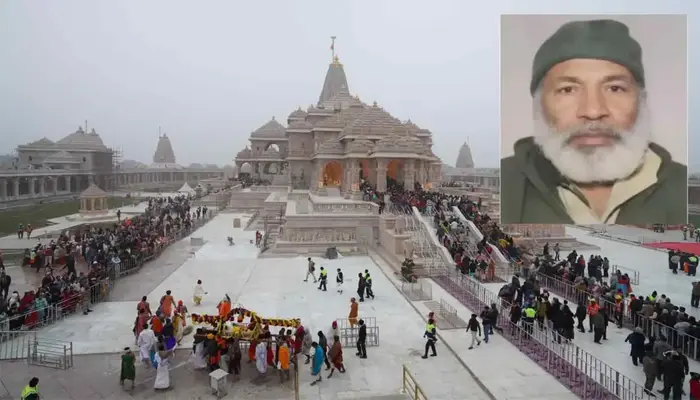
Case Summary
In Ayodhya, Uttar Pradesh, Hindu religious sentiments were insulted and defiled after a group of Kashmiri Muslims entered the Shri Ram Janmabhoomi complex and attempted to offer Islamic prayers within the Hindu sacred space. According to reports, on 10 January 2026, a serious security-related incident occurred inside the high-security Shri Ram Janmabhoomi complex. Three Kashmiri Muslims, comprising two men and a woman dressed in traditional Kashmiri attire, entered the temple premises. One of the men, later identified as a Muslim man named Abu Ahmed Sheikh (55), a resident of Shopian district in Jammu and Kashmir, proceeded towards the Sita Rasoi area, located approximately 200 metres from the main sanctum. During this time, he spread a cloth on the ground and began to offer namaz (Islamic prayers) inside the temple complex. Security personnel deployed at the site immediately noticed the act, intervened, and detained him. During this time, the group also raised religious slogans of "Nara-e-takbir, Allahu Akbar" (Allah is great), escalating concerns within the sensitive temple environment. The woman accompanying him was identified as Sofia, while the identity of the third individual remained unidentified. Upon examination, Sheikh was found carrying items such as cashews and raisins, which drew additional scrutiny due to established security protocols at terror-sensitive sites. Intelligence agencies, senior police officials, and administrative authorities promptly reached the location, and the individual was taken to the police control room within the temple complex for interrogation to ascertain his intent and broader connections. CCTV footage from the Ram Mandir premises and railway stations was reviewed, revealing that he had travelled to Uttar Pradesh via Bihar before reaching Ayodhya. The incident took place amid heightened security concerns, as the Ram Temple received multiple bomb threats in prior months and continued to witness an average daily footfall of nearly 1.5 lakh devotees since the consecration of Ram Lalla in January 2024. The incident occurred shortly before the Makar Sankranti festivities, prompting authorities to maintain a high alert to prevent disturbances and safeguard the sanctity and security of the temple complex. After the arrest of the accused Muslim man, Abu Ahmed Sheikh, his family claimed that he was ‘mentally ill’.
Why it is Hate Crime ?
This case has been added to the tracker under the primary category- Attack on Hindu religious representations. Within this, the subcategory is- Defiling religious customs. Sanatan Dharma is not a religion of one book, which is to say that while it has religious scriptures that form the central tenets of the faith, there are several traditions followed through thousands of years, mostly passed from generation to generation orally. There are several such customs and traditions that are followed by various Hindus and Hindu sects. Defiling of these traditions and customs is a breach of an individual or group’s religious practices. Such practices can range from dietary restrictions like not eating non-vegetarian food for a certain period of the year, not eating non-vegetarian food at all, not eating beef since the cow is considered holy in Hinduism, the sanctity of religious customs followed in the house (like many ISCKON devotees), etc. Any malicious action leading to the breach of such traditions or defilement of these traditions owing to animosity towards the faith or for the sake of activism stems not only from the lack of faith in the religion itself but also from disregard for the faith of the devotees who follow the customs/traditions and implicit bias against the faith, the tradition itself. Since these specific traditions are central to the faith of the devotees of that specific sect of Hindus, any non-compliance with these traditional rules would be considered a religiously motivated hate crime. The other sub-category selected here is - Breaking rules of place of worship. Sanatan Dharma is not a religion of one book, which is to say that while it has religious scriptures that form the central tenets of the faith, there are several traditions followed through thousands of years, mostly passed from generation to generation orally. One of these oral traditions or written traditions is the rules of specific temples. Certain temples have rules which are traditional rules, dependent on the worship of the presiding deities. These rules and traditions have been followed for thousands of years whether they find scriptural mention or not. Such traditions are based on the nature and rules of worship of the presiding deity of that temple. Any non-compliance of these traditions owing to animosity towards the faith or for the sake of activism stems not only from the lack of faith in the presiding deity but also disregard for the faith of the devotees of that deity/temple and implicit bias against the faith, the tradition and the deity itself. Since these specific traditions are central to the faith of the devotees of that specific temple and presiding deity, any non-compliance with these traditional rules would be considered a religiously motivated hate crime. The other relevant sub-category selected is- Abrahamic religious chanting outside Hindu religious places and/or during Hindu activities. In Hinduism, a temple is the abode of the Deity. The Deity in the Temple is consecrated, thereby, making it a real, breathing entity. Hindus believe that not just the Deity but the temple premises itself are sacred to Hindus since Hindus hold the faith that the entire Temple space is an amalgamation of the divine energy of the deity. Similarly, religious activities hold deep significance for Hindus, as they are intricately connected to their spiritual, cultural, and social lives. These practices encompass rituals, festivals, prayers, and pilgrimages that celebrate and honour various deities, fostering a sense of spiritual connection, community, and cultural continuity. Given the central significance of Temples and religious activities in Hindu Dharma, any aggressive Abrahamic chanting outside Temples or during religious activities negates the divinity of the religious space because the chanting itself negates the existence of any other God other than the God of the Abrahamic faith. Such chanting is specifically done to negate the faith of Hindus, establish religious supremacy, intimidate the devotees and mock the faith. Besides temples, such Abrahamic chanting outside any Hindu place of worship or religious structure or during any religious activity has the same effect. Since such acts are rooted in an inherent religious supremacist mentality driven by religious animosity, such crimes would be considered religiously motivated hate crimes under this category. This case has been added to the Hinduphobia Tracker because it involved a deliberate violation of Hindu temple sanctity through the performance of a non-Hindu religious rite within a consecrated Hindu sacred space. Any Hindu temple is not merely a public building but a ritually sanctified space governed by long-established customs, discipline, and worship norms specific to the deity and the temple tradition. Introducing an Islamic prayer ritual inside such a space is therefore inherently a form of desecration, because it disregards the sacred order of the temple and constitutes an affront to the faith and religious practice of Hindu devotees. The primary religious marker in this incident is the act of offering namaz within the temple complex. This is not comparable to an ordinary entry by a visitor. It is a conscious act of worship from another faith performed inside a Hindu place of worship, where the sanctity of space and exclusivity of ritual practice are central to Hindu temple tradition. Such a transgression predictably injures Hindu religious sentiments and signals contempt for Hindu worship norms. The public and demonstrative manner of the act further strengthens the religious motivation. Spreading a cloth and beginning prayers within the premises indicates a purposeful choice to conduct the ritual inside the sacred space itself rather than elsewhere. In a temple environment, this kind of deliberate boundary crossing is not neutral devotion but an assertion that violates religious discipline and challenges the temple’s sanctity. A second key marker is the aggressive chanting of Islamic slogans within the temple environment, particularly at the moment of intervention. Raising slogans such as “Nara-e-takbir, Allahu Akbar” inside a Hindu sacred site functions as an assertive religious display in a space devoted to another faith. In this context, it intensified the act from a violation of norms into an overt religious provocation that asserted Islamic identity within a Hindu shrine. While the act would constitute desecration in any Hindu temple, its occurrence within the Shri Ram Janmabhoomi complex further amplifies the seriousness due to the site’s exceptional sacred significance for Hindus. The Ram Mandir stands at the birthplace of Bhagwan Shri Ram and is among the most revered Hindu religious sites, making any violation of its sanctity especially sensitive and socially disruptive. The location, therefore, magnified the foreseeable impact on Hindu devotees and heightened the communal risk. In conclusion, this case qualifies as a religiously motivated hate incident because it involved the deliberate performance of a non-Hindu religious rite within a consecrated Hindu temple space and the assertion of religious slogans in that setting, amounting to a targeted affront to Hindu temple sanctity, worship norms, and collective religious sentiment. It is important to mention here that when the accused was arrested, his family claimed that he was ‘mentally ill’. In several cases, where Muslims vandalise and desecrate Hindu places of worship, a usual trope to shield the perpetrator is to attribute the crime to the mental health of the accused, claiming that the crime was committed since the perpetrator was ‘mentally ill’ or ‘mentally unstable’. The police and the media, in many such cases, where the crime has been committed against the Hindu faith by a non-Hindu perpetrator, deny that the crime committed was in any way motivated by a religious bias and attribute it to the perpetrator’s mental health. Many a time, the police downplay incidents of low-level communal crime because it is their jurisdiction that comes under question. The police also often say that the crime was committed since the accused was mentally unstable, because they wish to ensure that, owing to the crime already committed, there is no further flare-up in the area. In fact, there are many cases where this strategy has been used by the media to downplay such incidents where the crime was committed by a Muslim perpetrator, for example, the attack on the Gorakhnath temple or the incident in Telangana where two Muslim women wearing a burqa tried to damage temple and church idols. Likewise, in this case too, when a Muslim minor was caught vandalising the Hindu idol, the police attributed the act to his mental illness. The use of the "mental illness" trope to justify crimes targeting Hindu temples or idols by Muslim perpetrators raises critical questions. If perpetrators are indeed mentally unstable, why do they specifically target Hindu idols and places of worship, leaving mosques untouched? This selective focus suggests that such acts are not driven by mental health issues but by religious animosity. The repeated use of this narrative to downplay crimes against Hindus reflects a strategic effort to whitewash religious hatred, obscuring the true motivations and intentions behind the attacks.


Case Status
Arrested


Perpetrators Details
Perpetrators
Muslim Extremists
Perpetrators Range
From 2 To 5
Perpetrators Gender
both
 Sources




