Dalit Hindu man brutally killed by Muslim man over minor dispute in Sindh, Pakistan
 Badin, Sindh, Pakistan
  4 January, 2026
Case Summary
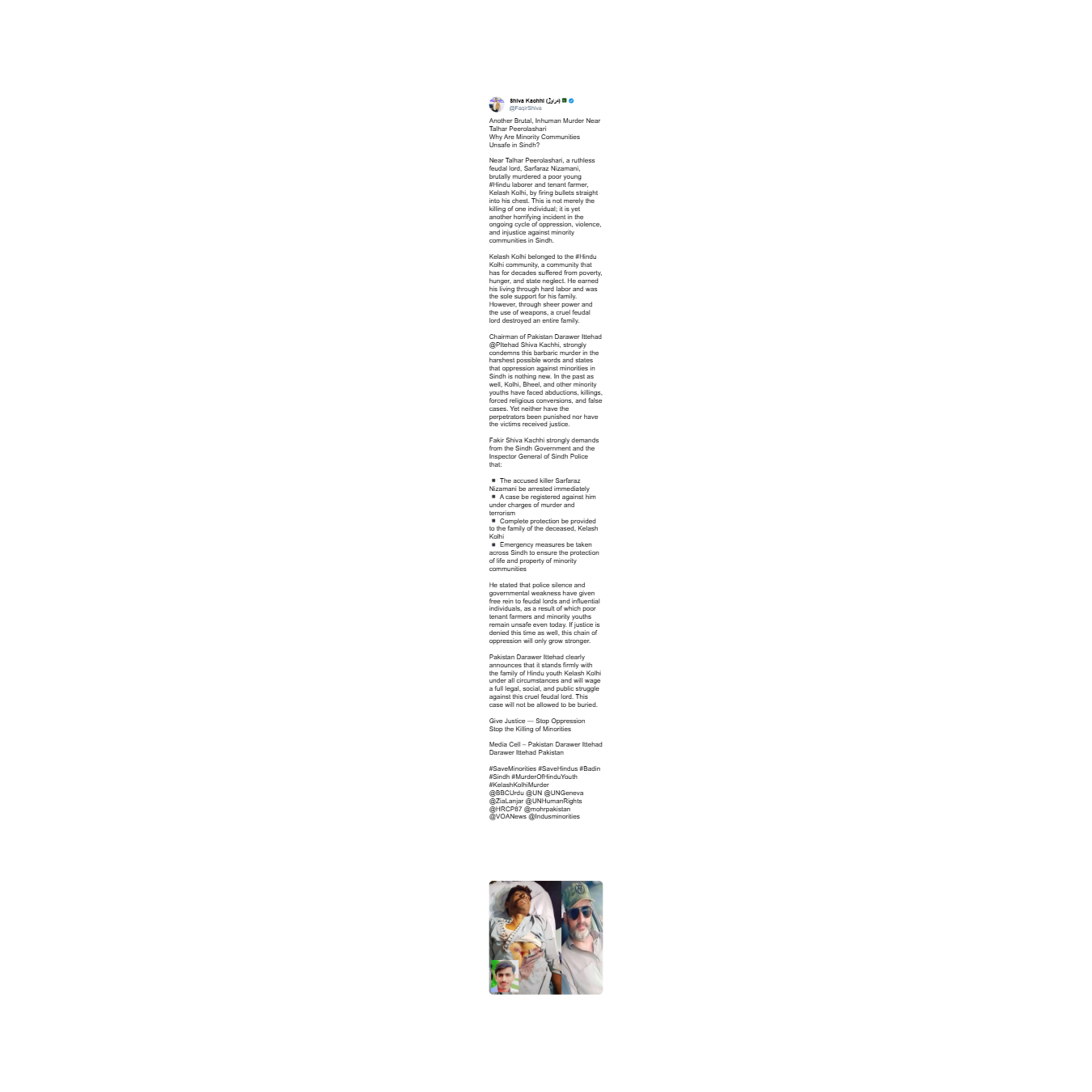
In Sindh, Pakistan, a Hindu man named Kailash Kolhi, belonging to the Kolhi community, a Dalit Hindu community, was brutally murdered by a Muslim man named Sarfaraz Nizamani over a minor dispute. The accused was the victim's landlord, and he shot the Hindu victim twice, resulting in his death. As per media reports, this incident occurred near Talhar in the Badin district, Sindh. Kailash Kolhi was shot dead by Sarfaraz after a dispute over shelter on agricultural land. According to eyewitnesses and the victim's family, Kailash Kolhi, a poor agricultural labourer, had constructed a small hut on the land where he worked to house his family. This led to repeated threats from the accused landlord, Sarfaraz Nizamani. On the day of the incident, witnesses state that the accused opened fire, shooting Kailash twice in the chest, resulting in his immediate death. Following this, the Muslim accused fled the scene. The victim's family, his grieving wife, young children, and elderly parents staged a protest, demanding justice and the immediate arrest of the accused. They said they feared further intimidation and pleaded with authorities for protection and accountability. The killing sparked outrage among minority rights advocates and local communities, highlighting persistent concerns over violence, impunity, and insecurity faced by religious minorities in rural Pakistan. Even Hindu activist Shiva Kachhi from Pakistan posted on X (formerly Twitter) detailing the incident and condemning the act. He also demanded that the authorities arrest the accused and provide protection to the deceased's family. This case highlights the persecution faced by the Hindu minorities in Pakistan, marked by systemic discrimination, violence, and forced conversions. Hindu women, particularly young girls, are often abducted, forcibly converted to Islam, and married off to Muslim men with little to no legal recourse. Temples are frequently vandalised or destroyed, and Hindu communities are subjected to social and economic marginalisation. Blasphemy laws are disproportionately used against Hindus, leading to false accusations and severe punishments. Many Hindu families are forced to flee their homes due to religious intolerance, living in constant fear of attacks. This sustained persecution highlights the dire conditions for Hindus in Pakistan, where their religious identity makes them targets of oppression.
Case Images
Why it is Hate Crime ?
This case has been added to the tracker under the primary category- Attack resulting in Death. The subcategory selected is- Attacked for Hindu identity. In several cases, Hindus are attacked merely for their Hindu identity without any perceived provocation. A classic example of this category of religiously motivated hate crime is a murder in 2016. 7 ISIS terrorists were convicted for shooting a school principal in Kanpur because they got ‘triggered’ seeing the Kalava on his wrist and tilak that he had put. In this, the Hindu victim had offered no provocation except for his Hindu religious identity. The motivation for the murder was purely religious, driven by religious supremacy. Such cases where Hindus are targeted merely for their religious identity would be documented as a hate crime. Under this category, cases where the attack led to the death of the Hindu victim/s would be documented. This case constitutes a clear instance of a religiously motivated hate crime against Hindus, as the Muslim perpetrator, Sarfaraz Nizamani, brutally murdered a Hindu man, Kailash Kolhi, in Sindh, Pakistan, a nation notorious for the systematic persecution of its Hindu minority by the Muslim majority, driven by entrenched religious animosity. Pakistan operates within a framework of anti-Hindu hostility that has persisted since its inception in 1947, where Hindus face routine brutal killings, vilification, temple desecrations, rape, forced conversions to Islam, and abductions of women for marriage to Muslim men. Amidst this pervasive backdrop of communal violence, the targeted killing of a vulnerable Dalit Hindu agricultural labourer like Kailash over a mere land dispute reveals unmistakable religious undertones, positioning the Hindu community as one of the world's most precarious due to their faith alone. Some might contend that the incident lacked an overt religious motive, appearing instead as a fallout from a minor dispute over a hut on agricultural land. The Hinduphobia Tracker would classify such a case from India under the "Undecided database" due to a lack of explicit religious animus. However, in Pakistan's context, where a well-documented pattern of religiously motivated atrocities against Hindus prevails, this distinction collapses: the endemic persecution renders every violent act against a Hindu presumptively communal, even if the religious motivation is not explicitly present in the immediate crime. The Tracker thus assumes religious motivation ab initio for documentation, removing entries only if proven otherwise through non-religious adjudication. Here, the landlord bypassed legal recourse, readily available through courts, and instead violently killed Kailash by shooting him twice in the chest, a disproportionate ferocity that clearly demonstrates premeditated malice beyond mere property dispute. Against the backdrop of anti-Hindu persecution in Pakistan, this case exposes the land dispute as a flimsy pretext to mask deeper religious hatred, where the victim's Hindu identity invited lethal retribution. The severity of the violence, immediate execution-style murder, coupled with the impunity, underscores communal motivation: a Muslim landlord enforcing dominance over a powerless Hindu tenant through gunfire, not litigation. Such disproportionate retaliation transforms a trivial quarrel into a stark emblem of anti-Hindu aggression, where belonging to the Hindu faith itself provokes vicious and deadly assaults. Such attacks on Hindus for their religious identity clearly demonstrate that the perpetrator held deep-seated animosity towards the Hindu victim and his faith identity. Since this case meets the parameters of a religiously motivated offence, it is being added to the hate crime database of the Hinduphobia Tracker. Disclaimer: The Hinduphobia Tracker records the dates of incidents based on when the crime occurs rather than when it is reported by the media. In this case, media reports did not state the exact date when the crime occurred. Hence, the date when the media report was published, 5 January 2026, is selected as the indicative date of the incident. This is recorded for documentation purposes only.
Victim Details
Total Victim
1
Deceased
1
Gender
- Male 1
- Female 0
- Third Gender 0
- Unknown 0
Caste
- SC/ST 1
- OBC 0
- General 0
- Unknown 0
Age Group
- Minor 0
- Adult 1
- Senior Citizen 0
- Unknown 0


Case Status
Unknown


Perpetrators Details
Perpetrators
Muslim Extremists
Perpetrators Range
One Person
Perpetrators Gender
male
 Sources




