Hindu community subjected to violent threats by Muslim boy during a demolition drive in Delhi
 North Delhi, Delhi, India
  6 January, 2026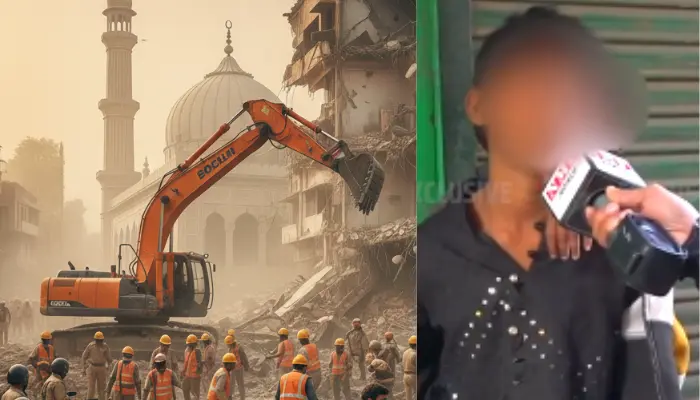
Case Summary
The Hindu community faced verbal hostility from a Muslim minor boy during a demolition drive by the Municipal Corporation of Delhi. The incident took place near the Faiz-e-Ilahi Mosque in the Turkman Gate area of Delhi. At the time, civic authorities were removing illegal encroachments from government land. During the demolition, the minor reacted strongly to the removal of unauthorised structures and stated, “Man toh karta hai Hindustan ko yahin zinda gaad doon” (I wish to bury India). The statement was made openly at the site during the disturbance. In the same exchange, the child acknowledged that the mosque had been constructed illegally on government land, even while expressing anger over the civic action. The demolition drive took place in the early hours of 7 January 2026. Officials from the Municipal Corporation of Delhi, accompanied by police personnel, carried out the operation to remove unauthorised constructions adjoining the mosque. These structures included community halls, dispensary areas, and parking spaces that had been built without permission on public land. The action was conducted under municipal law to reclaim government property. The mosque structure itself was not demolished. As the operation continued, a group of 30 to 35 Muslim individuals assembled at the site and attempted to obstruct the demolition. The situation escalated when members of the group engaged in stone pelting, targeting police personnel deployed to maintain security. Five police officers sustained injuries during the violence. Police used tear gas to disperse the crowd and prevent further escalation, allowing the demolition team to complete the operation. The hostile statement by the minor occurred during this period of unrest, when Hindu residents in the surrounding area witnessed violent resistance to a lawful civic exercise, alongside direct physical attacks on police personnel performing their duty. Following the violence, the Delhi Police registered a First Information Report at Chandni Mahal Police Station under provisions of the Indian Penal Code relating to violence against public servants and unlawful assembly. Five individuals, including the minor, were taken into custody for their involvement in stone pelting and obstruction of the demolition drive. Security arrangements remained heightened in the Turkman Gate area to prevent further disturbances.
Why it is Hate Crime ?
This case is documented under the selected primary category: Hate speech against Hindus. Under this, the selected secondary category is: Violent threats. Violent threats, explicit, implicit or implied, is the most dangerous form of hate speech since it goes beyond discriminatory and prejudicial language to express the intent of causing harm to an individual or a group of people based on their religious identity and faith. There could be several different kinds of threats that are issued to Hindus based on religious animosity. An explicit threat would mean the direct threat of violence towards an individual Hindu, a group of Hindus or Hindus at large. Physical violence, death threats, threats of destruction of property belonging to Hindus and threats of genocide would mean explicit threats against Hindus for their religious identity. Implicit threats may not be a direct threat but implied through the use of symbols of actions – for example – in the Nupur Sharma case, other than explicit threats, there were also implicit threats when Islamists took to the streets to burn and beat her effigies. It implies that they want to do the same to Nupur Sharma – thereby is considered an implicit threat. Violent threats can be delivered in person, through letters, phone calls, graffiti, or increasingly through social media and other online platforms. It would be important to understand that a threat – explicit or implicit, online or offline – to an individual who happens to be a Hindu does not qualify as a religiously motivated threat. Such a threat, while vile and dangerous, could be owing to non-religious reasons and/or personal animosity. To qualify as a religiously motivated threat, it would need to exhibit an indication that the individual is being targeted for religious reasons and/or owing to his/her religious identity as a Hindu. In this case, it is first important to state that some could argue that the violent threats made by the Muslim boy are anti-India, but not anti-Hindu. However, making such statements not only shows anti-India sentiments but also anti-Hindu sentiments. It is pertinent to note that Muslim extremists harbour specific animosity towards Hindus and their faith, and also view India as a Hindu collectivity. Even regarding Muslim separatism, the very basis of the partition of India and creation of Pakistan is that the Muslims believe that Islam is a nation unto itself, which cannot survive with a Hindu collectivity like India. Further, Muslims often believe in transnational unity or the Ummah (global Muslim brotherhood), which is a belief that all Muslims across the world are a nation unto themselves and therefore, loyalty as far as the nation-state is concerned lies with the Muslim collectivity and not with a Hindu collectivity like India. This also means that any anti-India slogan is about opposing the Hindu collectivity, and it demonstrates the anti-Hindu sentiments that the perpetrator holds. In this case, in which the Muslim boy threatens to bury India, it showcases that India is just used as a pretext; his actual animosity is towards Hindus. Thus, this case is added to the tracker. The hostility displayed during the Municipal Corporation of Delhi's demolition drive targeted not just a civic action, but India as a Hindu civilisational and religious collective. A Muslim boy openly expressed a desire to "bury India alive," turning a routine law-enforcement activity into an act of communal hostility. Hindu residents witnessed this, making it a public expression of religious animosity. The boy was aware that the mosque-linked constructions were built illegally on government land. Despite this knowledge, his anger was not directed at the authorities or the demolition process. Instead, it was directed at India as a Hindu collective and Hindus as a community. This demonstrated that the boy's actions were motivated by religious ideology rather than a disagreement with legal procedures, establishing the religious nature of the offence. The seriousness of the incident heightened because it occurred during public disorder, including stone pelting and attacks on police personnel. The statements carried an implicit threat, showing contempt for Hindus and their country India. Speaking such words publicly served to intimidate and dehumanise the Hindu community, increasing communal tension at the scene. Even at a young age, the Muslim boy's statements reflected deep ideological conditioning rather than spontaneous anger. The phrasing resembled rhetoric often used by Islamist extremists who consider India incompatible with Islamic identity and hence always advocate its destruction or Islamisation. All such actions against India were motivated by hatred for Hindus since they viewed India as a Hindu collectivity. In this case, the accused's actions indicated early internalisation of religiously motivated hostility towards Hindus and the Indian nation, rather than a reaction limited to the immediate demolition activity. In this context, the boy's words could not be dismissed as mere provocation or childish misbehaviour. They reflected an ideology that cast Hindus and India as enemies. The religiously charged hostility during public unrest elevated the act from disorderly conduct to a hate-driven offence. The fact that the speaker was a minor did not lessen the impact, as hate crimes are defined by the motivation and harm caused. The incident created fear, alienation, and communal tension among Hindu residents, fulfilling the recognised criteria for a religiously motivated hate crime. Therefore, this case was added to the hate crime database of the Hinduphobia Tracker. Disclaimer: The Hinduphobia Tracker records the dates of incidents based on when the crime occurs rather than when it is reported by the media. However, in this case, media reports have not stated the exact date when the accused boy made such anti-Hindu remarks. Henceforth, the date when the demolition drive took place, and the police were attacked, that is, 7th January 2026, is being selected as the indicative incident date. This is recorded for documentation purposes only.


Case Status
Unknown


Perpetrators Details
Perpetrators
Muslim Extremists
Perpetrators Range
One Person
Perpetrators Gender
male
 Sources




