Hindu community hurt as school song performance spreads hate rhetoric against Hindu deities in Sheopur, Madhya Pradesh
 Sheopur, Madhya Pradesh, India
  5 January, 2026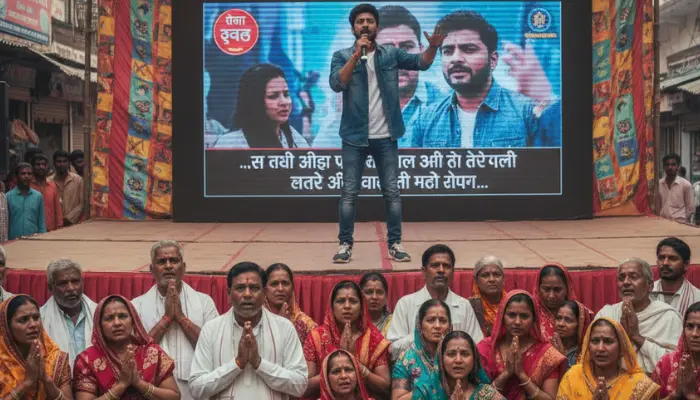
Case Summary
Hindu residents were distressed after a private school operator performed a controversial song at a public programme in Sheopur, Madhya Pradesh. The performance insulted Hindu gods and goddesses and sparked outrage among the community, who described it as a direct attack on their faith and religious practices. The song included lines such as, “Why do you leave school and go to the temple…” and “…the almighty gods you worship are all murderers.” The performance was recorded, and the video later circulated widely on social media, drawing attention from viewers across the region. Members of the Hindu community said the content demeaned centuries-old religious traditions and caused hurt to the sentiments of devotees. Local residents emphasised that the song was not only offensive but also caused emotional distress. They expressed concern over the public nature of the performance, noting that such acts undermined the dignity of the Hindu community and threatened communal harmony. The widespread circulation of the video intensified the emotional impact, leaving many devotees feeling insulted and vulnerable. At the time of reporting, no administrative or legal action had been taken against the school operator or the event organisers. The community expressed frustration over the absence of any official response, urging authorities to acknowledge the harm caused and take measures to prevent similar incidents in the future.
Why it is Hate Crime ?
This case has been documented under the selected primary category: Hate speech against Hindus. Under this, the selected secondary category is: Anti Hindu slurs, mocking faith. Anti-Hindu slurs and the deliberate mocking of the Hindu faith owing to religious animosity involve the usage of derogatory terms, stereotypes, or offensive references to religious practices, symbols, or figures. One of the common anti-Hindu slurs used against Hindus is “cow-worshipper” and “cow piss drinker”. The intention of using this term is to demean and mock Hindus as a group and their religious beliefs since Hindus consider the cow holy. Additionally, some symbols and the slurs attached to them have a historical context that exacerbates the insult, hate, stereotyping, dehumanisation and oppression against Hindus. Cow worship has been used for centuries to denigrate Hindus, insult their faith and oppress Hindus specifically as a religious group. There has been overwhelming documentation about how cow slaughter has been used to persecute Hindus with cow meat being thrown in temples and places of worship. There has also been overwhelming documentation where cow meat (beef) has been force-fed to Hindus to either forcefully convert them to Islam or denigrate their faith. Apart from cow worship, the Swastika – which holds deep religious significance for the Hindus – has also been misinterpreted and distorted to use as a slur against Hindus. Similarly, the worship of the Shivling has been used by supremacist ideologies and religions to denigrate Hindus owing to religious animosity. Such slurs and denigration stem out of inherent animosity and hate towards Hindus and their faith, therefore, it is categorised as hate speech targeted at Hindus specifically owing to their religious identity. This incident qualifies as a religiously motivated hate crime due to the deliberate and public denigration of the Hindu faith, beliefs, and sacred figures. First, the performance directly targeted Hindu religious practices and deities. The lyrics questioning temple worship and portraying Hindu gods as “murderers” were not abstract social commentary but explicit insults aimed at Hindu belief systems. Such language reduces revered deities to criminal caricatures, amounting to a direct attack on the religious identity of Hindus. In Hinduism, deities are not symbolic or metaphorical constructs but living embodiments of the divine, central to daily worship, moral life, and cultural continuity. Reverence for deities forms the core of Hindu religious expression. Mocking or maligning them, therefore, inflicts collective religious injury, striking at the spiritual dignity of devotees and undermining the sanctity of their faith. Second, the act caused significant emotional and psychological distress to Hindu residents. Community members stated that the performance demeaned centuries-old traditions and left them feeling humiliated and disrespected. The fact that the song was performed at a public programme amplified the harm, as it normalised ridicule of Hindu beliefs in a shared civic space. Third, the recording and circulation of the performance on social media substantially widened the impact. What began as a local act of religious insult was transformed into a broader episode of public shaming, exposing Hindu viewers beyond the immediate audience to the same denigrating content and reinforcing feelings of vulnerability and marginalisation. Finally, the absence of administrative or legal action at the time of reporting deepened the sense of injustice. The lack of accountability conveyed institutional indifference toward the harm suffered by the Hindu community, further reinforcing perceptions of unequal treatment of religious sentiments. Taken together, the intentional public denigration of Hindu deities, the emotional harm inflicted on devotees, the amplification through digital platforms, and the absence of corrective action establish this incident as a clear case of religiously motivated hate. Disclaimer: The Hinduphobia Tracker records incident dates based on when the crime occurred, rather than when the media reports it. However, in this case, media reports have not specified the exact date when the victim's ordeal began. Henceforth, for documentation purposes, 6th January, 2026, the date of media reporting, has been selected as the indicative incident date.


Case Status
Unknown


Perpetrators Details
Perpetrators
Unknown
Perpetrators Range
One Person
Perpetrators Gender
male
 Sources




