Hindu judge vilified through derogatory book ahead of Chennai Book Fair in Chennai, Tamil Nadu
 Chennai, Tamil Nadu, India
  6 January, 2026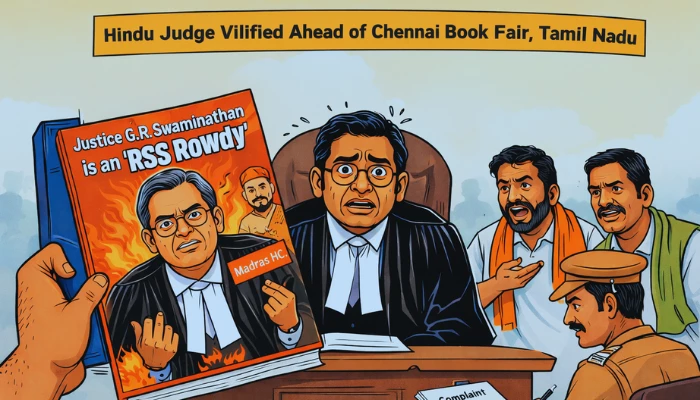
Case Summary
In Chennai, Tamil Nadu, a derogatory book targeting a sitting Hindu judge, Justice G. R. Swaminathan of the Madras High Court, was circulated ahead of the forty-ninth Chennai Book Fair on 7 January 2026. The book attacked his character and portrayed him as a rowdy. A book titled “Thirupparankundram Issue: G. R. Swaminathan – Judge or Rashtriya Swayamsevak Sangh Rowdy?” was circulated ahead of the forty-ninth Chennai Book Fair on 7 January 2026 in Chennai. It carried a caricature of Justice Swaminathan in judicial robes and was priced at thirty rupees. A formal complaint was filed with the Chennai Police seeking the registration of a First Information Report against those responsible for the book’s authorship, publication, advertisement, and distribution. The complainant, Chennai resident S. Muralidharan, stated that the publication lowered the dignity of the judiciary, damaged public confidence in the justice system, and amounted to a personal attack on a serving High Court judge. According to the complainant, filing the complaint became an ordeal. He stated that he was required to move between multiple police jurisdictions, Kotturpuram, Saidapet, and Butt Road, before the office of the Joint Commissioner of Police (South Zone) finally accepted the complaint. An acknowledgement was issued, and an action taken report remained awaited. In his complaint, Muralidharan stated that the book and its promotional material amounted to criminal defamation, deliberate scandalisation of the judiciary, promotion of hatred, and circulation of offensive material targeting a sitting judge. He further stated that the caricatures and captions were designed to lower the dignity of a constitutional court, damage the judge’s impartiality, and provoke public distrust in the justice delivery system. The complaint invoked provisions of the Bharatiya Nyaya Sanhita, 2023, corresponding to offences such as criminal defamation, promotion of enmity, and acts that scandalised or lowered the authority of courts, and also noted the applicability of proceedings under the Contempt of Courts Act.
Why it is Hate Crime ?
This incident has been categorised under the Undecided database because, while the publication is derogatory and deeply concerning, the available material does not conclusively establish that the attack was motivated by hostility toward Hindu religious identity. The book targets a sitting judge through character assassination and attempts to undermine his judicial credibility by associating him with a political and ideological organisation. The primary axis of attack, as reflected in the content, appears to be political and institutional rather than explicitly religious. Although the Rashtriya Swayamsevak Sangh is widely perceived as a Hindu organisation and is frequently subjected to hostility that overlaps with prejudice against Hindu identity, the material circulated in this case does not directly attack Hindu religion, deities, rituals, or Hindus as a collective. The language used focuses on portraying the judge as biased or unfit for office, rather than expressing animosity toward the Hindu faith or religious practice. This places the case in a grey zone where political hostility and ideological opposition may intersect with broader cultural prejudice. Such overlap warrants scrutiny, but without explicit religious markers such as anti-Hindu slurs, denigration of Hindu beliefs, or calls to hostility against Hindus as a group, the threshold for classification as a religiously motivated hate crime is not clearly met at this stage. The complaint itself highlights issues related to criminal defamation, scandalisation of the judiciary, erosion of public confidence in the justice system, and contempt of court. These are serious harms, but they pertain primarily to institutional integrity and personal targeting rather than demonstrable religious persecution. For these reasons, the case has been placed under Undecided as a precautionary and evidence-based classification. This does not minimise the gravity of the incident. Rather, it ensures analytical consistency and credibility by reserving hate crime classification for cases where religious motivation is clearly established. Should further evidence emerge indicating that the publication was intended to vilify Hindu identity or incite hostility against Hindus through the targeting of the judge, the classification may be reviewed and revised accordingly.
Victim Details
Total Victim
1
Deceased
0
Gender
- Male 1
- Female 0
- Third Gender 0
- Unknown 0
Caste
- SC/ST 0
- OBC 0
- General 1
- Unknown 0
Age Group
- Minor 0
- Adult 0
- Senior Citizen 0
- Unknown 1


Case Status
Complaint filed


Perpetrators Details
Perpetrators
Unknown
Perpetrators Range
Unknown
Perpetrators Gender
unknown
 Sources




