Hindu man brutally killed, his throat slit by unidentified people in Bangladesh amidst ongoing persecution of Hindus
 Comilla District, Bangladesh
  10 December, 2025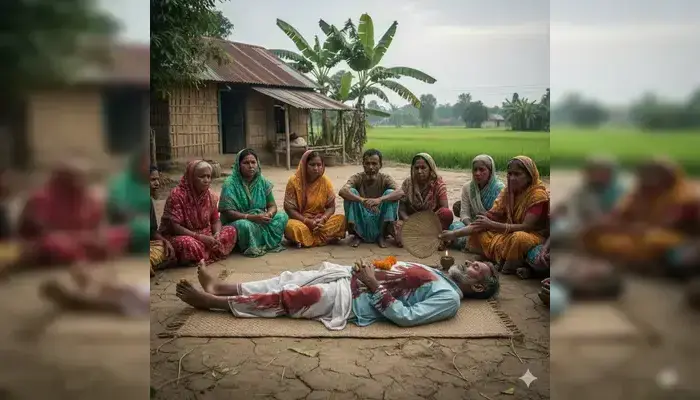
Case Summary
In the Homna sub-district of Comilla district of Bangladesh, an 18-year-old Hindu man named Shanto Das was brutally killed by a few unidentified people. The attackers stabbed the victim several times in the neck and also slit his throat. This incident came to light on 12 December 2025 when the dead body of Shanto Das was recovered from a cornfield in Homna. The victim's throat was slit, and there were multiple stab wounds on his neck. According to media reports, the deceased victim was a resident of Bijoynagar village, an auto-rickshaw driver and a member of the village police force. His father, Arun Chandra Das, said of the incident, "My son Shanto used to drive an auto-rickshaw. We have not been able to contact him since Thursday (11 December 2025) evening." The victim's elder brother, Antu Chandra Das, said Shanto left home with his auto-rickshaw on Thursday (11 December 2025) afternoon. When his phone went unreachable by 8 pm, the family began searching for him. The next morning, they learned from the police about a throat-slit body in Kararkandi and identified it as Shanto, he said, adding that the assailants killed his brother and took away the auto-rickshaw. Officer-in-Charge of Homna Police Station, Morshedul Alam Chowdhur,y claimed that the murder could be over robbery. Police recovered Shanto Das's body and sent it to Comilla Medical College Hospital for an autopsy, and registered a case in this matter. This case serves as a stark reminder of the continued persecution of Hindus in Bangladesh, which has only increased manifold since the fall of Sheikh Hasina’s Awami League government on August 5, 2024. After her violent ouster, Bangladesh plunged into chaos as Islamist extremists took advantage of the political turmoil to unleash a wave of terror and violence against the Hindu community. The Islamist mobs have attacked Hindu homes, burned them to the ground, and abducted women in a horrific descent into anarchy. Several temples have been destroyed in various parts of the Islamic country in a major crackdown on Hindus. Reports have exposed how Muslim students forced around 60 Hindu teachers, professors, and government officials to resign. Exiled Bangladeshi activist Asad Noor has also revealed that the minority Hindu community is now being coerced into joining ‘Jamaat-e-Islami’. Hindu religious events have been repeatedly targeted. On 6th September, a procession carrying Lord Ganesha’s idol was attacked in Chittagong. Ahead of Durga Puja, multiple incidents of idol vandalism occurred, including attacks in Mymensingh, Pabna, Rajshahi, Kishoreganj, and Dhaka. On 29th November, a violent Muslim mob attacked three temples in Patharghata, Chittagong, immediately after Jumma Namaz. The crackdown on Hindu voices has also escalated. On 30th November, Hindu journalist Munni Saha was arrested in Dhaka. Muslim mob attacks have increased in Bangladesh, for example, on 22nd May 2025, a Muslim mob carried out arson attacks selectively on Hindu homes in Dahar Mashihati village in Abhaynagar upazila in Jessore district of Bangladesh. Even ISKCON leader Chinmoy Krishna Das Prabhu and his aides have been targeted, and attempts have been made to ban ISKCON and suppress Hindu protests through sedition charges. These arbitrary actions point to a systematic pattern of persecution under Muhammad Yunus’s interim government.
Why it is Hate Crime ?
This case has been added to the tracker under the primary category- Attack resulting in death. Within this, the subcategory selected is - Attacked for Hindu identity. In several cases, Hindus are attacked merely for their Hindu identity without any perceived provocation. A classic example of this category of religiously motivated hate crime is a murder in 2016. 7 ISIS terrorists were convicted for shooting a school principal in Kanpur because they got ‘triggered’ seeing the Kalava on his wrist and tilak that he had put. In this, the Hindu victim had offered no provocation except for his Hindu religious identity. The motivation for the murder was purely religious, driven by religious supremacy. Such cases where Hindus are targeted merely for their religious identity would be documented as a hate crime. Under this category, cases where the attack led to the death of the Hindu victim/s would be documented. This case constitutes a clear instance of a religiously motivated crime, as an 18-year-old Hindu man, Shanto Das, was singled out, brutally stabbed multiple times, had his throat slit, and his body discarded in a cornfield in Bangladesh, a country that experiences sustained and well-documented persecution of Hindus. The killing did not occur in isolation; it reflected deep-seated hatred tied to the victim's faith in a nation gripped by anti-Hindu hostility. Regarding this incident, some may say that the case details do not explicitly indicate a religious motive. However, the broader context of anti-Hindu persecution in Bangladesh cannot be ignored. When there is ongoing ethnic cleansing based on religious identity, every crime is assumed to be motivated by the same religious animosity, even if there is no specific religious marker in the immediate crime. During ongoing ethnic cleansing, the dehumanisation of people based on their religious identity and the normalisation of religious hostility drive the crimes committed against them, even when there is no stated religious motive. For the purpose of documenting the 2024 ethnic cleansing of Hindus in Bangladesh, the Hinduphobia Tracker is assuming religious motivation ab initio. If a case is specifically and beyond a reasonable doubt proven to be driven by motivations other than religious hostility, it will post-facto be removed from the hate crime database. The Hindu victim was subjected to brutal murder amidst the religious persecution of Hindus in Bangladesh. The timing and severity of this brutal killing, with savage stab wounds and a deeply slashed throat found on his body in the Homna sub-district of Comilla, signalled hostility towards the victim's religious identity rather than a random act of violence. This showcased that he was brutalised and murdered not for any other reason but specifically for being a Hindu. The violence showcased clear communal undertones, making it a religiously motivated offence. If the perpetrators targeted Shanto Das for robbery, as the police claimed, they could have simply stolen the autorickshaw and harmed him minimally. Yet the extreme brutality of stabbing him multiple times in the neck and slitting his throat far exceeds the usual robbery attacks. This savagery, uncommon in mere theft cases, reveals deeper hatred directed at the victim due to his Hindu identity, marking it as a hate-driven crime amidst rising anti-Hindu violence in Bangladesh The murder of a Hindu man over his identity laid bare the terror Hindus face in Bangladesh, where simply existing as one invites deadly violence. Such targeted brutality unmasked profound animosity towards Hinduism and its adherents, marking this as an undeniable instance of a hate-driven attack. The convergence of the victim’s Hindu identity, the violent death, and the manner of his body’s disposal met the threshold for a religiously motivated hate crime targeting Hindus. Even though the religious identity of the perpetrators remained unknown, the act clearly showcased communal motivations behind the crime. Therefore, this case was added to the hate crime database of the Hinduphobia Tracker.
Victim Details
Total Victim
1
Deceased
1
Gender
- Male 1
- Female 0
- Third Gender 0
- Unknown 0
Caste
- SC/ST 0
- OBC 0
- General 0
- Unknown 1
Age Group
- Minor 0
- Adult 1
- Senior Citizen 0
- Unknown 0


Case Status
Complaint registered


Perpetrators Details
Perpetrators
Unknown
Perpetrators Range
Unknown
Perpetrators Gender
unknown
 Sources




