Hindu religious site targeted; Waqf Board stakes claim over sacred Deepathoon at Thiruparankundram hill
 Madurai, Tamil Nadu, India
  5 January, 2026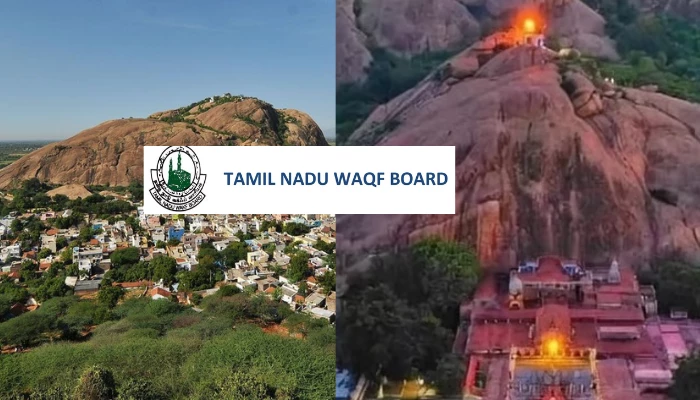
Case Summary
On 6 January 2026, the Tamil Nadu Waqf Board asserted ownership over the land of the Thiruparankundram Hill lamp pillar. This sacred Deepathoon is where Hindus have lit the sacred deepam (lamp) for centuries. The Muslim Waqf Board in Madurai, Tamil Nadu, through the appellants Hazarat Sultan Sikandar and Badusha Avuliya Dargah, staked claim over this centuries-old Hindu worship space. The Tamil Nadu Waqf Board, in a case concerning the lighting of the lamp on the sacred pillar at Thiruparankundram Hill, Madurai, submitted that the sacred Hindu lamp pillar, where Hindus lit the lamp, originally belonged to the Waqf Board and the Badusha Avuliya Dargah. The contention regarding ownership of the sacred lamp pillar on Thiruparankundram Hill was raised when the Madurai Bench was hearing a batch of appeals following the 1 December 2025 order, which permitted Hindus to light the lamp on Thiruparankundram Hill. The Madurai Division Bench, presided over by Justice G. Jayachandran and Justice K. K. Ramakrishnan of the Madras High Court, strongly rebuked the Tamil Nadu Waqf Board. The Court pronounced it to be a “mischievous” assertion over the centuries-old stone lamp pillar (Deepathoon) at the centre of the Thiruparankundram Hill dispute. It held, “For the first time in the course of argument in the intra-court appeals, on behalf of the Waqf, a mischievous submission was made that the lamp pillar belongs to the Dargah.” Further, the judges clarified that the Waqf Board had no locus standi in the matter. Clarifying further, the court added that the ‘Sikandar Dargah’ was not a notified dargah or mosque under the Waqf Act. The entire Thiruparankundram Hill was a protected archaeological site under the Ancient Monuments Act. Moreover, under Section 3-D of the Waqf (Amendment) Act, 2025, any Waqf notification was void if the property was a protected monument. The Madurai Bench also upheld Justice G. R. Swaminathan’s judgment, which directed the lamp to be lit atop the ancient stone pillar over the iconic Thiruparankundram Hill, one of the six abodes of Lord Murugan. The Bench reaffirmed that the lamp pillar was situated within the portion of the hill legally owned by the Arulmigu Subramanian Swamy Temple, as decreed by the civil court in Original Suit Number 4 of 1920 and later confirmed by the Privy Council. It further added, “The location of the pillar is in the portion of the hill declared by a competent civil court as property of the Devasthanam.” Additionally, the judgment noted that the presence of the Sikandar Dargah, Jain caves, and other later structures did not divest the temple of its larger proprietary and religious rights over the hill. The Court pointedly remarked that these structures were “not of contemporaneous origin” and had arisen “much after the hill had attained religious significance for Hindu worship.” With this observation, the Court dismissed the Waqf’s position as legally untenable, reaffirmed temple ownership over the Deepathoon, and raised doubts about the Waqf’s neutrality in future mediation efforts. The pillar was directed to be used for the Karthigai Deepam lighting under the supervision of the district administration, with no role for the Waqf Board. It reaffirmed that the hill was a protected area under the Ancient Monuments and Archaeological Sites and Remains Act and maintained that everyone must abide by the Act and its regulations. The judges announced that the lamp at the Deepathoon was required to be lit by the Devasthanam. The Archaeological Survey of India would apply suitable and necessary conditions, alongside the limitations and prohibitions under the Ancient Monuments and Archaeological Sites and Remains Act, to protect the hill’s monuments. They outlined, “The Devasthanam, through its team, has to light the lamp in the Deepathoon on the occasion of the Karthigai Deepam festival falling in the Tamil month of Karthigai. No member of the public shall be allowed to accompany the Devasthanam team.” The number of team members was to be selected after consultation with the police and the Archaeological Survey of India, while the event was to be coordinated and overseen by the District Collector.
Why it is Hate Crime ?
The primary category selected in this case is: Attack on Hindu religious representations. The subcategory under this is: Encroachment/Illicit takeover of temple land/land near temple. In Hinduism, a temple is the abode of the Deity. The Deity in the Temple is consecrated, thereby making it a real, breathing entity. Hindus believe that not just the Deity but the temple premises itself are sacred to Hindus since Hindus hold the faith that the entire Temple space is an amalgamation of the divine energy of the deity. Not only the Temple but the Temple premises in its entirety are considered sacred by Hindus. In several cases, the premises of the Temple and/or religious centre are illicitly taken over by institutions belonging to other faiths, like the Waqf board or the Church. Other times, the temple property, land or the property of religious centres are illicitly encroached upon by non-Hindu groups. Any illicit takeover or encroachment is a crime an initio; however, when non-Hindu groups illicitly take over or encroach on the sacred land of Hindus, it is an affront to the Hindu community and is therefore classified as a religiously motivated hate crime under this category. This case is added to the Hinduphobia Tracker because it involves a direct and sustained intervention into an ancient Hindu religious practice and a centuries-old sacred structure at Thiruparankundram Hill. The dispute did not concern a recent or incidental activity but centred on the Deepathoon, a stone lamp pillar that Hindus had historically used for lighting the Karthigai Deepam. The temple land or areas around the sacred space are not simply a piece of property; they hold profound religious significance for the Hindu community. For Hindus, both the temple and its land are regarded as the abode of the deity. The assertion of ownership over the Deepathoon by the Tamil Nadu Waqf Board represented nothing but an attempt to encroach and illegally seize the temple land. The Deepathoon was not a neutral structure but a recognised Hindu religious symbol tied to temple worship and ritual visibility. By seeking to reclassify the lamp pillar as belonging to a Dargah, the action sought to detach the structure from its Hindu religious meaning and heritage. This attempt to alter the identity of a Hindu sacred object directly undermined Hindu religious representation and continuity at the site. It is important to understand that any form of encroachment or seizure of temple land is an attack on the religious rights and sentiments of Hindus, disrupting their ability to worship and to maintain their sacred spaces. Any unauthorised occupation or illegal construction in this space, especially one that halts worship and religious observance, is a violation of that sanctity. Moreover, this is not the first time that the Waqf board has claimed ownership over temple land. There have been a plethora of instances of land grabs by the Waqf Board. For example, land grabbing of Waqf Boards in Kolhapur, Maharashtra, where it asserted its claim over land adjacent to the Mahadev Temple. In another case, it declared Surat Municipal Corporation (SMC), known as ‘Muglisara’ (Mughal Sarai), as waqf property, though it got quashed by the court. In yet another shocking revelation in August 2023, the Waqf Board of Tamil Nadu claimed ownership of Anangakaundanputhur village, which is located in the Komarapalayam Panchayat of Sathyamangalam, Tamil Nadu’s Erode district. The Waqf board claimed the land of the whole village. In another case, Uttar Pradesh Waqf Board asserted its claim over Chandrashekhar Azad Park, a public space of national significance. These are no rare instances; these are egregious examples showing how the Waqf Board has been planning and plotting for ages to grab the land of Hindus. Notably, India's Waqf Boards manage a vast amount of land, with estimates suggesting over 8.7 lakh properties covering more than 38 lakh acres (around 15,000 sq km), making them significant landowners, often cited as the country's largest urban landowners after the Railways and Army. The amount of land grabbed by the Waqf Board itself exemplifies the kind of encroachment practices it has carried out. However, since it targeted a sacred Hindu site for encroachment, this showcased its hatred and animosity towards Hindu sacred spaces and religious practices. Its actions are clearly aimed to encroach upon Hindu sacred spaces and provoking the sentiments of the Hindu community, making it a hate crime and warranting inclusion in the tracker.


Case Status
Case adjudicated


Perpetrators Details
Perpetrators
Muslim Extremists
Perpetrators Range
Unknown
Perpetrators Gender
unknown
 Sources




