Hindu religious sentiments hurt after Muslim youths abuse deities on social media triggering law and order crisis in Nepal
 Nepal
Nepal  3 January, 2026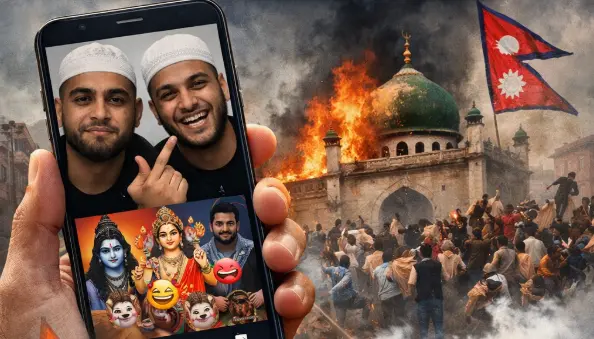
Case Summary
Hindu deities were abused by two Muslim youths through social media posts, triggering widespread unrest across southern Nepal and escalating into a serious law and order situation on 4 January. The controversy began when two Muslim youths, identified as Haider Ansari and Amanat Ansari, uploaded reels containing derogatory and offensive remarks against Hindu Gods. The content circulated rapidly online and caused deep hurt to Hindu religious sentiments. The impact of the videos was first felt in Kamala Municipality of Dhanusha district, where Hindu residents stated that the reels crossed all limits of religious tolerance and disrupted long-standing communal harmony. As public anger intensified, local residents traced the individuals responsible for the posts and handed them over to the police, demanding firm action to prevent further provocation and unrest. Despite the arrests, tensions did not subside. The situation worsened after a mosque was vandalised in the Sakhuwa Maran area of Kamala, which further aggravated fear and mistrust between communities. Hindu organisations stated that the vandalism occurred in the aftermath of the offensive content and contributed to the deteriorating atmosphere. Protests soon spread beyond Dhanusha district to neighbouring areas, including Parsa, with large crowds gathering on the streets. The unrest turned violent in Birgunj, a major commercial town near the India-Nepal border. Protesters clashed with police, pelted stones, and vandalised a local police station, forcing shop closures and creating panic. Police responded by firing tear gas shells, and the Parsa district administration imposed a curfew to restore order. Given Birgunj’s proximity to the Indian border, Indian authorities heightened security and sealed border crossings. Civilian movement was restricted, intensive checks were initiated, and additional forces were deployed to prevent any spillover of unrest while monitoring the situation closely.
Why it is Hate Crime ?
This incident has been added to the tracker under the primary category- Hate speech against Hindus. Under this, the sub-category selected is- Anti-Hindu slurs, mocking faith. Anti-Hindu slurs and the deliberate mocking of the Hindu faith owing to religious animosity involve the usage of derogatory terms, stereotypes, or offensive references to religious practices, symbols, or figures. One of the common anti-Hindu slurs used against Hindus is “cow-worshipper” and “cow piss drinker”. The intention of using this term is to demean and mock Hindus as a group and their religious beliefs since Hindus consider the cow holy. Additionally, some symbols and the slurs attached to them have a historical context that exacerbates the insult, hate, stereotyping, dehumanisation and oppression against Hindus. Cow worship has been used for centuries to denigrate Hindus, insult their faith and oppress Hindus specifically as a religious group. There has been overwhelming documentation about how cow slaughter has been used to persecute Hindus with cow meat being thrown in temples and places of worship. There has also been overwhelming documentation where cow meat (beef) has been force-fed to Hindus to either forcefully convert them to Islam or denigrate their faith. Apart from cow worship, the Swastika – which holds deep religious significance for the Hindus – has also been misinterpreted and distorted to use as a slur against Hindus. Similarly, the worship of the Shivling has been used by supremacist ideologies and religions to denigrate Hindus owing to religious animosity. Such slurs and denigration stem out of inherent animosity and hate towards Hindus and their faith, therefore, it is categorised as hate speech targeted at Hindus specifically owing to their religious identity. The other category relevant is- Attack not resulting in death, and within this, the sub-category selected is- Communal clash/attack. Communal clash is a form of collective violence that involves clashes between groups belonging to different religious identities. For a communal clash between Hindus and non-Hindus to qualify as a religiously motivated hate crime, the trigger of the violence itself would have to be anti-Hindu in essence. For example, if there is a Hindu religious procession that comes under attack from a non-Hindu mob and after the initial attack, Hindus retaliate in self-defence, leading to a communal clash between the two religious communities. While at a later stage, both communities are involved in the clash/violence, the initial trigger of the violence was by the non-Hindu mob against the Hindus and therefore, it could safely be termed as an anti-Hindu violence. Further, the trigger would also have to be religiously motivated. In the cited example, the attack by the non-Hindu mob was against religious processions and therefore, can be concluded to be religiously motivated. In some cases, the trigger may be non-religious, however, it develops into religious violence against Hindus at a later stage. In such cases too, the foundational animosity towards Hindus becomes the motivating factor of the crime and therefore, it would be classified as a religiously motivated hate crime against Hindus under this category. This incident qualifies as a hate-driven act because it began with the deliberate abuse and mockery of Hindu deities by two Muslim youths on social media, directly targeting the Hindu faith and religious identity. The content constituted explicit vilification of Hindu beliefs and was designed to demean and provoke Hindus as a religious community. In Hinduism, deities are not abstract symbols but living objects of devotion and worship, central to spiritual life, cultural continuity, and personal identity. Insulting or abusing Hindu Gods, therefore, inflicts collective religious injury. Such acts are experienced by devotees as direct hostility toward their faith and dignity, not as a casual or harmless expression. The online abuse caused widespread hurt to Hindu religious sentiments and acted as a catalyst for unrest, demonstrating how targeted hate speech can spill into public disorder. While the subsequent protests and clashes were secondary developments, they underscore the real-world consequences of anti-Hindu vilification and the capacity of such speech to destabilise communal harmony. Taken together, the intentional denigration of Hindu deities and the resulting communal fallout establish this incident as a case of hate speech against Hindus with tangible social impact. This is why the incident warrants inclusion in the tracker.


Case Status
Arrested


Perpetrators Details
Perpetrators
Muslim Extremists
Perpetrators Range
From 2 To 5
Perpetrators Gender
male
 Sources




