Hindu temples targeted, sacred idols desecrated by miscreants in Varanasi, Uttar Pradesh
 Varanasi, Uttar Pradesh, India
  5 January, 2026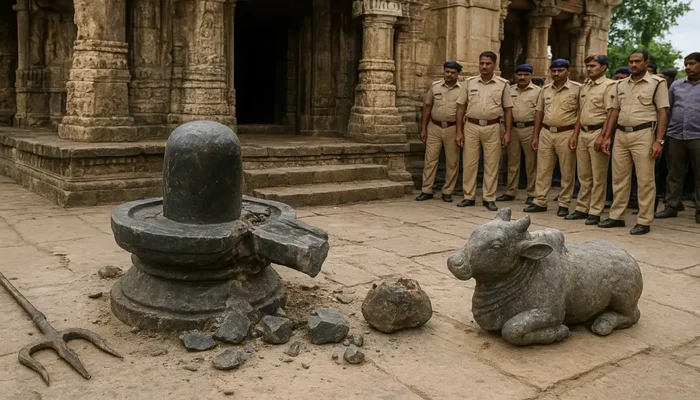
Case Summary
In two villages of Varanasi, Uttar Pradesh, two Hindu temples were targeted, and their sacred idols of deities were desecrated by unknown miscreants. According to media reports, the miscreants removed the idol of Lord Hanuman from a temple in Munari village (Patel Nagar) and broke it into several pieces. The second incident occurred in the neighbouring village of Latauni, where idols of Lord Shiva and Lord Krishna installed in the temple were also vandalised by miscreants. Both incidents occurred on the same night, creating tension in the area. Upon receiving news of the incident, a large number of villagers from both villages gathered at the scene. Villagers said this act deeply hurt their religious sentiments. Such incidents cause instability and tension in society, which is a matter of concern for any community. Locals condemned the incident and considered it a serious attack on their religion. Regarding this matter, the respective village heads of both villages submitted a written complaint to the Chaubepur Police Station, demanding the registration of a case against the unknown perpetrators and their immediate arrest. The village heads said that such incidents create an atmosphere of fear and insecurity in society. They appealed to the administration to apprehend the culprits quickly so that peace and harmony could be restored in the area. The local administration took the incident seriously and formed a special team to investigate the matter. Police assured that they would take all necessary steps to apprehend the culprits soon. Following the incident, security increased in the area, and police patrols intensified to prevent any further incidents.
Why it is Hate Crime ?
The primary category selected in this case is- Attack on Hindu religious representations. The subcategory selected is- Desecration of Hindu religious symbols. Icons and symbols or a religious representation of a spiritual ideal are widely revered in Hinduism. Iconography is of vital significance in the Hindu milieu. It helps connect people’s spiritual beliefs with the real world. Iconography within the Hindu faith takes several shapes and forms. Murtis are of most significance to Hindus, to which daily rituals, prayers and offerings are done. Besides the murtis, there are several other symbols which have deep significance in the Hindu faith – the Om and Swastika for example. Since these Hindu religious symbols hold paramount importance in Hinduism, any desecration of symbols, icons, murtis, religious representations and manifestations, is driven by animosity towards the faith itself which manifests itself through these murtis, icons and symbols. Therefore, any desecration of these Hindu religious symbols and representations is considered religiously motivated hate crimes under this category. The other subcategory selected is- Attack on Temples. In Hinduism, a temple is the abode of the Deity. The Deity in the Temple is consecrated, thereby, making it a real, breathing entity. Hindus believe that not just the Deity but the temple premises itself are sacred to Hindus since Hindus hold the faith that the entire Temple space is an amalgamation of the divine energy of the deity. Given the central significance of Temples in Hindu Dharma, any attack against a Hindu Temple or its peripheral premises is an attack on the faith itself and is born out of animosity towards the faith, of which, the Temple is a central tenet. Any manner of attack against a Temple and/or its premises would therefore be considered a religiously motivated hate crime. This case was added to the tracker as the perpetrators deliberately targeted two Hindu temples. A temple holds immense spiritual importance in the Hindu faith. For Hindus, temples are not mere physical structures; they are sanctified spaces that embody the divine presence of Hindu deities. Acts of violence against such spaces are not isolated incidents of destruction but reflect underlying hostility towards Hindu beliefs and identity. The attack also involved the deliberate desecration of Hindu religious symbols through the desecration of sacred idols of Lord Hanuman, Shiva and Krishna. In Hinduism, idols of Hindu deities are not just artistic representations but deeply revered manifestations of the divine. Their desecration is a direct affront to the religious sentiments of Hindus and an act of profound disrespect. Such acts of violence against Hindu temples and their idols are not just an attack on temple property; they are an act of violence against the religious sentiments of the Hindu community that derives spiritual, cultural and social meaning from that temple space. Furthermore, the psychological impact of such attacks is immense. Hindu devotees who visit temples seek solace, peace and a sense of connection with the divine. When these sacred temples are targeted and desecrated, it shatters the sense of security and belonging that the Hindu community derives from its religious institutions. The pain caused by the desecration of the temple idols is not limited to the physical damage; it is a wound to the collective psyche of the Hindu community. Another point to highlight is that the attackers targeted not one but two temples, showcasing that these were not isolated incidents but deliberate attacks meant to violate and hurt the sentiments of the Hindu community and desecrate their sacred places of worship. It is important to mention that, although the last update stated that the miscreants were unknown, regardless, the action stemmed from hatred against Hinduism and resulted in the desecration of sacred temple idols and would therefore be considered a religiously motivated hate crime. Hence, this case is being added to the Hate Crime database of the Hinduphobia Tracker. Disclaimer: The Hinduphobia Tracker records the dates of incidents based on when the crime occurs rather than when it is reported by the media. However, in this particular case, media reports have not specified the exact date when the crime occurred. Hence, for documentation purposes, the date when the media published this report, 6 January 2026, is being considered as the indicative date of the incident


Case Status
Complaint filed


Perpetrators Details
Perpetrators
Unknown
Perpetrators Range
Unknown
Perpetrators Gender
unknown
 Sources




