Hindu families targeted for religious conversion during illegal prayer meeting, Sanatan Dharma denigrated
 Unnao, Uttar Pradesh, India
  3 January, 2026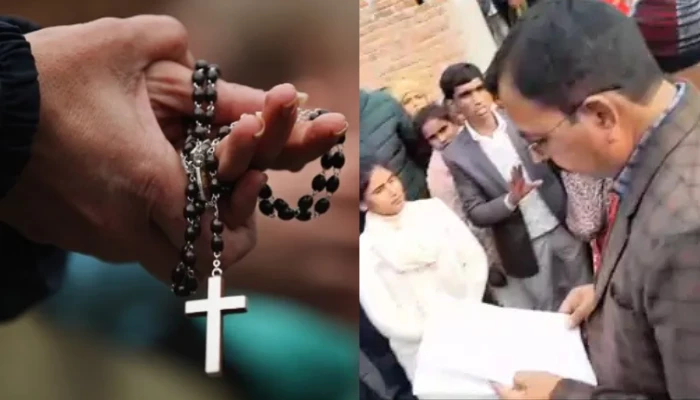
Case Summary
In Unnao, UP, a Christian resident, along with other Christian missionaries, was caught holding illegal prayer meetings to convert 70-80 Hindu men and women on 04th January 2026. As per reports, Neeraj Kumar Raidas, a Christian resident of Unnao village, along with Christian missionaries, was holding a prayer meeting at his home without permission, during which a large number of Hindu families were converted. Around 70 to 80 Hindu men and women were attending the prayer meeting. Upon receiving information from the villagers, members of the Bajrang Dal reached the spot and found that the men and women present inside were being instigated in the name of Sanatan Dharma. When the Bajrang Dal protested, a few women wearing white saris came forward and blocked the entry. Fearing a riot, the police were informed. When the police arrived, they were also not allowed to enter. First, the gate was closed from inside, after which some women wearing white saris came and stood at the gate. This forced the police to retreat. Meanwhile, angry villagers raised slogans against the ongoing conversions and began reciting the Hanuman Chalisa while sitting at the spot. Additional police personnel were called from the police station to evict the people present inside. The Naib Tehsildar asked for the necessary documents and permissions to conduct the prayer meeting, but it was found that no permission had been obtained. They also lacked a No Objection Certificate for the meeting. Section 144 was in force in the area. Upon enquiry, it was found that Neeraj Kumar had been attempting to operate a church for a long time. Last year, after facing opposition from villagers, he began constructing a permanent house with a lintel outside the village to operate the church. While the pillars were being erected, a petition was submitted to Sub-Divisional Magistrate Sadar Kshitij Dwivedi demanding action, but no official visited the site. Consequently, Neeraj began converting people by constructing a church-like house. Dahi Police Station in-charge Gyanendra Singh stated that the matter was being investigated from every angle. He added that if any case of religious conversion were found, strict action would be taken. The station in charge also appealed to the villagers to maintain peace.
Why it is Hate Crime ?
The primary category selected is Predatory Proselytisation. The secondary categories selected are, first, 'Attempting to convert by denigrating Hinduism'. In several cases, Hindus are converted, or an attempt is made to convert Hindus by denigrating their faith, Hinduism. In such cases, the Hindus associate with the non-Hindu perpetrators often by choice,e and then, the attempt to convert them by insulting their faith, showing the faith down, etc. begins. An example of this would be a non-Hindu gathering where the Hindus are attending the gathering of their own free will. However, once they attend the gathering, there is an explicit attempt to convert them by abusing their faith and hailing the faith of the perpetrator. The denigration of the Hindu faith is often based on misrepresentation of the Hindu faith, its doctrine and scriptures, and an insult to espoused traditions, if not blatant lies about Hindu beliefs and ways. Such conversions or attempts at conversions are driven by animosity towards the Hindu faith and are therefore documented as religiously motivated hate crimes. The second sub- category selected is: Conversion/ attempts to convert by inducement. Predatory Proselytisation is not just limited to threat, harassment, force, and violence, but it also has contours of stealth. In several cases, the Hindu victim is exploited to convert, with non-Hindus taking advantage of their poverty. In such cases, the Hindu victim who is suffering financially is offered monetary benefits, including lucrative offers for jobs, health treatment, education, etc, to induce the victim into changing his/her religion. In such cases, the religious identity of the victim and the aim to disenfranchise him from his faith form the heart of the crime. Also, taking advantage of and exploiting an individual’s economic vulnerabilities is widely acknowledged as exploitation, forms of which are often penalised by law. Such cases, therefore,e are considered religiously motivated hate crimes since the victim’s religious identity forms the very heart of the crime itself. The third sub- category selected is Proselytisation by grooming, brainwashing, manipulation, or subtle indoctrination. Further, a tertiary category selected under it is: 'Pattern of targeting Hindus' Religious brainwashing essentially means the often subtle and forcible indoctrination to induce someone to give up their religious beliefs to accept contrasting,g regimented ideas. Religious grooming or brainwashing also involves propaganda and manipulation. It involves the systematic effort, driven by religious malice and indoctrination, to persuade “non-believers’ to accept allegiance, command, or doctrine to and of a contrasting faith. Cases of such grooming or brainwashing are far more nuanced than direct threats, coercion, inducement,nt and violence. In such cases, it is often seen that there is repeated, subtle, and continual manipulation of the victim to induce disaffection towards their own faith and acceptance of the contrasting faith of the perpetrator. While subtle indoctrination is widely acknowledged as predatory, an element which is often understated in such conversions or the attempts of such conversion is the role of loyalty and trust which might develop between the perpetrator and the victim. Fiduciary relationships are often abused to affect such religious conversion. For example, an educator transmitting religious doctrine of a competing faith to a Hindu student. The Hindu student is likely to accept what the teacher is transmitting owing to the existence of the fiduciary relationship. The exploitation of the fiduciary relationship to religiously indoctrinate victims would also be included in this category. Since the underlying animosity towards the victim’s faith forms the basis of predatory proselytization, such cases are considered religiously motivated hate crimes. This case is added to the tracker because Hindu villagers were targeted and converted by Christian evangelist Neeraj Kumar, along with other Christian missionaries, under the guise of prayer meetings. The Christian evangelists glorified Christianity while instigating the Hindus against Hinduism. Firstly, targeting Hindu villagers in this manner transforms aid into a tool of religious domination rather than genuine welfare. The repeated prayer meetings and insistence on attendance reveal a pattern of grooming and psychological manipulation rather than informed consent. Families were gradually drawn into missionary spaces where Hindu practices were discouraged, Christian doctrine was normalised, and emotional dependency was cultivated through claims of divine intervention. This slow and sustained process worked to replace indigenous belief systems with a new religious identity by eroding resistance over time. Such methods rely on repetition, authority projection, fear of divine punishment, and promises of salvation, all of which constitute subtle indoctrination rather than voluntary spiritual exploration. Secondly, what is presented as a simple prayer gathering inside a house is, in reality, a covert attempt at religious conversion. These are not genuine community prayers but calculated efforts to exploit the trust of Hindus and manipulate them into abandoning their faith. It is a well-recognised tool in organised Christian proselytisation networks. These gatherings usually employ songs, testimonies, and emotionally charged prayer sessions to influence and induce vulnerable individuals without openly declaring the underlying objective. By conducting such gatherings, the Christian evangelists sought to manipulate vulnerable Hindus, taking advantage of their emotional and social circumstances to push them towards conversion. Thirdly, the denigration of Hindu dharma, exploitation of poverty and illness, use of inducements, and sustained grooming through religious pressure establish this incident as a clear case of religious persecution. It reflects a broader pattern in which Hindu tribal communities are targeted precisely because of their vulnerability and strong indigenous faith traditions, making this not merely a conversion dispute but a hate-driven attempt to erase Hindu religious identity from a marginalised population. This is not an isolated case; several such cases where attempts were made to convert Hindu villagers have been reported in the area. These instances of targeted proselytisation activities stem from inherent hostility towards the victims' professed faith since Abrahamic faiths believe that any non-adherent to their faith is subject to being dehumanised till they convert, making it a religiously motivated crime against Hindus. Therefore, this case is being added to the hate crime database of the Hinduphobia Tracker. Disclaimer: The Hinduphobia Tracker records incidents based on when an event occurred or when the victim's ordeal began and not when the incident was reported in the media. Therefore, for documentation purposes, we have recorded the date as 04 January 2026. Disclaimer: The case mentions that between 70 and 80 individuals were baptised by the accused, but does not provide an exact number. For documentation purposes, we have recorded the maximum count of 80 victims in the database. It is also stated that both men and women were among those baptised, though no specific gender breakdown is provided. Therefore, we have evenly divided the count, recording 40 male and 40 female victims for the sake of consistency in documentation.
Victim Details
Total Victim
80
Deceased
0
Gender
- Male 40
- Female 40
- Third Gender 0
- Unknown 0
Caste
- SC/ST 0
- OBC 0
- General 0
- Unknown 80
Age Group
- Minor 0
- Adult 0
- Senior Citizen 0
- Unknown 80


Case Status
Unknown


Perpetrators Details
Perpetrators
Christian Extremists
Perpetrators Range
From 5 to 10
 Sources




