Hindu temple's rules violated, sanctity desecrated, and its priest attacked by miscreant in Tamil Nadu
 Chidambaram, Tamil Nadu, India
  3 January, 2026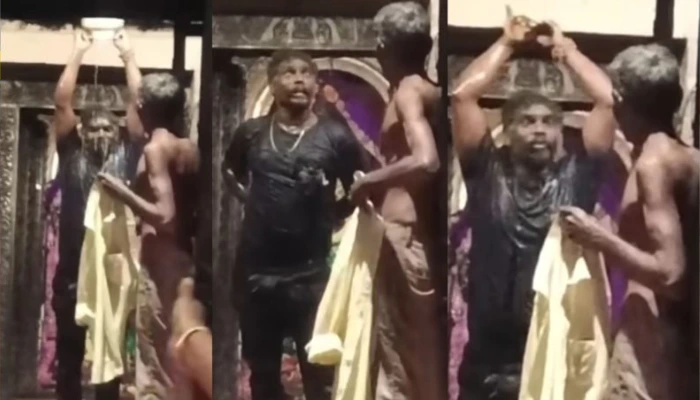
Case Summary
In Chidambaram, Tamil Nadu, a Hindu temple known as the Chidambaram Nataraja temple's sanctity and rules were violated by a miscreant who entered the Garbhagriha (sanctum sanctorum) of the Sivakamasundari shrine inside the temple. The accused also attacked the temple priest and a watchman who tried to oppose him. This occurred amidst the grand Arudra Darshan celebrations at the temple on 4 January 2026, when a tense situation prevailed after the miscreant wearing a black shirt entered the sanctum of the Sivakamasundari Amman shrine and caused a disturbance. The accused, carrying a pot of milk meant for worship and abhishekam (Hindu ritual of bathing the deity's idol), poured the milk over himself in front of the deity and proclaimed, “I am God.” When Selva Ganesh Dikshitar, a temple priest, and Kannan, a watchman present at the shrine, attempted to intervene and restrain him, the man attacked them with the pot. Both Selva Ganesh Dikshitar and Kannan sustained injuries in the incident and were admitted to a hospital, where they underwent treatment. Their condition remained stable. Members of the public present at the temple quickly apprehended the accused and handed him over to the Chidambaram Town Police. During interrogation, police identified the accused as Manikandan (35), a resident of the Valaragurchi area under Sendurai Taluk in Ariyalur district. Further investigation revealed that Manikandan was a graduate of Annamalai University. Police claimed that he suffered from mental health issues, which contributed to his behaviour at the temple. The police also informed Manikandan’s family about the incident and continued an intensive investigation. Security at the temple was also reviewed in the aftermath of the incident, especially in view of the large crowds attending the Arudra Darshan festival. Tamil Nadu BJP leaders condemned the incident and slammed the DMK government. BJP Tamil Nadu Youth Wing President Dr SG Suryah lambasted the DMK, saying that its ‘anti-Sanatan Dharma’ poison exploded as violence within temples. “Why did the police stand by with folded hands, watching the ongoing attacks on Hindus? It once again confirmed that Hindus in Tamil Nadu had no protection,” Suryah said. Coimbatore South BJP MLA Vanathi Srinivasan slammed the DMK government and its Hindu Religious and Charitable Endowments Minister Sekar Babu, who abused Hindus at the entrance of a temple a few days before this incident.
Why it is Hate Crime ?
The primary category selected in this case is- Attack on Hindu religious representations. The subcategory selected is- Breaking rules of place of worship. Sanatan Dharma is not a religion of one book, which is to say that while it has religious scriptures that form the central tenets of the faith, there are several traditions followed through thousands of years, mostly passed from generation to generation orally. One of these oral traditions or written traditions is the rules of specific temples. Certain temples have rules which are traditional rules, dependent on the worship of the presiding deities. These rules and traditions have been followed for thousands of years whether they find scriptural mention or not. Such traditions are based on the nature and rules of worship of the presiding deity of that temple. Any non-compliance of these traditions owing to animosity towards the faith or for the sake of activism stems not only from the lack of faith in the presiding deity but also disregard for the faith of the devotees of that deity/temple and implicit bias against the faith, the tradition and the deity itself. Since these specific traditions are central to the faith of the devotees of that specific temple and presiding deity, any non-compliance with these traditional rules would be considered a religiously motivated hate crime. The other subcategory selected is- Defiling religious customs. Sanatan Dharma is not a religion of one book, which is to say that while it has religious scriptures that form the central tenets of the faith, there are several traditions followed through thousands of years, mostly passed from generation to generation orally. There are several such customs and traditions that are followed by various Hindus and Hindu sects. Defiling of these traditions and customs is a breach of an individual or group’s religious practices. Such practices can range from dietary restrictions like not eating non-vegetarian food for a certain period of the year, not eating non-vegetarian food at all, not eating beef since the cow is considered holy in Hinduism, the sanctity of religious customs followed in the house (like many ISCKON devotees), etc. Any malicious action leading to the breach of such traditions or defilement of these traditions owing to animosity towards the faith or for the sake of activism stems not only from the lack of faith in the religion itself but also from disregard for the faith of the devotees who follow the customs/traditions and implicit bias against the faith, the tradition itself. Since these specific traditions are central to the faith of the devotees of that specific sect of Hindus, any non-compliance with these traditional rules would be considered a religiously motivated hate crime. Another primary category selected is- Attack not resulting in death. The subcategory selected is- Attacked for opposing radicals or trying to save victim. In several cases, Hindus are attacked for opposing religiously motivated crimes being committed against a fellow Hindu or simply for voicing an opinion opposing radical elements, who either have in the past or continue to persecute Hindus. In such cases, the initial attack against the victim, against which the Hindu was trying to defend the victim, would also need to be classified as a religiously motivated hate crime. Since the initial crime itself was religiously motivated and the subsequent crime of attempting to save the victim or speaking against the radical elements ends up inviting a violent attack, it would also be classified as a religiously motivated hate crime under this category. This case stands as a clear instance of religiously motivated crime against a Hindu place of worship and a targeted attack on a Hindu priest. It is added to the tracker because the perpetrator singled out the Chidambaram Nataraja Temple, a renowned Hindu site. Hindus view this temple as the divine abode of Lord Nataraja, a sacred space they hold inviolable. The perpetrator broke into the temple's innermost chamber (garbhagriha), a holy room only priests can enter to keep it pure. No outsiders are allowed there. This deliberate violation of sacred temple rules shows outright contempt for Hindu traditions and direct animosity towards Hindu sacred spaces. Furthermore, the perpetrator took milk meant for abhishekam, the Hindu ritual of bathing the deity's idol with sacred items like milk, poured it on himself, and said, "I am God". This act defiles and desecrates a key Hindu worship practice and insults Hindu beliefs. Such desecration of sacred Hindu rituals shows the perpetrator's deep-rooted animosity towards Hinduism, the Hindu community, and their places of worship. When the priest and watchman tried to stop the perpetrator, he hit them with the pot and injured them badly. This attack on Hindus protecting the temple shows that the perpetrator aimed to harm Hindus and damage their place of worship. Their efforts to defend the shrine led these Hindu victims to suffer violence too, making it a clear case of religiously motivated crime and violence. Overall, all these acts show that the perpetrator had no respect for Hindu temples or the faith itself, making this a clear religiously motivated hate crime. In this case, police claimed the perpetrator was 'mentally unstable', but this does not excuse the crime and points to a deliberate cover-up. In many cases where anti-Hindu perpetrators vandalise and desecrate Hindu places of worship, police use the excuse of mental health to protect the accused, saying the perpetrator acted because he was "mentally ill" or "unstable". Police often deny religious bias in crimes against Hindus by anti-Hindu perpetrators and blame mental health instead. They downplay low-level communal crimes to avoid questions about their own failures and prevent further tension in the area. In this case too, when the miscreant was caught desecrating the sanctity of a Hindu temple, police blamed his mental illness. Claiming mental illness to justify crimes against Hindu temples raises serious questions. If the perpetrator was truly unstable, why target only a Hindu place of worship and leave non-Hindu sites alone? This choice shows religious animosity, not mental health problems. The repeated use of this narrative to downplay crimes against Hindus reflects a strategic effort to whitewash religious hatred, obscuring the true motivations and intentions behind the attacks. Since this case meets key markers of a religiously motivated offence, it is added to the hate crime database of the Hinduphobia Tracker.
Victim Details
Total Victim
2
Deceased
0
Gender
- Male 2
- Female 0
- Third Gender 0
- Unknown 0
Caste
- SC/ST 0
- OBC 0
- General 1
- Unknown 1
Age Group
- Minor 0
- Adult 2
- Senior Citizen 0
- Unknown 0


Case Status
Arrested


Perpetrators Details
Perpetrators
Others
Perpetrators Range
One Person
Perpetrators Gender
male
 Sources




