Hindus and Hindu organisations branded as terrorists by Muslim man; threaten to bomb Hindu activist when confronted
 Moradabad, Uttar Pradesh, India
  2 January, 2026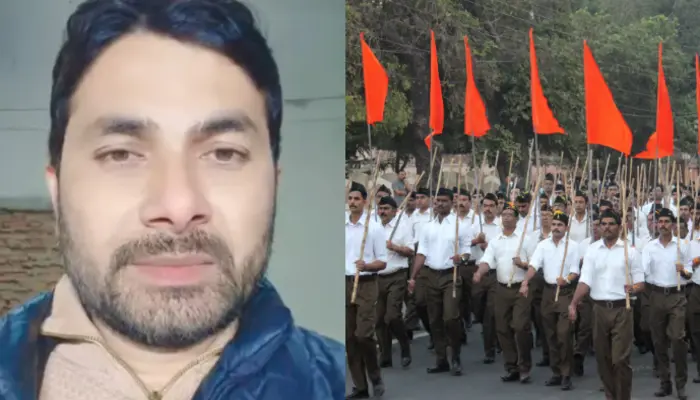
Case Summary
In Moradabad district, Uttar Pradesh, Hindu sentiments were insulted after Hindu organisations were called terrorist organisations by a Muslim man named Sharafat Ali. The accused also gave death threats to Hindu activists when they attempted to question him. According to reports, the accused, Sharafat Ali, the city president of the Azad Samaj Party, circulated a video on social media in which he identified himself as a resident of Bhojpur Dharampur and described Hindu organisations, including the Rashtriya Swayamsevak Sangh, Vishwa Hindu Parishad and Bajrang Dal as terrorist organisations. He also branded Hindus as terrorists. These remarks caused widespread anger within the Hindu community. Furthermore, when VHP district president Sachin Vishnoi contacted the accused regarding the video, the accused issued death threats, declaring that he would kill him by bombing, which further intensified concerns over public safety. Subsequently, a complaint was filed by Kishan Pal Singh, District Minister of the Vishwa Hindu Parishad (Moradabad Rural), on behalf of the organisation, stating that the video had hurt Hindu religious sentiments and disturbed communal harmony. Acting on the complaint, the police registered an FIR under Sections 299 and 351(3) of the Indian Penal Code, took the accused into custody, and interrogated him while examining social media content, videos and call records. A challan was issued, and Sharafat Ali was produced before the court, after which he was sent to jail.
Why it is Hate Crime ?
This case has been added to the tracker under the primary category- Hate Speech against Hindus. The subcategory selected is- Anti-Hindu slurs, mocking faith. Anti-Hindu slurs and the deliberate mocking of the Hindu faith owing to religious animosity involve the usage of derogatory terms, stereotypes, or offensive references to religious practices, symbols, or figures. One of the common anti-Hindu slurs used against Hindus is “cow-worshipper” and “cow piss drinker”. The intention of using this term is to demean and mock Hindus as a group and their religious beliefs since Hindus consider the cow holy. Additionally, some symbols and the slurs attached to them have a historical context that exacerbates the insult, hate, stereotyping, dehumanisation and oppression against Hindus. Cow worship has been used for centuries to denigrate Hindus, insult their faith and oppress Hindus specifically as a religious group. There has been overwhelming documentation about how cow slaughter has been used to persecute Hindus with cow meat being thrown in temples and places of worship. There has also been overwhelming documentation where cow meat (beef) has been force-fed to Hindus to either forcefully convert them to Islam or denigrate their faith. Apart from cow worship, the Swastika – which holds deep religious significance for the Hindus – has also been misinterpreted and distorted to use as a slur against Hindus. Similarly, the worship of the Shivling has been used by supremacist ideologies and religions to denigrate Hindus owing to religious animosity. Such slurs and denigration stem out of inherent animosity and hate towards Hindus and their faith, therefore, it is categorised as hate speech targeted at Hindus specifically owing to their religious identity. The other sub-category selected is - Violent threats. Violent threats, explicit, implicit or implied, is the most dangerous form of hate speech since it goes beyond discriminatory and prejudicial language to express the intent of causing harm to an individual or a group of people based on their religious identity and faith. There could be several different kinds of threats that are issued to Hindus based on religious animosity. An explicit threat would mean the direct threat of violence towards an individual Hindu, a group of Hindus or Hindus at large. Physical violence, death threats, threats of destruction of property belonging to Hindus and threats of genocide would mean explicit threats against Hindus for their religious identity. Implicit threats may not be a direct threat but implied through the use of symbols of actions – for example – in the Nupur Sharma case, other than explicit threats, there were also implicit threats when Islamists took to the streets to burn and beat her effigies. It implies that they want to do the same to Nupur Sharma – thereby is considered an implicit threat. Violent threats can be delivered in person, through letters, phone calls, graffiti, or increasingly through social media and other online platforms. It would be important to understand that a threat – explicit or implicit, online or offline – to an individual who happens to be a Hindu does not qualify as a religiously motivated threat. Such a threat, while vile and dangerous, could be owing to non-religious reasons and/or personal animosity. To qualify as a religiously motivated threat, it would need to exhibit an indication that the individual is being targeted for religious reasons and/or owing to his/her religious identity as a Hindu. This case has been added to the tracker because the actions of Sharafat Ali were directed at Hindus and the Hindu organisation as a religious collectivity and were motivated by hostility towards their religious identity, rather than any individual dispute. By calling Hindu organisations such as the Rashtriya Swayamsevak Sangh, Vishwa Hindu Parishad and Bajrang Dal as terrorist organisations and explicitly referring to Hindus themselves as terrorists, the accused sought to stigmatise and demonise an entire religious community. The statements were made on social media, ensuring wide dissemination and amplifying their impact, thereby creating an atmosphere of fear, hostility and communal provocation against the Hindu community. By publicly calling Hindus terrorists, he incited anger and fear, stoked communal tensions, and sought to delegitimise their religious identity. It was not merely an insult but a deliberate attack on Hindu religious sentiments, constituting a clear instance of religion-based hostility. It is pertinent to note that Muslim extremists harbour specific animosity towards Hindus and their faith and also view India as a Hindu collectivity. The very basis of the partition of India was that the Muslims believed that Islam was a nation unto itself, which could not survive with a Hindu collectivity like India. Thus, when Muslims abuse Hindus or Hindu organisations, it is due to religious animosity rather than any personal dispute with those people. Furthermore, the accused also issued death threats and bomb threats to Sachin Vishnoi when he attempted to contact the accused regarding the video. This further demonstrated his hatred and intent to intimidate and silence members of the Hindu community through violence and terror. This demonstrated a clear intent to intimidate and terrorise the Hindu community through the threat of lethal violence. The combination of publicly demonising Hindu organisations and directly threatening a prominent Hindu activist highlights the religious motivation behind the act, showing that the purpose of the crime was to instil fear, disrupt communal harmony, and punish the Hindu community for its religious identity. In recent times, social media has increasingly become a platform for anti-Hindu hate, with derogatory memes, videos, and messages targeting Hindu religious symbols, practices, and deities. Such content is recognised as part of a broader pattern of Hinduphobia and religious hate crimes online. The conduct not only insulted Hindu religious sentiments but also attempted to normalise the portrayal of Hindus as legitimate targets of suspicion and violence. This deliberate targeting of Hindus firmly establishes this act as a religiously motivated hate crime; therefore, it is being categorised under the hate crime database. Disclaimer: The Hinduphobia Tracker records incidents based on when an event occurred or when the victim's ordeal began. It is important to clarify that none of the media sources covering this case has specified the exact date when the video was posted. Therefore, for documentation purposes, we have recorded the date based on when the incident was reported in the media, 3 January 2026.
Victim Details
Total Victim
1
Deceased
0
Gender
- Male 1
- Female 0
- Third Gender 0
- Unknown 0
Caste
- SC/ST 0
- OBC 0
- General 1
- Unknown 0
Age Group
- Minor 0
- Adult 1
- Senior Citizen 0
- Unknown 0


Case Status
Arrested


Perpetrators Details
Perpetrators
Muslim Extremists
Perpetrators Range
One Person
Perpetrators Gender
male
 Sources




