Hindu priest subjected to death threats and violent attack by armed Muslim mob over false blasphemy allegations
 Chittagong Division, Bangladesh
  3 January, 2026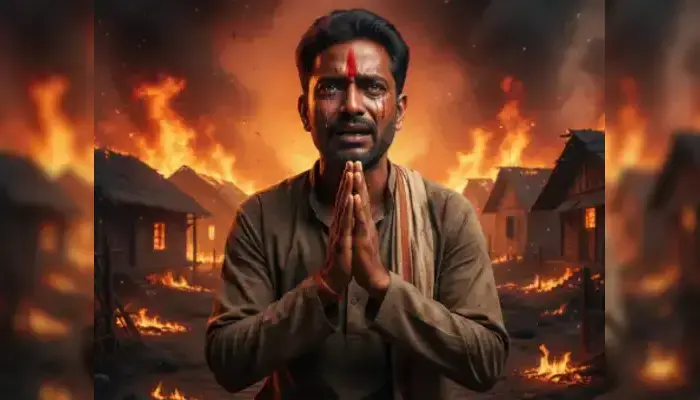
Case Summary
In the Chandpur district of Chittagong division, Bangladesh, a Hindu priest named Anik Goswami was forced to flee the country and take refuge in India after facing sustained death threats and a violent mob attack by members of the Muslim community over false blasphemy allegations. According to the victim, Anik Goswami, served as a priest at the Chaitanya Mahaprabhu temple in Puranbazar and conducted Bhagavad recitals. He received a death threat on his mobile phone from an unknown number in March 2025, claiming that he had insulted the Prophet. The phone call was accompanied by a fabricated screenshot of an objectionable social media post, which he had never written. Despite approaching the Chandpur police station and reporting the threat, no protection or remedial action was provided. Within days, the fabricated post was circulated widely on social media. Approximately 600 armed Muslim mob gathered outside the temple where Goswami lived with his family, openly declaring their intent to kill him for insulting the Prophet. As the mob surrounded the temple, Goswami hid within the premises before fleeing to save his life, while the attackers vandalised and ransacked the temple complex. Video footage later surfaced showing the mob outside the temple, with protesters shouting threats as police presence failed to prevent the escalation. The group responsible for the attack included members linked to Jamaat-e-Islami and its student and affiliate organisations. Goswami subsequently crossed into India through the India–Bangladesh border and went into hiding, stating that returning to Bangladesh would result in his death. His wife and child were left behind in Bangladesh, without financial support or security, after the family home was abandoned. Goswami stated that his persecution stemmed from his propagation of Sanatan Dharma and his association with the ISKCON movement, asserting that the objective of the extremists was to drive Hindus out of Bangladesh entirely. This incident reflects a troubling and recurring pattern across Bangladesh, where blasphemy accusations, often unverified or entirely fabricated, are weaponised to target Hindu minorities. Such cases are frequently followed by orchestrated campaigns of intimidation, social exclusion, and, in some instances, outright violence. The use of blasphemy as a tool for communal targeting not only endangers individual lives but also undermines the safety and rights of entire minority communities. A fresh wave of anti-Hindu violence prevailed across Bangladesh following the death of Sharif Osman Bin Hadi. This escalation occurred against the backdrop of ongoing anti-Hindu violence that had persisted since the ouster of the Sheikh Hasina government in August 2024, during which Hindu homes, temples, and religious spaces were repeatedly attacked, and the Hindu community faced intimidation, arson, and mob attacks. In the aftermath of Hadi’s death, Hindu homes were selectively targeted and set ablaze in multiple localities by Muslim mobs, forcing families to flee and rendering many homeless. The violence was not sporadic but patterned, with Muslim mobs targeting Hindu neighbourhoods, properties, and religious symbols with impunity. One of the many victims of this wave of violence was a Hindu man named Dipu Chandra Das, who was brutally lynched by a Muslim mob over false allegations of blasphemy. Such targeting of innocent Hindus over fabricated charges illustrated the vulnerability of the Hindu minority under conditions of rising communal hostility. Posters and written materials calling for the extermination of Hindus were displayed in public spaces, signalling an alarming normalisation of genocidal rhetoric. Combined with acts of physical violence, arson, and vandalism, these developments demonstrated a coordinated campaign designed to terrorise the Hindu community and assert Islamic dominance. Notably, Sharif Osman Bin Hadi was a Muslim political activist and student leader known for his anti-Hindu and anti-India stance. He was actively involved in the political unrest that followed the fall of Sheikh Hasina’s government and was killed in Dhaka in December 2025 during clashes, after which Hindus were blamed and subsequently targeted.
Why it is Hate Crime ?
This case has been added to the tracker under the primary category of: - Attack not resulting in death. Within it, the sub-category selected is: - Attacked over 'Blasphemy'. Blasphemy essentially refers to the desecration of anything which is held sacred/holy to a group of people. However, for religious supremacist groups, the elements of ‘blasphemy’ are ever-changing, shifting and expanding – leading to infringement on the rights of other religious groups, freedom of speech and expression, threats and even physical violence. There are instances where blasphemy is also used as a dog whistle to target Hindus owing to intrinsic animosity towards Hinduism. There are several instances where stating truths as mentioned in the non-Hindu doctrine itself has led to unmitigated violence against Hindus. There have also been instances where non-Hindus have themselves created a ‘blasphemous’ situation, like placing a Quran in a temple, to use it as an excuse to attack Hindus. Essentially, Blasphemy charges are often made up and/or are used to shut down any form of criticism of non-Hindu faiths and as a tool to target Hindus. Any physical violence over Blasphemy charges against Hindus are foundationally based on animosity for Hindus and their faith owing to religious supremacist ideologies, therefore, such attacks would be documented as religious motivated hate crimes under this category. The other sub-category selected here is: - Attacked for Hindu identity. In several cases, Hindus are attacked merely for their Hindu identity without any perceived provocation. A classic example of this category of religiously motivated hate crime is a murder in 2016. 7 ISIS terrorists were convicted for shooting a school principal in Kanpur because they got ‘triggered’ seeing the Kalava on his wrist and tilak that he had put. In this, the Hindu victim had offered no provocation except for his Hindu religious identity. The motivation for the murder was purely religious, driven by religious supremacy. Such cases where Hindus are targeted merely for their religious identity would be documented as a hate crime under this category. The other primary category selected here is - Attack on Hindu religious representations. Within it, the sub-category selected here is - Attack on temples. In Hinduism, a temple is the abode of the Deity. The Deity in the Temple is consecrated, thereby, making it a real, breathing entity. Hindus believe that not just the Deity but the temple premises itself are sacred to Hindus since Hindus hold the faith that the entire Temple space is an amalgamation of the divine energy of the deity. Given the central significance of Temples in Hindu Dharma, any attack against a Hindu Temple or its peripheral premises is an attack on the faith itself and is born out of animosity towards the faith, of which, the Temple is a central tenet. Any manner of attack against a Temple and/or its premises would therefore be considered a religiously motivated hate crime. The removal of Sheikh Hasina from power in Bangladesh on August 5, 2024, escalated the persecution and marginalisation of the Hindu minority in the predominantly Islamic nation, intensifying what can be described as a silent genocide. Since her exile, Muslim radicals have carried out unchecked atrocities against Hindus, including physical violence, the destruction of temples and religious symbols, and the systematic displacement of Hindus from their ancestral lands. Hundreds of attacks on Hindu temples, shops, and businesses have been recorded following Sheikh Hasina's removal as Prime Minister. Many Hindus have been brutally murdered or injured in Muslim mob attacks. This widespread persecution of Hindus only escalated after the killing of Sharif Osman Bin Hadi, an anti-Hindu, anti-India activist. After Hadi's death, Muslim mobs unleashed a violent rampage, selectively killing Hindus, torching their homes, issuing death threats and genocidal calls, and desecrating Hindu temples. The Hindu priest, Anik Goswami, who was targeted and attacked by a Muslim mob following false allegations of blasphemy against him, placing his life under immediate threat and resulting in an organised attempt to attack him, was one of the several Hindus who became a target of this ongoing onslaught. This was not an isolated incident but part of a larger, entrenched pattern of systemic religious persecution. Such allegations, often fabricated or unverified, are used to legitimise hate crimes and social ostracism against the Hindu community. This incident reflected a clear instance of religiously motivated targeting rooted in hostility towards his Hindu identity. Blasphemy laws, particularly in Muslim-majority countries like Bangladesh, are routinely weaponised to target Hindus. Even unverified rumours circulating on social media are sufficient to mobilise violent mobs, leading to attempted lynchings, destruction of Hindu religious spaces, and forced displacement. In this case, the rumour accusing Anik Das of insulting Islam rapidly escalated into mob violence, culminating in an attack on a Hindu temple where he had sought shelter, underscoring how such accusations function as instruments of collective punishment against the Hindu community. More often than not, especially during these waves of targeted violence, Islamist groups just need an excuse to attack non-Muslims, particularly Hindus. And that excuse is frequently "blasphemy." It has become a common and convenient trigger, fabricated or exaggerated, to justify a Muslim mob action against Hindus. The criteria for what constitutes blasphemy keep shifting, and in most cases, there's no actual offence, just a pretext born out of deep-seated animosity toward Hindus and their beliefs. The flexibility and vagueness of what constitutes blasphemy allow Muslim extremists to weaponise it at will, making Hindus and other minorities easy targets. Historically, blasphemy accusations have been used by Islamists to incite violence, settle personal scores, or intimidate Hindus into silence and submission. The disproportionate targeting of Hindus through such accusations is neither accidental nor incidental but reflects an underlying structure of religious prejudice, where mobs are mobilised to enforce ideological conformity through fear. The vandalisation of the Hindu temple during this incident further highlighted the collective nature of the hostility, extending beyond the individual victim to the broader Hindu community. The attack was not limited to the individual victim, as the Muslim mob also targeted the Hindu temple where Anik Goswami worked as a priest. The Muslim mob vandalised the temple and ransacked its premises. The temple as an institution holds immense spiritual importance in the Hindu faith. For Hindus, temples are not mere physical structures; they are sanctified spaces believed to embody the divine presence of Hindu deities. Such acts of violence against sacred spaces were not isolated incidents of destruction but reflected a broader hostility towards Hindu beliefs, practices, and symbols, reinforcing the communal nature of the attack. The attack on Anik Goswami, therefore, formed part of a continuing pattern of religiously motivated hate crimes against Hindus in Bangladesh, similar to previous incidents involving Dipu Chandra Das. Given that the core motivation of the attack stemmed from religious animosity and the weaponisation of blasphemy allegations, this case has been added to the Hate Crime database of the Hinduphobia Tracker. Disclaimer: It is important to clarify that none of the media sources covering this case have specified the exact date when the victim's ordeal began, though it is mentioned that he received the death threat in March 2025. Thus, to document this case, we have used an indicative date—4 March 2025—as a placeholder to represent the beginning of his suffering. While media coverage of the incident emerged on 4 January 2026, the Hinduphobia Tracker records the incident based on when the victim’s ordeal began, not when it was reported.
Victim Details
Total Victim
1
Deceased
0
Gender
- Male 1
- Female 0
- Third Gender 0
- Unknown 0
Caste
- SC/ST 0
- OBC 0
- General 1
- Unknown 0
Age Group
- Minor 0
- Adult 1
- Senior Citizen 0
- Unknown 0


Case Status
Unknown


Perpetrators Details
Perpetrators
Muslim Extremists
Perpetrators Range
From 10 to 100
Perpetrators Gender
unknown
 Sources




