Missionary school object to Hindu student's tilak, chops off his shikha
 Ballia, Uttar Pradesh, India
  1 May, 2024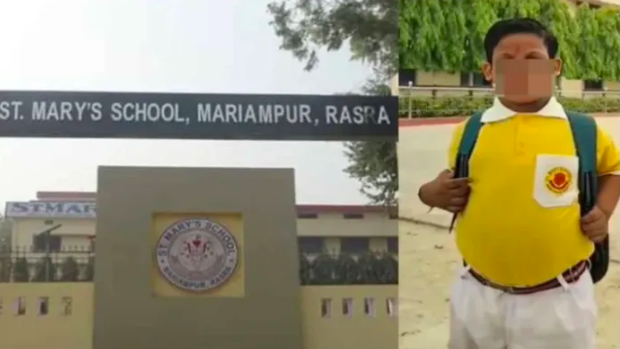
Case Summary
A police complaint was filed against a Missionary school in Ballia, Uttar Pradesh, after objections were raised over a Hindu student wearing a tilak. The school, St. Mary’s in the Mariampur Raghopur area, is reportedly run by Christian missionaries. The student, Prabhakar, a class 4 student, wears a braid and tilak as part of Hindu tradition. When the class teacher objected to Prabhakar's attire, it led to the cutting of his shikha with scissors. It was also said that not only the class teacher but also the principal misbehaved with the child’s mother when she went to confront them. Both of them said, “Do whatever you want.” The father, Vivekananda Singh, accused St. Mary’s School of insulting Hinduism and forcing religious conversion. An FIR has been registered against the principal, Sister Mercy Das, and teacher under relevant sections of the IPC, and the Ballia Police have initiated an investigation.
Why it is Hate Crime ?
This particular case has been classified as a religiously motivated hate crime under two prime categories- 'Restriction/ban on Hindu practices' and 'Predatory Proselytisation'. Under Predatory Proselytisation, the sub-category relevant in this case is 'Attempting to convert/converting by denigrating Hinduism.' In several cases, Hindus are converted or an attempt is made to convert Hindus by denigrating their faith, Hinduism. In such cases, the Hindus associate with the non-Hindu perpetrators often by choice and then, the attempt to convert them by insulting their faith, showing the faith down etc begins. An example of this would be a non-Hindu gathering where the Hindus are attending the gathering of their own free will. However, once they attend the gathering, there is an explicit attempt to convert them by abusing their faith and hailing the faith of the perpetrator. The denigration of the Hindu faith is often based on misrepresentation of the Hindu faith, its doctrine and scriptures and insult to espoused traditions if not blatant lies about Hindu beliefs and ways. Such conversions or attempts at conversions are driven by animosity towards the Hindu faith and are therefore documented as religiously motivated hate crimes. In this case, the victims whose parents accused the missionary school of religious conversion were children, which essentially means that the element of consent and genuine change of conscience was missing ab initio. The accused, who were teachers in this case, subtly tried to influence the impressionable minds of the children by denigrating Hindu religious symbols like tilak and the Sanatan braid. It is a well-established fact that children are more susceptible to manipulation since they are still developing emotionally, cognitively, and socially. Their brains are not fully matured, making them more vulnerable to influence and less capable of critically evaluating information. Moreover, subtle manipulation tactics can be difficult to detect, especially when they are employed by trusted authority figures in positions of influence. This makes it challenging for parents, to identify and address instances of religious manipulation in schools. Since the underlying offence in this case is against children of a specific faith and involves subtle tactics of indoctrination, which obviously stems from a bias against the Hindu faith, this case has been documented as a hate crime. The second sub-category that this is being added to is 'Proselytisation by brainwashing, grooming, manipulation or subtle indoctrination'. Religious brainwashing essentially means the often subtle and forcible indoctrination to induce someone to give up their religious beliefs to accept contrasting regimented ideas. Religious grooming or brainwashing also involves propaganda and manipulation. It involves the systematic effort, driven by religious malice and indoctrination, to persuade “non-believers’ to accept allegiance, command, or doctrine to and of a contrasting faith. Cases of such grooming or brainwashing are far more nuanced than direct threats, coercion, inducement and violence. In such cases, it is often seen that there is repeated, subtle and continual manipulation of the victim to induce disaffection towards their own faith and acceptance of the contrasting faith of the perpetrator. While subtle indoctrination is widely acknowledged as predatory, an element which is often understated in such conversions or the attempts of such conversion is the role of loyalty and trust which might develop between the perpetrator and the victim. Fiduciary relationships are often abused to affect such religious conversion. For example, an educator transmitting religious doctrine of a competing faith to a Hindu student. The Hindu student is likely to accept what the teacher is transmitting owing to existence of the fiduciary relationship. The exploitation of the fiduciary relationship to religiously indoctrinate victims would also be included in this category. Since the underlying animosity towards the victim’s faith forms the basis of predatory proselytization, such cases are considered religiously motivated hate crimes. The case reveals that the Hindu victims were minors, indicating a lack of consent and genuine change of conscience. It is a well-established fact that children are more susceptible to manipulation since they are still developing emotionally, cognitively, and socially. Their brains are not fully matured, making them more vulnerable to influence and less capable of critically evaluating information. Moreover, subtle manipulation tactics can be difficult to detect, especially when employed by trusted authority figures in positions of influence. This makes it challenging for parents, to identify and address instances of religious manipulation in schools. In this case, the accused, teachers in a position of trust, demonstrated a clear animosity towards Hinduism by forcefully removing the Tilak and chopping off the Shikha of the student. Furthermore, the teachers covertly tried to push the children towards Christianity by distancing them from their religion and practices. This sort of harassment is rooted in animosity towards the victim’s religious identity. The second prime category relevant here is 'Restriction/ban on Hindu practices', under which the sub-category chosen is 'Restriction on expression of Hindu identity' An example of the state-affected prejudicial and targeted orders against the Hindu community would be a government denying the right of a Hindu or a group of Hindus to hold a religious procession owing to the animosity of non-Hindu groups. Denial of the religious right of the Hindus to assuage the non-Hindu group which harbours animosity to a point where it could lead to violence against Hindus is not only a failure of law and order but is a prejudicial order against Hindus, denying them their fundamental rights to express their religious identity. An example of a hate crime against Hindus by a non-Hindu would be a non-Hindu institution forcing its Hindu employees to abandon religious symbols that a Hindu would wear as an expression of faith owing to inherent prejudice against the faith professed by the victim or a non-Hindu group of people restricting a Hindu group from constructing a place of worship simply because the demography of the area in which the temple is being built is dominated by non-Hindus. Such actions are driven by religious animosity and/or prejudice against Hindus and their faith and would therefore be categorized as a hate crime.
Victim Details
Total Victim
1
Deceased
0
Gender
- Male 1
- Female 0
- Third Gender 0
- Unknown 0
Caste
- SC/ST 0
- OBC 0
- General 0
- Unknown 1
Age Group
- Minor 1
- Adult 0
- Senior Citizen 0
- Unknown 0


Case Status
Complaint registered


Perpetrators Details
Perpetrators
Christian Extremists
Perpetrators Range
From 2 To 5
Perpetrators Gender
female
 Sources




