Anti-Hindu slogans targeting Brahmins and Baniyas raised by Leftist-Ambedkarite students in Haryana
 Sonipat, Haryana, India
  25 March, 2024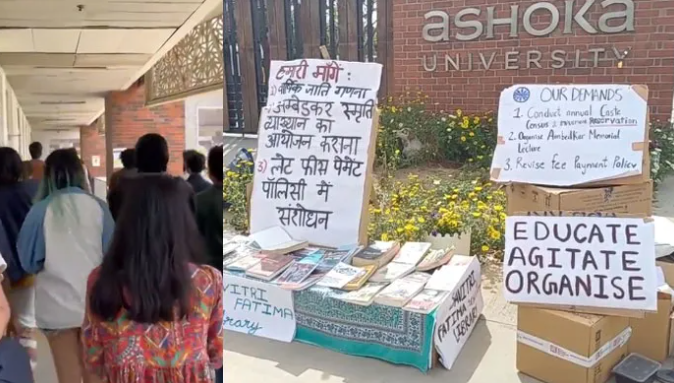
Case Summary
Anti-Hindu slogans targeting the Hindu community, particularly Brahmins and Baniyas, were raised by Leftist-Ambedkarite students at Ashoka University in Sonipat, Haryana. According to reports, on 26th March 2024, students at Ashoka University protested, raising Hinduphobic slogans and demanding a caste census and reservations. Videos showing students chanting slogans such as “Brahmin-Baniyawaad Murdabad” went viral on social media. Alongside abusing the Brahmin and Baniya communities, they also raised slogans including “Jai Bheem-Jai Meem” and “Jai Savitri-Jai Fatima”. Additionally, they called for zero penalties on late fees and events to honour Dr B.R. Ambedkar. The agitation, which lasted for seven days, echoed Rahul Gandhi’s call for a caste census. In response to the ‘Brahmin-Baniyawaad Murdabad’ slogans, netizens criticised the university for allowing such sloganeering on its premises. DD News journalist Prakhar Shrivastava questioned who was inciting the students with such hatred. A X user, Anshul Saxena, wrote, “This is from Ashoka University. The slogan is Brahmin-Baniyawaad Murdabad. First, they targeted Brahmins, now Baniyas. Anyone who thinks this is limited to certain castes is mistaken; eventually, caste by caste, they will target you. Their goal is to divide and attack Hindus.” Another X user, Mr Sinha, wrote, “Slogans like ‘Brahmin-Baniyawaad Murdabad’ are being raised in Ashoka University. They accuse Brahmins of atrocities in the past, but what about the Baniya community? The truth is, they don’t hate Brahmins or Baniyas or any other caste; they hate Hinduism. Such woke clowns deserve beIt treatment.” Despite the university’s promise to address the concerns of netizens, no disciplinary action was taken against the students for the Hinduphobic slogans. Notably, Ashoka University has a history of controversies. In January 2021, faculty member Neelanjan Sircar mocked Bhagwan Ram under the guise of criticising the Bharatiya Janata Party. Similarly, in August 2023, Ashoka University faced criticism over a flawed research paper making dubious claims about election manipulation. Although the university distanced itself from the paper, Congress leader Shashi Tharoor and leftist propagandists amplified it.
Why it is Hate Crime ?
This case is being recorded in the tracker under the primary category- Hate Speech against Hindus. The subcategory selected is- Anti-Hindu slurs, mocking faith. Anti-Hindu slurs and the deliberate mocking of the Hindu faith owing to religious animosity involve the usage of derogatory terms, stereotypes, or offensive references to religious practices, symbols, or figures. One of the common anti-Hindu slurs used against Hindus is “cow-worshipper” and “cow piss drinker”. The intention of using this term is to demean and mock Hindus as a group and their religious beliefs since Hindus consider the cow holy. Additionally, some symbols and the slurs attached to them have a historical context that exacerbates the insult, hate, stereotyping, dehumanisation and oppression against Hindus. Cow worship has been used for centuries to denigrate Hindus, insult their faith and oppress Hindus specifically as a religious group. There has been overwhelming documentation about how cow slaughter has been used to persecute Hindus with cow meat being thrown in temples and places of worship. There has also been overwhelming documentation where cow meat (beef) has been force-fed to Hindus to either forcefully convert them to Islam or denigrate their faith. Apart from cow worship, the Swastika – which holds deep religious significance for the Hindus – has also been misinterpreted and distorted to use as a slur against Hindus. Similarly, the worship of the Shivling has been used by supremacist ideologies and religions to denigrate Hindus owing to religious animosity. Such slurs and denigration stem out of inherent animosity and hate towards Hindus and their faith, therefore, it is categorised as hate speech targeted at Hindus specifically owing to their religious identity. In this instance, the anti-Hindu hate speech is clearly evident through the actions and statements of the students at Ashoka University. The slogans raised—such as “Brahmin-Baniyawaad Murdabad”—are explicitly Hinduphobic, targeting specific Hindu communities like Brahmins and Baniyas. However, it is imperative to understand that such targeted verbal abuse serves as a veneer for broader anti-Hindu sentiment. While some might argue that the slogans are directed only at these castes, it is well-established that Ambedkarite and leftist circles often propagate a narrative that vilifies the entire Hindu community under the guise of caste criticism. The aggressive targeting of Brahmins and Baniyas, therefore, is a strategic act of vilification aimed at creating division within the Hindu society, and by extension, attacking Hinduism itself. This movement has historically been used to undermine the unity of Hindus, presenting their faith as inherently oppressive and deserving of rejection, which makes this a textbook case of religiously motivated hate speech. Furthermore, these slogans and acts of abuse are not isolated incidents but part of a long-standing pattern of anti-Hindu activism linked to Ambedkarism and the leftist ecosystem in India. Such groups have consistently employed discourse that targets the entire Hindu community—demonising their gods, scriptures, and cultural practices—to advance their political narrative. The participation of such ideology in this current protest underscores a broader motive rooted in religious hostility towards the Hindu community. This overarching animosity makes this incident a definitive example of anti-Hindu hate speech. It is also essential to note that Ambedkarism, as a political ideology, fundamentally fosters opposition against Hindu identity and the Hindu way of life. While it ostensibly advocates for social justice, its core often manifests as hostility towards Hinduism, which it seeks to discredit and dismantle. Ambedkarites frequently indulge in activities such as abusing Hindu gods and goddesses, desecrating temples, and propagating anti-Hindu slurs—actions motivated by deep-seated religious animosity. When such groups openly participate in or endorse protests that shout anti-Hindu slogans, it becomes evident that their actions are driven by religious antagonism, aligning with their broader ideological goal of opposing Hindu religious and cultural identity. Overall, the case at Ashoka University exemplifies explicit Hinduphobia, where the targeted abuse of Brahmins and Baniyas serves as a cover for an underlying anti-Hindu agenda. The involvement of Ambedkarite and leftist groups, driven by their hostility towards Hinduism, further confirms the deeply rooted religious animosity. The sustained pattern of derogatory acts, combined with the openly expressed anti-Hindu slogans, makes this incident a stark manifestation of religiously motivated hate speech, warranting its inclusion in the hate crime database of the Hinduphobia Tracker.


Case Status
Unknown


Perpetrators Details
Perpetrators
Others
Perpetrators Range
Unknown
Perpetrators Gender
both
 Sources




