Hanuman Temple idol broken, priest assaulted by unknown man in Datia, MP
 Datia, Madhya Pradesh, India
  8 December, 2025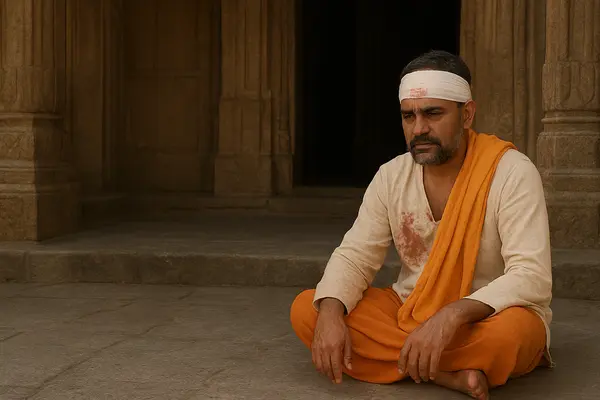
Case Summary
An unidentified man entered the Pola Pahad Hanuman Temple on Bhander–Chirgaon Road, Datia, Madhya Pradesh, on 9 December 2025, around 1:00 PM, and vandalised the consecrated murti of Lord Hanuman by breaking it into pieces. When the temple priest, Mahant Pappu Baba, tried to stop him, the man snatched the priest’s mobile phone, smashed it, and attempted to assault him before fleeing the spot. The incident triggered strong protests from residents. Several devotees gathered at the temple and later marched to the Bhander police station, where Mahant Pappu Baba submitted a written complaint. The police registered an FIR immediately under the relevant sections and began an investigation. Hindu organisations in Datia termed the act a deliberate attack on religious sentiments. They demanded the immediate arrest of the accused, stricter security for temples, and the installation of CCTV cameras at religious sites.
Why it is Hate Crime ?
This case has been added to the tracker under two primary categories - The first primary category being: Attack on Hindu religious representations; under which the first subcategory is: Attack on temples. In Hinduism, a temple is the abode of the Deity. The Deity in the Temple is consecrated, thereby, making it a real, breathing entity. Hindus believe that not just the Deity but the temple premises itself are sacred to Hindus since Hindus hold the faith that the entire Temple space is an amalgamation of the divine energy of the deity. Given the central significance of Temples in Hindu Dharma, any attack against a Hindu Temple or its peripheral premises is an attack on the faith itself and is born out of animosity towards the faith, of which, the Temple is a central tenet. Any manner of attack against a Temple and/or its premises would therefore be considered a religiously motivated hate crime. The second subcategory is: Desecration of Hindu religious symbol. Icons and symbols or a religious representation of a spiritual ideal are widely revered in Hinduism. Iconography is of vital significance in the Hindu milieu. It helps connect people’s spiritual beliefs with the real world. Iconography within the Hindu faith takes several shapes and forms. Murtis are of most significance to Hindus, to which daily rituals, prayers and offerings are done. Besides the murtis, there are several other symbols which have deep significance in the Hindu faith – the Om and Swastika for example. Since these Hindu religious symbols hold paramount importance in Hinduism, any desecration of symbols, icons, murtis, religious representations and manifestations, is driven by animosity towards the faith itself which manifests itself through these murtis, icons and symbols. Therefore, any desecration of these Hindu religious symbols and representations is considered religiously motivated hate crimes under this category. The second primary category is: Attack not resulting in death; under which the sub category is: attacked for opposing radicals or trying to save the victim. In several cases, Hindus are attacked for opposing religiously motivated crimes being committed against a fellow Hindu or simply for voicing an opinion opposing radical elements, who either have in the past or continue to persecute Hindus. In such cases, the initial attack against the victim, against which the Hindu was trying to defend the victim, would also need to be classified as a religiously motivated hate crime. Since the initial crime itself was religiously motivated and the subsequent crime of attempting to save the victim or speaking against the radical elements ends up inviting a violent attack, it would also be classified as a religiously motivated hate crime under this category. This incident qualifies as a hate crime because the actions of the accused were directed specifically at Hindu religious symbols and a Hindu place of worship, rather than being random or opportunistic. The man entered the Hanuman Temple on Pola Pahad in Datia and proceeded to vandalise the consecrated murti of Lord Hanuman, breaking it into pieces. Within the Hindu faith, a consecrated murti is not treated as a mere statue; it is regarded as the living embodiment of the deity. Therefore, intentionally damaging such a murti goes beyond property destruction and constitutes a direct assault on the religious beliefs and identity of the Hindu community. The temple itself is a sacred space for devotees, and any desecration within its premises is inherently understood as an act motivated by hostility toward the religion. This intent becomes even clearer from the fact that the accused did not simply leave after the vandalism; when the temple priest, Mahant Pappu Baba, attempted to intervene, the accused assaulted him. This shows aggression not only toward the religious symbol but also toward the religious custodian who tried to protect it, indicating that the offender’s hostility was tied directly to the religious context of the incident. Because the object of attack was a sacred Hindu murti, the location was a Hindu temple, and the victim who intervened was a temple priest, the incident aligns with the characteristics of a religiously motivated hate crime. Thus, the incident has been added to the tracker.
Victim Details
Total Victim
1
Deceased
0
Gender
- Male 1
- Female 0
- Third Gender 0
- Unknown 0
Caste
- SC/ST 0
- OBC 0
- General 1
- Unknown 0
Age Group
- Minor 0
- Adult 1
- Senior Citizen 0
- Unknown 0


Case Status
Complaint filed


Perpetrators Details
Perpetrators
Unknown
Perpetrators Range
One Person
Perpetrators Gender
male
 Sources




