Hindu students forced to remove kalava and tilak in missionary school premises in Udaipur
 Udaipur, Rajasthan, India
  9 December, 2025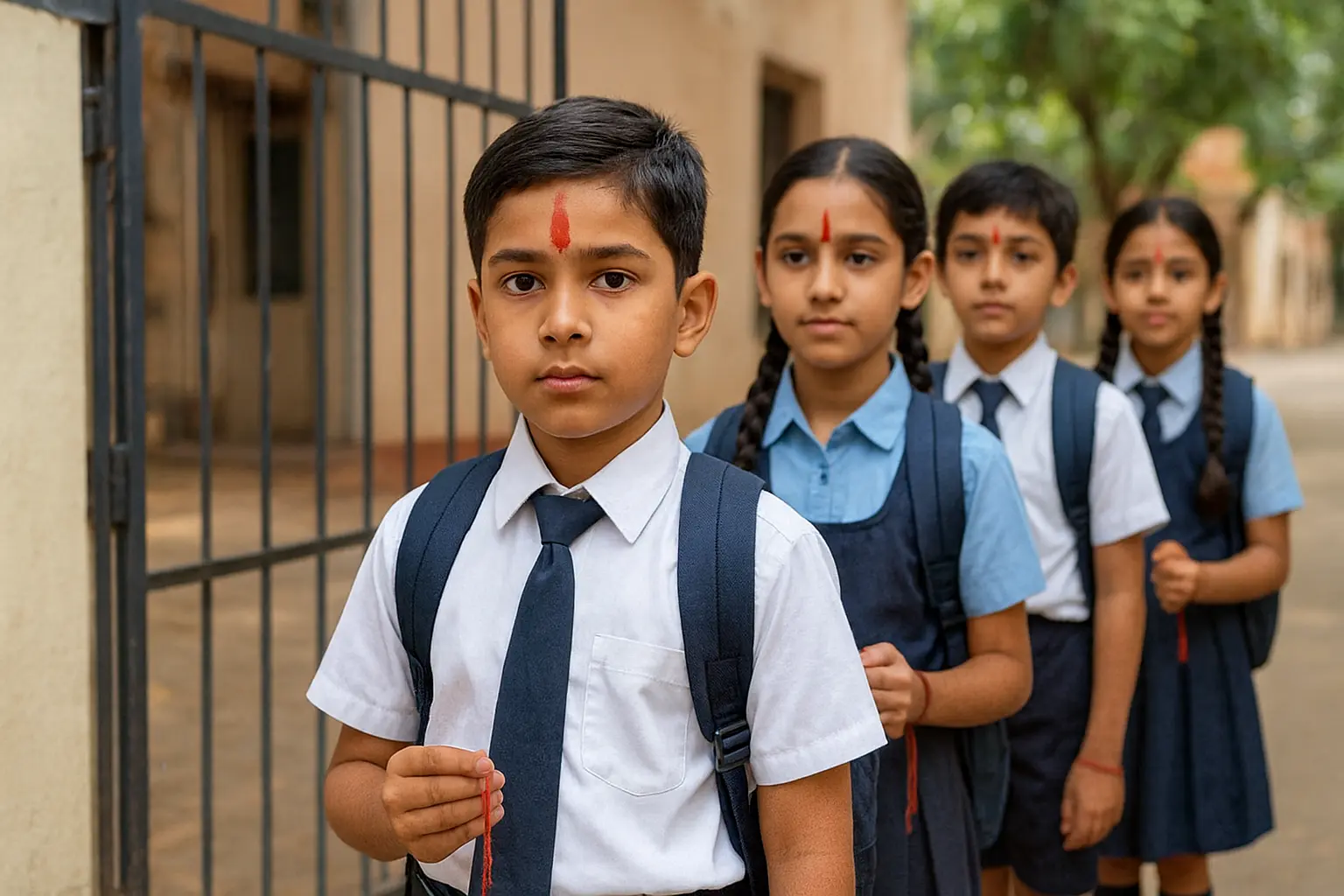
Case Summary
Several Hindu students were forced to remove their sacred threads (kalava) and tilak before entering the school premises at St. Gregorios Senior Secondary School in Udaipur. Parents reported that their children had been stopped at the gate and were told that such religious symbols would not be permitted inside the school premises. The directive caused immediate concern among Hindu families, who viewed it as a clear interference with their children’s religious practices. Parents were informed that the directive had been enforced by Vice-Principal Anil Goswami, who had been involved in similar complaints earlier, for which legal proceedings were already underway. Following the controversy, a large number of Hindu parents and community representatives gathered at the school to protest the restriction. They argued that the sacred thread and tilak were basic expressions of Hindu identity and that no institution had the authority to prohibit them. Parents also reported that their children had felt uncomfortable and singled out due to the action taken by the school staff. The matter escalated when parents confronted the school administration. Principal Subha Josh and Father Varghese Thomas engaged in discussions with the aggrieved families but were unable to provide a satisfactory explanation. Political representatives also reached the spot and supported the parents’ demand for accountability. Although the administration assured that the matter would be reviewed, the episode remained a point of concern within the Hindu community. Families maintained that such incidents should not be repeated and that students' religious identity must be respected at all times.
Why it is Hate Crime ?
The case has been added as a religiously motivated hate crime under two main categories of the tracker. The first category selected is: Restriction/ban on Hindu practices; within this the secondary category selected is: Restriction on expression of Hindu identity. Restricting religious practices by non-Hindu groups harbouring animosity towards Hindus or the State implementing targeted and/or prejudicial policies specifically against Hindus as a hate crime involves actions and/or policies that stop the religious expression in the form of processions, rituals, display of religious symbols, celebration of festivals targeted towards a specific religious group in this case the Hindus. Restrictive actions could include banning the expression/display of religious symbols, prohibiting certain religious practices, targeting religious gatherings, restriction on building places of worship, restrictions imposed on conducting religious rituals/puja etc and targeted and/or prejudicial policies by the state specifically against the Hindu community. International conventions too and the United Nations too classify restrictions on religious practices as violation of fundamental human rights. In India, the restrictions come from multiple sources. The restriction on religious practices could come from non-Hindu religious denominations owing to their intolerance and animosity towards Hindus, Hinduism and their religious practices and/or the state itself, when it clamps down on religious processions, religious practices and rituals of Hindus for reasons like ensuring that those who harbour animosity towards Hinduism don’t get ‘provoked’ into violence. The restriction of Hindu religious practices in order to assuage the intolerance of non-Hindu communities can be viewed as the denial of the fundamental rights of the Hindu community on an individual and community level. In this category, therefore, we would document restriction/ban on Hindu religious practices not just by non-Hindu groups but also the state. The second category selected is: Predatory proselytisation; within this, the secondary category selected is: Proselytisation by grooming, brainwashing, manipulation or subtle indoctrination; within this, the tertiary category selected is: Family claims grooming. Religious brainwashing essentially means the often subtle and forcible indoctrination to induce someone to give up their religious beliefs to accept contrasting regimented ideas. Religious grooming or brainwashing also involves propaganda and manipulation. It involves the systematic effort, driven by religious malice and indoctrination, to persuade “non-believers’ to accept allegiance, command, or doctrine to and of a contrasting faith. Cases of such grooming or brainwashing are far more nuanced than direct threats, coercion, inducement and violence. In such cases, it is often seen that there is repeated, subtle and continual manipulation of the victim to induce disaffection towards their own faith and acceptance of the contrasting faith of the perpetrator. While subtle indoctrination is widely acknowledged as predatory, an element which is often understated in such conversions or the attempts of such conversion is the role of loyalty and trust which might develop between the perpetrator and the victim. Fiduciary relationships are often abused to affect such religious conversion. For example, an educator transmitting religious doctrine of a competing faith to a Hindu student. The Hindu student is likely to accept what the teacher is transmitting owing to existence of the fiduciary relationship. The exploitation of the fiduciary relationship to religiously indoctrinate victims would also be included in this category. Since the underlying animosity towards the victim’s faith forms the basis of predatory proselytisation, such cases are considered religiously motivated hate crimes. In this particular incident, Hindu students were stopped at the gate and forced to remove their tilak and sacred threads (kalava), markers that carry deep spiritual and cultural meaning in Hindu tradition. By compelling minors to strip themselves of these symbols, the school sent a clear message that Hindu identity was unwelcome within its premises. This was not viewed by families as a one-off disciplinary action but as part of a pattern in which children were repeatedly discouraged from displaying any sign of their faith. Because the instructions came from teachers and school authorities, figures children instinctively trust, the incident involved an abuse of fiduciary power. When such authority is used to subtly condition minors to detach from their religious identity, it moves beyond simple rule-enforcement and enters the realm of grooming-based proselytisation. Families perceived the school’s behaviour as an attempt to normalise the erasure of Hindu symbols in a missionary environment, thereby weakening the child’s connection to their own faith through consistent psychological pressure rather than overt coercion. At the same time, the act directly restricted the expression of Hindu identity. Tilak and kalava are essential, everyday manifestations of Hindu belief, and selectively banning them amounts to discriminatory interference in the students’ constitutional right to practise their religion. When only Hindu symbols are targeted, the restriction reveals underlying prejudice rather than neutral policy. Crucially, the victims in this case were minors, an age group far more vulnerable to subtle manipulation, identity-shaping, and pressure from institutions. What may appear as a simple instruction to an adult becomes, for a child, a directive from an unquestioned authority figure with the power to shape self-perception and belief. For these reasons, hostility toward Hindu symbols, misuse of authority over impressionable children, subtle conditioning that undermined Hindu identity, and selective restriction of Hindu religious expression, incident is ocumented in the Hinduphobia tracker. Here, it is important to mention that in 2022, a massive controversy erupted in Karnataka, which took a national form, after Muslim women insisted that they should be allowed to wear burqas and hijabs in their schools and classrooms. At that time, the argument given by several politicians, social commentators, Hindu activists, and even the judiciary was that schools have the right to enforce uniform rules, since wearing uniforms brings harmony and equality in the classroom, and therefore, schools not allowing girls to wear hijab in the classroom is not religious discrimination, but merely an enforcement of widely accepted uniform norms. The pseudo-seculars and leftist groups may argue that a similar line of reasoning should be applied in this case. However, it becomes important to mention here that most uniform codes focus on standardising clothing and accessories like shoes, belts, and hair. A tilak and kalava do not change the appearance of the uniform itself. This religious symbol is benign and does not cause disruption or harm, raising serious concerns about the motivations behind such enforcement. When an ostensibly secular institution, such as a government school, imposes restrictions specifically targeting Hindu religious symbols, it reflects institutional prejudice against Hinduism. This form of targeted suppression echoes broader patterns where Hindu practices are curtailed under the guise of neutrality or discipline, often to appease other religious groups.


Case Status
Unknown


Perpetrators Details
Perpetrators
Others
Perpetrators Range
One Person
Perpetrators Gender
male
 Sources




