Hindus attacked by Muslim men and women for opposing disrespectful social media post on Shivaji Maharaj
 Saharanpur, Uttar Pradesh, India
  6 December, 2025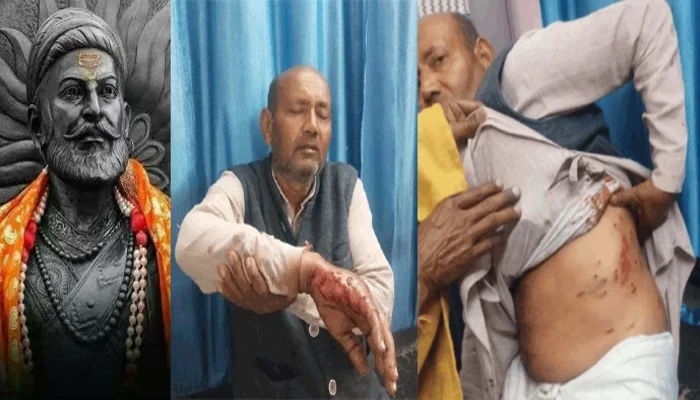
Case Summary
A Hindu youth named Rohit, the son of Mohkam Singh, was assaulted at his own home on 8 December 2025 by Zeeshan, Auris, Akram, Anees, Rais and several Muslim women. The attack took place after Rohit had asked Auris to remove an objectionable social media post he had uploaded the previous day, 7 December 2025, which contained derogatory remarks about Shivaji Maharaj. To defuse the situation, villagers gathered for a panchayat meeting. The situation changed abruptly when members of the Muslim group suddenly became aggressive during the discussion. One of the victims stated that a group of about 10–12 people arrived at the meeting armed with sticks, sharp-edged weapons, and illegal firearms. Satish, who was present, suffered a bullet injury to his hand while trying to shield himself, and additional pellets struck his waist. Another villager, Narendra, also sustained pellet injuries. According to the injured side, some of the attackers had brought outsiders with them and used both firearms and sticks during the assault. The shooting caused widespread panic, leading residents to call the police. Officers arrived quickly, and the injured men were taken to a community health centre before being referred to a higher medical facility for further treatment. Community members at the hospital stated that the firing had left residents, particularly those in the Hindu community, feeling targeted and intimidated. Police presence increased in the aftermath, and local leaders from Vishwa Hindu Parishad visited the injured to check on their condition and to request firm action against those responsible.
Why it is Hate Crime ?
This case has been added to the tracker under the first primary category: Attack not resulting in death. The first sub-category selected under this is: Attacked for opposing radicals or trying to save victim. In several cases, Hindus are attacked for opposing religiously motivated crimes being committed against a fellow Hindu or simply for voicing an opinion opposing radical elements, who either have in the past or continue to persecute Hindus. In such cases, the initial attack against the victim, against which the Hindu was trying to defend the victim, would also need to be classified as a religiously motivated hate crime. Since the initial crime itself was religiously motivated and the subsequent crime of attempting to save the victim or speaking against the radical elements ends up inviting a violent attack, it would also be classified as a religiously motivated hate crime under this category. The second sub-category selected under this is: Attacked for Hindu identity. In several cases, Hindus are attacked merely for their Hindu identity without any perceived provocation. A classic example of this category of religiously motivated hate crime is a murder in 2016. 7 ISIS terrorists were convicted for shooting a school principal in Kanpur because they got ‘triggered’ seeing the Kalava on his wrist and the tilak that he had put. In this, the Hindu victim had offered no provocation except for his Hindu religious identity. The motivation for the murder was purely religious, driven by religious supremacy. Such cases where Hindus are targeted merely for their religious identity would be documented as a hate crime under this category. The third subcategory selected is- Communal clash/attack Communal clash is a form of collective violence that involves clashes between groups belonging to different religious identities. For a communal clash between Hindus and non-Hindus to qualify as a religiously motivated hate crime, the trigger of the violence itself would have to be anti-Hindu in essence. For example, if there is a Hindu religious procession that comes under attack from a non-Hindu mob and after the initial attack, Hindus retaliate in self-defence, leading to a communal clash between the two religious communities. While at a later stage, both communities are involved in the clash/violence, the initial trigger of the violence was by the non-Hindu mob against the Hindus and therefore, it could safely be termed as an anti-Hindu violence. Further, the trigger would also have to be religiously motivated. In the cited example, the attack by the non-Hindu mob was against religious processions and therefore, can be concluded to be religiously motivated. In some cases, the trigger may be non-religious, however, it develops into religious violence against Hindus at a later stage. In such cases too, the foundational animosity towards Hindus becomes the motivating factor of the crime and therefore, it would be classified as a religiously motivated hate crime against Hindus under this category. The second primary category applicable is: Hate speech against Hindus. The subcategory under this is: Mocking/denigrating Hindu leaders. Hate speech is defined as any speech, gesture, conduct, writing, or display that is prejudicial against a specific individual and/or group of people, which leads to or may lead to violence, prejudicial action or hate against that individual and/or group. Religious leaders are often seen as representatives of the community, especially the community’s religious faith and beliefs. Mocking or denigrating a religious leader specifically owing to his religious identity and/or the religious rituals he observes can be considered hate speech because the motivating factor of the speech is animosity and/or dislike for what he represents – the religious beliefs and faith of the community. It is important to note that mere insulting words against an individual do not constitute hate speech. It is entirely possible that insulting words are used for an individual; however, the specific speech is not the result of religious hate and/or animosity towards the professed faith of the religious leader, but the individual himself. For the speech to be considered hate speech, the speech itself or the motivating factor behind the speech has to be religious in nature. Such speech, which denigrates Hindu religious leaders specifically owing to animosity towards the faith they profess and the community faith they represent, will be treated as hate speech under this category. This case qualifies as a hate crime against Hindus because the violence began with a direct assault on Hindu men inside their own village. Rohit, a Hindu youth, was attacked at his home by several Muslim men and women. The assault was intended to punish and intimidate him, sending a clear message that any Hindu who challenges radical conduct could face violent consequences. The violence escalated further during the panchayat meeting. Instead of resolving the dispute, a larger Muslim group arrived armed with sticks, sharp weapons and illegal firearms. They launched a coordinated attack targeting the Hindu side. Satish suffered a bullet injury to his hand, and pellets struck his waist. Narendra also sustained pellet injuries. The attackers had even brought outsiders, showing that the second assault was organised and deliberate. This incident qualifies as a communal attack not only because the violence was group based and targeted multiple Hindu men, but also because the initial trigger itself was religiously motivated. The entire conflict began when a Hindu man objected to the denigration of a revered Hindu figure. A religious insult was the starting point, and the subsequent violence unfolded along clear communal lines. The attackers responded as a group representing their religious identity, and the victims were targeted as a group representing theirs. This fulfils the criteria of a communal attack where both motive and mobilisation stem from religious hostility. The motive becomes clear when one examines what preceded the assault. The day before the violence, Auris, one of the attackers, had posted derogatory content about Chhatrapati Shivaji Maharaj on social media. When Rohit asked him to remove the insult, the hostility began. This shows that the confrontation was rooted directly in a religious and cultural provocation. Understanding the significance of this insult is important. In Hindu tradition, icons and revered figures represent dharma, cultural memory and civilisational identity. Chhatrapati Shivaji Maharaj stands as a protector of Hindu culture during the Mughal period and is celebrated for reviving temples, traditions and Hindu sovereignty. Disrespect toward him is understood by Hindus as a deliberate attack on their identity and dignity. When Rohit opposed this denigration, the accused group reacted violently. Their goal was not only to assault one individual but to intimidate and silence the wider Hindu community. The armed attack during the panchayat reinforces this motive, showing that the violence was communal, targeted and rooted in hostility toward Hindus who assert their identity. Such actions go beyond ordinary crime. They qualify as a hate crime because the victims were targeted for being Hindu and for defending Hindu values. They qualify as a communal attack because the trigger was religious, the attackers mobilised as a group along religious lines, and the violence targeted the Hindu community collectively. For these reasons, this incident is categorised as both a hate crime and a communal attack and is recorded accordingly in the Hinduphobia Tracker. Disclaimer: The case involves two separate instances of attacks on Hindu individuals. In both events, the exact number of attackers is not specifically mentioned. It was reported that 10 to 12 individuals were the aggressors during the panchayat event. For documentation purposes, we have recorded the maximum count of 12 perpetrators in the database. It is also stated that both men and women were among the attackers, though no specific gender breakdown is provided.
Victim Details
Total Victim
3
Deceased
0
Gender
- Male 3
- Female 0
- Third Gender 0
- Unknown 0
Caste
- SC/ST 0
- OBC 0
- General 0
- Unknown 3
Age Group
- Minor 0
- Adult 0
- Senior Citizen 0
- Unknown 3


Case Status
Complaint filed


Perpetrators Details
Perpetrators
Muslim Extremists
Perpetrators Range
From 10 to 100
Perpetrators Gender
both
 Sources




