Beheading threats from Muslim man to whoever opposes construction of 'Babri Masjid' at Murshidabad
 Murshidabad, West Bengal, India
  5 December, 2025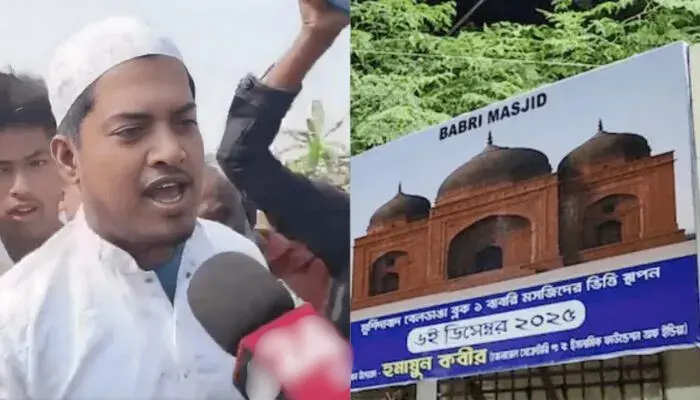
Case Summary
On 6th December 2025, during the foundation-laying ceremony for a mosque referred to as the ‘Babri Masjid’ in Bengal's communally sensitive Murshidabad, a video surfaced on social media showing a Muslim man making an alarming beheading threat against anyone who might oppose the construction of the mosque. The event, organised by ex-TMC MLA Humayun Kabir, drew a sizable crowd, including a cleric from Saudi Arabia. In the video, the man made a violent and inflammatory statement, threatening to behead anyone who attempts to stop the mosque's construction, declaring, “If anyone tries to stop us from building the Babri Masjid, we will cut off their heads and play football with them.” He is also seen expressing support for Kabir. The video quickly gained widespread attention on social media, with many reacting to the extreme nature of the threat. Amit Malviya, head of the BJP’s IT cell, shared the video and criticised the West Bengal government led by Mamata Banerjee. Malviya said this open threat proves that law and order in the state is failing and claims that Bengal is being systematically turned into an “Islamic state.”
Why it is Hate Crime ?
This case has been added to the tracker under the primary category- Hate Speech against Hindus. The subcategory selected is- Violent Threats. Violent threats, explicit, implicit or implied, are the most dangerous form of hate speech since they go beyond discriminatory and prejudicial language to express the intent of causing harm to an individual or a group of people based on their religious identity and faith. There could be several different kinds of threats that are issued to Hindus based on religious animosity. An explicit threat would mean the direct threat of violence towards an individual Hindu, a group of Hindus or Hindus at large. Physical violence, death threats, threats of destruction of property belonging to Hindus and threats of genocide would mean explicit threats against Hindus for their religious identity. Implicit threats may not be a direct threat but implied through the use of symbols of actions – for example – in the Nupur Sharma case, other than explicit threats, there were also implicit threats when Islamists took to the streets to burn and beat her effigies. It implies that they want to do the same to Nupur Sharma, thereby is considered an implicit threat. Violent threats can be delivered in person, through letters, phone calls, graffiti, or increasingly through social media and other online platforms. It would be important to understand that a threat – explicit or implicit, online or offline – to an individual who happens to be a Hindu does not qualify as a religiously motivated threat. Such a threat, while vile and dangerous, could be owing to non-religious reasons and/or personal animosity. To qualify as a religiously motivated threat, it would need to exhibit an indication that the individual is being targeted for religious reasons and/or owing to his/her religious identity as a Hindu. This case involves a Muslim man issuing an open beheading threat to anyone who opposed the construction of the so called Babri masjid. Although he did not explicitly name Hindus, the target was unmistakable because the threat was rooted entirely in the religious and historical context of Ram Janmabhoomi. The accused weaponised a dispute that has already been conclusively settled in order to imply that Hindus remain legitimate targets for violence. It is essential to clarify the historical background he invoked. The demolition of the Babri structure in 1992 was not a sudden act. It was the culmination of a centuries-long Hindu struggle to reclaim a sacred site marking the birthplace of Lord Ram. Historical, archaeological and documentary evidence consistently pointed to the existence of a pre-existing Hindu temple. The Supreme Court in 2019 affirmed the Hindu claim, recognised the land as Ram Janmabhoomi and granted it for the construction of the Ram Mandir. Legally and historically, the dispute is over. Yet the accused deliberately resurrected it, presenting Hindus as adversaries whose presence must be met with retaliation. This was a deliberate effort to provoke Muslims into viewing Hindus as enemies and to encourage violence against them. The threat also drew from a long-running pattern of radical Islamist rhetoric. The man issued a beheading warning similar to the slogan Sar Tan Se Juda, an Islamist clarion call that has become a hallmark of radical mobilisation in South Asia. The chant “Gustakh e Rasool ki ek hi saza, sar tan se juda, sar tan se juda”, meaning “There is only one punishment for being disrespectful to the Prophet, the head separated from the torso”, has repeatedly appeared in violent protests. This slogan has been linked to the murders of at least six Hindus, including Kanhaiya Lal in Udaipur and Umesh Kolhe in Amravati, after radicalised groups were agitated by the dog whistles directed at former BJP spokesperson Nupur Sharma. From Kanpur to Bengaluru and from Kolkata to Hyderabad, mobs have run amok shouting this chant, treating perceived blasphemy as justification for violence. Although the slogan originated with a radical Muslim outfit in Pakistan, it has since gained traction across India. Large crowds of Islamists have used it openly as a direct incitement to beheading. It is not a symbolic protest. It is a call for execution based solely on religious identity. When chanted in public, it sends a clear and chilling message not only to the immediate target but to all who may share similar views: dissent will be punished with death. This tactic aims to silence Hindu voices and suppress free expression in religious matters. The slogan has also been weaponised by Islamists to settle personal scores with Hindu and Christian families by levelling false charges of blasphemy, creating public outrage and placing a fatal target on their backs. The underlying animosity toward non Muslims, especially Hindus, drives this pattern of false accusation, subjugation and violence. The location of this incident further heightens its seriousness. Murshidabad has a long and well-documented history of communal tension and violence against Hindus. The district has seen repeated attacks by Muslim mobs, including recent large-scale violence carried out under the pretext of protesting the new Waqf law, during which Hindu homes, shops and temples were targeted. In such a sensitive region, issuing a beheading threat at a public religious gathering is deeply provocative. It functions as an incitement, signalling to local Muslim groups that violence against Hindus is both acceptable and expected. This was not an individual opinion but a public instigation wrapped in religious symbolism, historical grievance and radical slogans. By invoking revenge, divine sanction and the imagery of beheading, the accused sought to legitimise violence against Hindus and encourage communal mobilisation. Given these elements, this case clearly qualifies as a religiously motivated act of hate speech intended to incite hostility and intimidation against Hindus. It is therefore being documented as a hate crime by the Hinduphobia Tracker.


Case Status
Unknown


Perpetrators Details
Perpetrators
Muslim Extremists
Perpetrators Range
One Person
Perpetrators Gender
male
 Sources




