Hindu villagers indoctrinated, brainwashed and offered inducements for conversion by Christian missionaries
 Kannauj, Uttar Pradesh, India
  6 December, 2022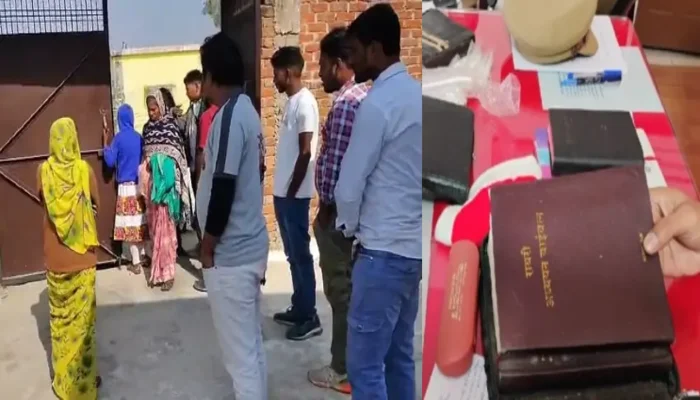
Case Summary
In the Karsah village of Kannauj district, Uttar Pradesh, Hindu villagers, primarily Scheduled Caste individuals, were indoctrinated, brainwashed and offered inducements for religious conversion by three Christian missionaries inside an illegal church. According to reports, a Christian farmer named Pannalal constructed an unauthorised church in his agricultural field in 2022. He began conducting systematic conversion activities by posing as a priest/pastor, targeting Scheduled Caste Hindu families across multiple villages. The church he built was entirely illegal, with no documentation or approvals from the SDM or the fire department. The accused, Pannalal, had been attracting and targeting Hindu villagers into regular prayer gatherings by promising money, education for their children in states like Kerala and Goa. He also claimed to cure people of their sicknesses and offered various material benefits. He would give grape juice to Hindu villagers suffering from cough, cold, or fever, three times a day, presenting it as prasad and assuring them that relief would come through prayers. Once their symptoms improved, he used the moment to manipulate them into adopting Christianity. Around fifty villagers from Karsah and its neighbouring villages have already been converted through these tactics. The conversion racket came to light on 7 December 2025, when Bajrang Dal, a Hindu organisation, received information about a prayer that was being conducted in the Karsah village. When they reached the site, they found Pannalal and two of his associates, Umashankar and Vidyasagar, conducting prayers for a group of about fifty men and women. It was revealed that the accused, Pannalal, had been converting Scheduled Caste members through promises of healing and material support. Villagers also reported that whenever a child or elderly person in the village developed a cough, cold, or fever, Pannalal would call them to the church three times and make them drink grape juice. Upon relief, he would convert them to Christianity. Bajrang Dal members began protesting, following which the police were informed, who promptly reached the site. During the search, police recovered around twenty Bibles, Christian lockets, musical instruments, grape-juice bottles marked for church use, and handwritten slips containing conversion-related slogans. Pannalal, along with his associates Umashankar and Vidyasagar, was arrested by the police. During the investigation, it was revealed that Pannalal often travelled to other states, and individuals of Christian faith often came to stay with him. There was a submersible pump installed in the church, which had the name Nav Kanthi Society written on it. This raised the suspicion that Pannalal was connected to the network of the Nav Kanthi Society organisation, which was involved in illegal conversion. After his arrest, Pannalal folded his hands before Bajrang Dal officials and claimed that he would now worship Bajrangbali and install the deity’s statue in his home, asking for forgiveness. Superintendent of Police Vinod Kumar stated that the police were investigating all angles, and a case would be registered against those responsible for orchestrating conversions.
Why it is Hate Crime ?
This case has been added to the tracker under the primary category: Predatory Proselytisation. Within this, the subcategory selected is- Conversion/attempts to convert by inducement. Predatory Proselytisation is not just limited to threat, harassment, force and violence, but it also has contours of stealth. In several cases, the Hindu victim is exploited to convert, with non-Hindus taking advantage of their poverty. In such cases, the Hindu victim who is suffering financially is offered monetary benefits, including lucrative offers for jobs, health treatment, education, etc, to induce the victim into changing his/her religion. In such cases, the religious identity of the victim and the aim to disenfranchise him from his faith form the heart of the crime. Also, taking advantage of and exploiting an individual’s economic vulnerabilities is widely acknowledged as exploitation, forms of which are often penalised by law. Such cases therefore, are considered religiously motivated hate crimes since the victim’s religious identity forms the very heart of the crime itself. The other subcategory selected is: Proselytisation by grooming, brainwashing, manipulation or subtle indoctrination. Within this, the tertiary category selected is: Pattern of targeting Hindus and Conversion of minors. Religious brainwashing essentially means the often subtle and forcible indoctrination to induce someone to give up their religious beliefs to accept contrasting, regimented ideas. Religious grooming or brainwashing also involves propaganda and manipulation. It involves the systematic effort, driven by religious malice and indoctrination, to persuade “non-believers’ to accept allegiance, command, or doctrine to and of a contrasting faith. Cases of such grooming or brainwashing are far more nuanced than direct threats, coercion, inducement and violence. In such cases, it is often seen that there is repeated, subtle and continual manipulation of the victim to induce disaffection towards their own faith and acceptance of the contrasting faith of the perpetrator. While subtle indoctrination is widely acknowledged as predatory, an element which is often understated in such conversions or the attempts of such conversion is the role of loyalty and trust which might develop between the perpetrator and the victim. Fiduciary relationships are often abused to affect such religious conversion. For example, an educator transmitting religious doctrine of a competing faith to a Hindu student. The Hindu student is likely to accept what the teacher is transmitting owing to the existence of the fiduciary relationship. The exploitation of the fiduciary relationship to religiously indoctrinate victims would also be included in this category. Since the underlying animosity towards the victim’s faith forms the basis of predatory proselytisation, such cases are considered religiously motivated hate crimes. This case has been added to the tracker because Hindu villagers were indoctrinated, brainwashed and offered inducements for religious conversion by three Christian missionaries in the Karsah village. The accused lured Hindu villagers under the guise of a prayer meeting/religious gathering, where he brainwashed and converted Hindus. Firstly, what was presented as a harmless prayer meeting inside a church was, in reality, a covert and pre-planned operation to convert Scheduled Caste Hindus. These were not genuine community prayers but calculated efforts to exploit the trust of Hindus and manipulate them into abandoning their faith. Pannalal had constructed the church illegally, without any permission from the SDM or the district administration and deliberately conducted these meetings in secrecy so that neither the authorities nor the wider community would suspect ongoing conversion activity. By operating behind closed doors, away from public scrutiny, the missionaries created an environment where they could gradually influence and pressure Hindu villagers, especially those who were vulnerable and seeking relief, into abandoning their faith. Secondly, offering incentives or making false healing promises, especially when directed at vulnerable individuals in need, shows that these incentives are not acts of kindness or charity. Instead, they are calculated moves to exploit vulnerable Hindus because of their religion. By providing inducements or promising healing in exchange for conversion, the accused were effectively blackmailing those who might have been desperate for assistance or hope. Thus, in this case, the promises of money, rations, housing, education for children, and miraculous healing were used as tools to influence those struggling with illness or poverty. This was not assistance freely given, but support made conditional upon abandoning one’s faith. Such instances are seen in many cases where members of Christian missionary groups target socially and economically vulnerable Hindus to further their agenda of religious conversions. This form of coercion strips people of their agency and dignity and results in coerced conversions. These are not random or isolated incidents, but rather cases deeply rooted in religious animosity towards Hindu victims. Thirdly, the Christian perpetrators were also actively attempting to indoctrinate the Hindu victims by using Christian religious texts and literature. Using the scriptures or literature of one faith to deliberately target and manipulate members of another, with the clear intention of religious conversion, represents a direct attack on the Hindu faith. Such actions are designed to violate and undermine the beliefs of Hindu victims and are clear indicators of religious hostility towards Hindus and their religious identity. Such actions further demonstrate that this was not an isolated incident of evangelism, but rather part of a broader, organised operation to further religious conversions. When Christian religious material is used to exploit trust, sow doubt, and misrepresent the beliefs of Hindus to coerce conversion, particularly in a systematic manner, it constitutes a religiously motivated offence. Fourth, villagers also reported that some children, who developed cough or fever, also visited Pannalal. He would call them to the church, make them drink grape juice and upon relief, convert them to Christianity. Thus, some of the victims he converted were minors, which means the element of consent and genuine change of conscience was missing ab initio. Minors, due to their young age and lack of maturity, are particularly vulnerable to manipulation and coercion. They may not have the ability to fully understand the implications of converting to another religion, and the Christian perpetrator purposely targeted and exploited this vulnerability of the victim. Since this case exemplifies the use of brainwashing and manipulation to achieve religious conversion, it is a blatant act of religious hate. Such actions stem from inherent hostility towards the victim's professed faith since Abrahamic faiths believe that any non-adherent to the faith is subject to being dehumanised till they convert. Therefore, religious conversions, even of minors, are often seen as a badge of honour, totally disregarding the methods used to achieve it. Fifth, the nature of the conversion activities in Karsah and their broader effect on the surrounding villages all indicate a targeted action against Hindus as a collectivity. When individuals or groups focus their efforts on converting members of a particular religion, in this case, Hindus, then it demonstrates a fundamental disregard for the Hindu faith. Conversion, especially when not based on personal conviction but rather on external persuasion or pressure, is not simply about sharing a different belief system. It is an attempt to undermine the values, traditions, and identity of the Hindu community. In this context, the Christian perpetrators specifically targeted Hindus, which demonstrates a lack of respect for Hinduism and its followers. Such actions are carried out to strip Hindu victims of their faith, making it a religiously motivated crime. The Christian faith, by its very theological foundations, places a strong emphasis on proselytisation. In pursuit of conversion objectives, Christian evangelists often employ unethical means, ranging from psychological pressure and misinformation to inducements such as money or jobs. In such cases, Christian missionary groups often target and brainwash socially and economically vulnerable Hindus to further their agenda of religious conversions. These tactics are designed not as acts of charity but as tools to engineer religious change under the guise of social upliftment, particularly among vulnerable and underprivileged communities. Such acts were deeply rooted in religious animosity towards Hindu victims, and thus, this case was added to the tracker. Disclaimer: It is important to clarify that none of the media sources covering this case have specified the exact date when the accused began these conversion activities, though it is mentioned that the accused built the illegal church in 2022. Thus, to document this case, we have used an indicative date—7 December 2022—as a placeholder to represent the beginning of illegal conversions. While media coverage of the incident emerged on 7 December 2025, the Hinduphobia Tracker records the incident based on when the victim’s ordeal began, not when it was reported. Disclaimer: Media reports state that around 50 Hindu villagers were targeted for conversion in Karsha, but no gender-wise breakdown was provided. For documentation clarity, the Hinduphobia Tracker has applied a proportional demographic estimate based on India’s Census 2011 and NFHS-5 (2019–21) rural population patterns. Accordingly, the 50 participants are estimated as 20 men (40%), 18 women (35%), and 12 individuals (25%) whose ages remain unknown. Although the accused was known to target children for conversion, media reports did not specify whether any children were present in the prayer meeting on 7 December 2025; therefore, the number of children has been kept unknown. Moreover, since the exact age-wise breakdown has also not been specified in any of the available sources, the total number of victims has been recorded as 50 without separate categorisation by gender.
Victim Details
Total Victim
50
Deceased
0
Gender
- Male 20
- Female 18
- Third Gender 0
- Unknown 12
Caste
- SC/ST 50
- OBC 0
- General 0
- Unknown 0
Age Group
- Minor 0
- Adult 0
- Senior Citizen 0
- Unknown 50


Case Status
Arrested


Perpetrators Details
Perpetrators
Christian Extremists
Perpetrators Range
From 2 To 5
Perpetrators Gender
male
 Sources




