Hindu women face caste slurs and assault by members of Muslim community after minor dispute between children
 Bahraich, Uttar Pradesh, India
  2 December, 2025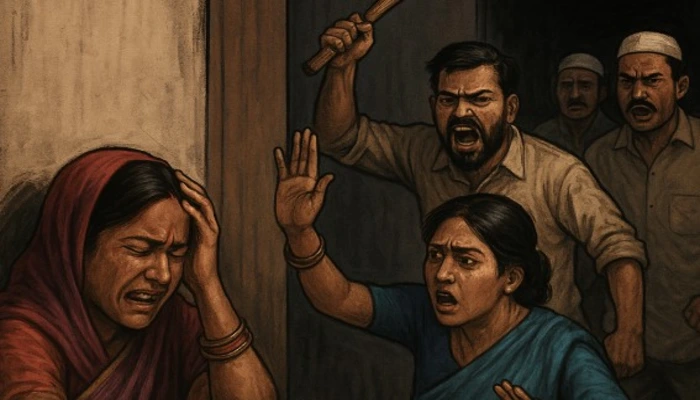
Case Summary
Two Hindu women were injured in Bahraich’s Matera area after members of the Muslim community stormed into a Hindu family’s home, hurled caste based slurs, and assaulted them. The incident happened following a dispute that began over children playing. Archana Devi of Nai Basti reported that Akhtar, Chhote, Chuna, Rozi, Munna, Rani, and several others forced their way into her house carrying sticks. She said they abused her using caste loaded insults and even threatened to kill her. Archana immediately called Dial 112, after which the emergency response team and local police arrived and brought the situation under control. Matera Station House Officer Surendra Pratap Bauddh confirmed that a case was registered against the accused under the relevant sections. Police stated that the victim belonged to the Scheduled Caste community and that the conflict began between children from her household and those from the Muslim community. At the time of writing this report, efforts were underway to arrest the accused.
Why it is Hate Crime ?
This case has been added to the tracker under the first category- Hate speech against Hindus. Under this, the subcategory selected is- Anti-Hindu slurs, mocking faith. Anti-Hindu slurs and the deliberate mocking of the Hindu faith owing to religious animosity involve the usage of derogatory terms, stereotypes, or offensive references to religious practices, symbols, or figures. One of the common anti-Hindu slurs used against Hindus is “cow-worshipper” and “cow piss drinker”. The intention of using this term is to demean and mock Hindus as a group and their religious beliefs since Hindus consider the cow holy. Additionally, some symbols and the slurs attached to them have a historical context that exacerbates the insult, hate, stereotyping, dehumanisation and oppression against Hindus. Cow worship has been used for centuries to denigrate Hindus, insult their faith and oppress Hindus specifically as a religious group. There has been overwhelming documentation about how cow slaughter has been used to persecute Hindus with cow meat being thrown in temples and places of worship. There has also been overwhelming documentation where cow meat (beef) has been force-fed to Hindus to either forcefully convert them to Islam or denigrate their faith. Apart from cow worship, the Swastika – which holds deep religious significance for the Hindus – has also been misinterpreted and distorted to use as a slur against Hindus. Similarly, the worship of the Shivling has been used by supremacist ideologies and religions to denigrate Hindus owing to religious animosity. Such slurs and denigration stem out of inherent animosity and hate towards Hindus and their faith, therefore, it is categorised as hate speech targeted at Hindus specifically owing to their religious identity. The other category selected is- Attack not resulting in death, and within this, the subcategory selected is- Attacked for Hindu identity. In several cases, Hindus are attacked merely for their Hindu identity without any perceived provocation. A classic example of this category of religiously motivated hate crime is a murder in 2016. 7 ISIS terrorists were convicted for shooting a school principal in Kanpur because they got ‘triggered’ seeing the Kalava on his wrist and tilak that he had put. In this, the Hindu victim had offered no provocation except for his Hindu religious identity. The motivation for the murder was purely religious, driven by religious supremacy. Such cases where Hindus are targeted merely for their religious identity would be documented as a hate crime under this category. In this incident, the violence did not escalate because of the children’s quarrel but because the attackers chose to target a Hindu Dalit family once the confrontation began. The moment the group entered the victim’s home, they dropped the issue of the children entirely and immediately used caste based slurs and threats, showing that their hostility was directed at the family’s Hindu SC identity, not at any genuine provocation. The women were harmed not for what they did, but for who they were. This fits a broader pattern in which Hindus are harmed simply because their identity is visible. In many cases, attackers look for the most obvious markers of the victim’s Hindu background such as caste, tilak, Kalava, temple association, or simply being part of a Hindu household. These markers become excuses to degrade, intimidate, or assault the victim, even when the situation itself has nothing to do with religion. The violence is not about the behaviour of the Hindu victim but about the identity the perpetrator believes they can attack without consequence. It can be argued that a caste-specific slur is aimed at her micro identity of belonging to the Dalit section of the Hindu community and not her Hindu identity itself. However, as far as Abrahamic religions are concerned, the micro identities of caste, region, and language are secondary. It is the religious identity that drives the animosity of the perpetrator against the Hindu victim. In this case, while the accused hurled caste abuses at the victim, the animosity was driven by his animosity towards Hinduism and Hindus. While the immediate trigger of the violence could be the "fight between children" as mentioned in reports, the fact that caste slurs were hurled at the victims by the perpetrator makes it a religiously motivated hate crime against the victims. The assault and abuse were driven by identity-based hostility, and the victim’s Hindu Dalit background was central to why the violence took the form it did. The attackers used a trivial dispute as an opportunity to assert prejudice, making the incident a clear instance of hate directed at Hindu identity rather than a simple neighbourhood disagreement.
Victim Details
Total Victim
2
Deceased
0
Gender
- Male 0
- Female 2
- Third Gender 0
- Unknown 0
Caste
- SC/ST 2
- OBC 0
- General 0
- Unknown 0
Age Group
- Minor 0
- Adult 2
- Senior Citizen 0
- Unknown 0


Case Status
Complaint filed


Perpetrators Details
Perpetrators
Muslim Extremists
Perpetrators Range
From 5 to 10
Perpetrators Gender
both
 Sources




