Hindu devotees blocked from doing weekly puja and reciting Hanuman Chalisa at historic Bhojshala site, Goddess Vagdevi painting seized
 Dhar, Madhya Pradesh, India
  1 December, 2025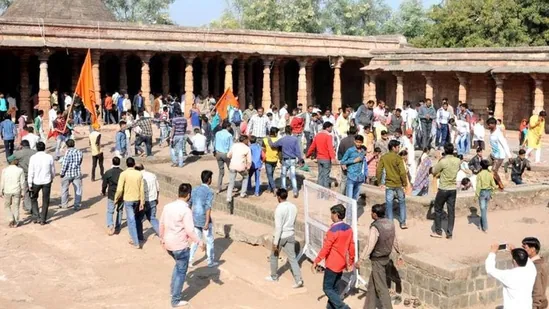
Case Summary
On 2 December, tensions around the historic Bhojshala site flared once again after Hindus who had gathered in Dhar, Madhya Pradesh, for puja and Hanuman Chalisa were stopped by the Archaeological Survey of India. ASI officials also seized a newly prepared oil painting of Goddess Vagdevi that the devotees had brought for worship and refused to allow it inside the complex. The Hindu groups had come with the deity’s portrait as part of their regular worship. They intended to place it within the sanctum for rituals, but ASI personnel denied entry. The president of the Bhoj Utsav Committee stated that every Tuesday, they perform a Satyagraha for the goddess using an oil painting, and this week, they had only replaced the old one with a fresh artwork. Despite this, it was stopped and confiscated. He argued that if other events at the site are being allowed to take place without ASI approval, then targeting Hindu worship alone is discriminatory. He demanded that the painting be returned immediately, warning that continued hostility would lead to a strong public protest. Hindu organisations also stated that preparations for the upcoming Muslim festival, Urs, including painting and whitewashing inside the premises, were taking place without permission, while their own religious activities face repeated restrictions. They said this selective treatment has deepened the resentment within the Sakal Hindu Samaj and the Bhoj Utsav Samiti. They cautioned that if the painting is not restored promptly and the unauthorised activities are not stopped, a large-scale agitation will become unavoidable. The issue has gained further urgency because the Vasant Panchami festival, which is sacred to Goddess Saraswati, falls on 23 January this year, which is also a Friday. Hindus wish to offer uninterrupted prayers on this day, while Muslims also use the premises for their Friday namaz. The 11th-century Bhojshala complex has long been claimed by Muslims as the Kamal Maula mosque, while Hindus maintain that it is the ancient temple of Goddess Vagdevi, the revered Saraswati. Following a directive from the Madhya Pradesh High Court, the ASI initiated a scientific survey on 22 March 2024. The survey revealed Sanskrit and Prakrit inscriptions predating the Arabic ones, many beginning with Om Sarasvityanamah and Om Namah Shivay. Idols and depictions of Hindu deities, along with inscriptions indicating the presence of an ancient learning centre, were also identified. These findings are consistent with the Hindu artefacts recovered during an earlier excavation in 1987, further strengthening the Hindu community’s claim over Bhojshala.
Why it is Hate Crime ?
This incident has been added to the tracker under the category- Restriction/ban on Hindu practices. Within this, the fist sub-category selected is- Restriction on expression of Hindu identity. An example of the state-affected prejudicial and targeted orders against the Hindu community would be a government denying the right of a Hindu or a group of Hindus to hold a religious procession owing to the animosity of non-Hindu groups. Denial of the religious right of the Hindus to assuage the non-Hindu group which harbours animosity to a point where it could lead to violence against Hindus is not only a failure of law and order but is a prejudicial order against Hindus, denying them their fundamental rights to express their religious identity. An example of a hate crime against Hindus by a non-Hindu would be a non-Hindu institution forcing its Hindu employees to abandon religious symbols that a Hindu would wear as an expression of faith owing to inherent prejudice against the faith professed by the victim or a non-Hindu group of people restricting a Hindu group from constructing a place of worship simply because the demography of the area in which the temple is being built is dominated by non-Hindus. Such actions are driven by religious animosity and/or prejudice against Hindus and their faith and would therefore be categorized as a hate crime. The other subcategory selected is- Administration restricting religious practices. In several cases, it is seen that the administration/state disallows a religious practice owing to prejudicial orders and concerns, targeted specifically against the Hindu community. Such restriction/prohibition would be considered documented as a hate crime because the orders are often a result of pressure by groups that harbour animosity towards Hinduism and Hindus. Often, the restriction by the authorities is driven by bias, hostility, or prejudice against the specific community being stopped from holding a religious practice, by pressure groups that harbour animosity towards Hindus, intrinsic to their faith. Since practices are intrinsic to the faith of the Hindus, such prejudicial restriction is considered a curtailing of the fundamental rights of the Hindu community. In several cases, for example, the authorities ban a Hindu religious practice due to pressure from groups opposed to the religion. In other instances the prohibition is selectively enforced against one religious group (Hindus) while others are allowed to proceed. There are still other cases where the authorities preemptively restrict a religious practice by Hindus because those who hold animosity towards Hindus may get “provoked” leading to them being violent, thereby assuaging the sentiments of those who hold animosity towards Hindus by curtailing the religious rights of Hindus. Such acts and orders are prejudiced, indicating discriminatory motives owing to the capitulation to groups that harbour animosity towards Hindus and therefore, would be categorized as a religiously motivated hate crime since the original pressure leading to the order itself is a result of hatred/bias/prejudice/religious hate against Hindus. The events at Bhojshala reflect a clear targeting of Hindu religious life by undermining the community’s ability to express its faith in a space that is historically and spiritually significant to them. When Hindu devotees arrived with a painting of Goddess Vagdevi for a routine puja, they were not only denied permission to worship but also had their sacred item seized by authorities. This was experienced as an act that directly suppressed their religious identity, since the very symbols through which Hindus affirm their devotion were treated as objects that needed to be removed rather than respected. A sense of religious bias was reinforced by the fact that preparations for an upcoming Muslim festival were reported to be taking place inside the premises without any formal approval. Activities such as painting and whitewashing were allowed to continue unchecked, even as Hindu devotees faced repeated obstacles for their own ritual practices. This imbalance demonstrated that the administration was enforcing rules selectively, permitting unapproved activities for one group while obstructing Hindu worship. The manner in which the administration intervened further showed a pattern of blocking Hindu religious activity while allowing other preparations on the same premises to continue without objection. This uneven treatment created a sense that Hindu worship was being singled out for control and disruption. By restricting their entry, stopping their rituals, and confiscating a representation of their goddess, the authorities effectively communicated that Hindu practices did not have an equal right to visibility or legitimacy at the site. Such actions have a deeper impact than the immediate incident. They foster an environment where Hindus feel their faith expression is constantly under scrutiny and vulnerable to institutional obstruction. For a community already sensitive to long-standing disputes over Bhojshala, this incident reinforced the belief that their sacred traditions and historical claims are being systematically sidelined. In this sense, the interference was not a routine administrative decision but a move that added to the ongoing discrimination faced by Hindus who seek to preserve and practice their heritage at a centuries-old sacred site.


Case Status
Unknown


Perpetrators Details
Perpetrators
State and Establishment
Perpetrators Range
Unknown
Perpetrators Gender
unknown
 Sources




