Hindus offered inducements to convert to Christianity; missionaries illegally construct church on tribal land
 Surat, Gujarat, India
  30 November, 2025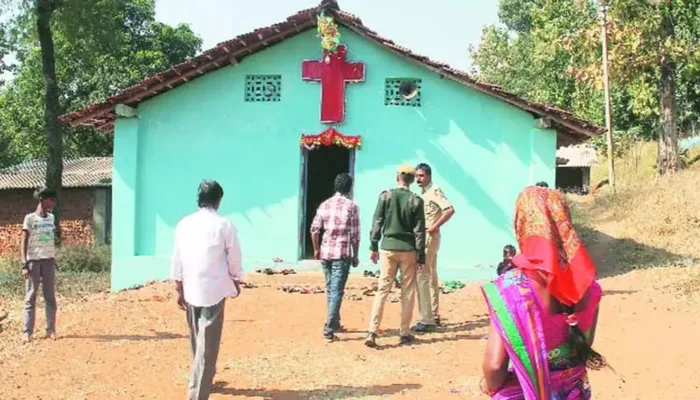
Case Summary
In Vahar village of Umarpada in Surat, Gujarat, tribal Hindu villagers were targeted and offered inducements for religious conversion by Christian missionaries, who also illegally built a church on the tribal land. According to reports, some Christian missionaries illegally constructed a church on the tribal land, which triggered strong resistance from the local Adivasi/tribal Hindu community. The church was being built without permission from the Collector, and the tribal community stated that it was directly connected to ongoing efforts to convert innocent tribal Hindu villagers to Christianity. They further stated that illegal gatherings were being held and various temptations and inducements were offered for religious conversion. It was part of a coordinated attempt to undermine their traditional practices, noting that the Adivasi community had worshipped deities such as Nagdev, Gowaldev and Waghdev, as well as natural elements like trees, stones and rivers, since ancient times. Tribal organisations such as the Dev Birsa Sena submitted petitions to the authorities, stating that no individual from the village had legally converted to Christianity as per official records, yet conversions were taking place illegally. They stated that such actions violated the Gujarat Freedom of Religion Act, including provisions under Sections 2(a) to 2(f), 4(2), 4(c) and Section 7. Community representatives submitted memoranda to the Mamlatdar (head of a taluka) demanding immediate intervention and legal action against the pastor and institutions involved. They also demanded the demolition of the unauthorised church.
Why it is Hate Crime ?
This case has been added to the tracker under the primary category - Predatory Proselytisation. The subcategory selected is- Conversion/ attempts to convert by inducements. Predatory Proselytisation is not just limited to threat, harassment, force and violence, but it also has contours of stealth. In several cases, the Hindu victim is exploited to convert, with non-Hindus taking advantage of their poverty. In such cases, the Hindu victim who is suffering financially is offered monetary benefits, including lucrative offers for jobs, health treatment, education, etc, to induce the victim into changing his/her religion. In such cases, the religious identity of the victim and the aim to disenfranchise him from his faith form the heart of the crime. Also, taking advantage of and exploiting an individual’s economic vulnerabilities is widely acknowledged as exploitation, forms of which are often penalised by law. Such cases, therefore, are considered religiously motivated hate crimes since the victim’s religious identity forms the very heart of the crime itself. The other subcategory selected is- Proselytisation by grooming, brainwashing, manipulation, or subtle indoctrination. Religious brainwashing essentially means the often subtle and forcible indoctrination to induce someone to give up their religious beliefs to accept contrasting regimented ideas. Religious grooming or brainwashing also involves propaganda and manipulation. It involves the systematic effort, driven by religious malice and indoctrination, to persuade “non-believers’ to accept allegiance, command, or doctrine to and of a contrasting faith. Cases of such grooming or brainwashing are far more nuanced than direct threats, coercion, inducement and violence. In such cases, it is often seen that there is repeated, subtle and continual manipulation of the victim to induce disaffection towards their own faith and acceptance of the contrasting faith of the perpetrator. While subtle indoctrination is widely acknowledged as predatory, an element which is often understated in such conversions or the attempts of such conversion is the role of loyalty and trust which might develop between the perpetrator and the victim. Fiduciary relationships are often abused to affect such religious conversion. For example, an educator transmitting religious doctrine of a competing faith to a Hindu student. The Hindu student is likely to accept what the teacher is transmitting owing to existence of the fiduciary relationship. The exploitation of the fiduciary relationship to religiously indoctrinate victims would also be included in this category. Since the underlying animosity towards the victim’s faith forms the basis of predatory proselytization, such cases are considered religiously motivated hate crimes. This case has been added to the tracker because tribal Hindu villagers were targeted and offered inducements for religious conversion by Christian missionaries. Firstly, offering incentives or inducements, especially when directed at vulnerable individuals in need, shows that these incentives were not acts of kindness or charity. Instead, they were calculated moves to exploit vulnerable Hindus because of their religion. By providing inducements or promising healing in exchange for conversion, the accused were effectively blackmailing those who might have been desperate for assistance or hope. Such instances are seen in many cases where members of Christian missionary groups target socially and economically vulnerable Hindus to further their agenda of religious conversions. This form of coercion strips people of their agency and dignity and results in coerced conversions. These are not random or isolated incidents, but rather cases deeply rooted in religious animosity towards Hindu victims. Secondly, the villagers also stated that illegal gatherings were being held in the village in an effort to convert them to Christianity. Often in such cases, religious gatherings or prayer meetings serve as a covert attempt at religious conversion. These are not genuine community prayers or gatherings but calculated efforts to exploit the trust of Hindus and manipulate them into abandoning their faith. The meetings were deliberately held in secrecy and without permission from the administration, indicating a deliberate and deceptive strategy designed to avoid public attention and scrutiny. By conducting such gatherings covertly, the Christian missionaries sought to manipulate vulnerable Hindus, taking advantage of their emotional and social circumstances to push them towards conversion. Thirdly, the missionaries built an illegal church on the tribal land, which further demonstrated a deliberate effort to establish a permanent base for their conversion activities. Constructing a religious structure without permission was a deliberate attempt at gaining territorial and social influence in a vulnerable village. Such illegal construction serves as a foothold for expanding conversion operations, as it allows missionaries to conduct gatherings, meetings, and outreach under the guise of religious activity while evading regulatory oversight. By erecting the church on tribal land, the missionaries attempted to legitimise their presence and normalise their influence over the villagers by exposing them to Christian culture and faith. Christianity, by its very theological foundations, places a strong emphasis on proselytisation. In pursuit of conversion objectives, Christian evangelists often employ unethical means, ranging from psychological pressure and misinformation to inducements such as money or jobs. These tactics are designed not as acts of charity but as tools to engineer religious change under the guise of social upliftment, particularly among vulnerable and underprivileged communities. This systematic attempt to erode the religious foundation of individuals and replace it with allegiance to another faith reflects deep religious malice and animus against the Hindu community. The core motivation of the act stems from hostility towards the victims' religion. Therefore, this case is being added to the hate crime database of the Hinduphobia Tracker. Disclaimer: The Hinduphobia Tracker records incidents based on when an event occurred or when the victim's ordeal began. It is important to clarify that none of the media sources covering this case has specified the exact date when the church was built or when the illegal gatherings began. Therefore, for documentation purposes, we have recorded the date based on when the incident was reported in the media, 1 December 2025. The Hinduphobia Tracker has not specified the exact number of perpetrators in this case. However, the Hindu community submitted a memorandum demanding intervention and legal action against the pastor and Christian institutions involved. Therefore, for documentation purposes, the perpetrator count will be conservatively recorded as '1', referring solely to the pastor. This estimate is based on available information and will be updated if further evidence emerges.


Case Status
Complaint filed


Perpetrators Details
Perpetrators
Christian Extremists
Perpetrators Range
One Person
Perpetrators Gender
unknown
 Sources




