Ganapati murti desecrated and removed without permission by revenue and police officials in Melapalayam, Tamil Nadu
 Karur, Tamil Nadu, India
  26 November, 2025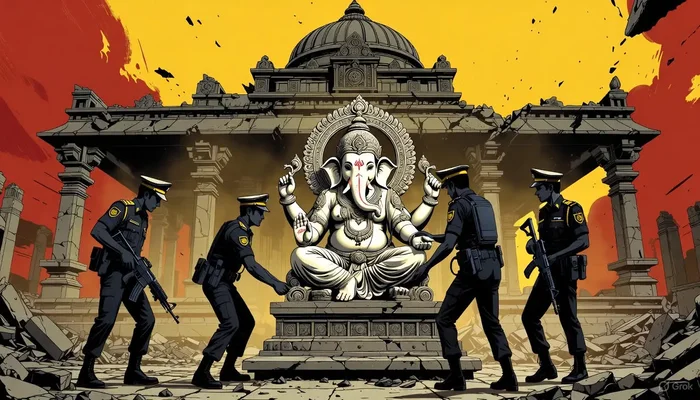
Case Summary
A temple named Vinayagar temple in Melapalayam was removed, leading to a sharp escalation of tensions across Tamil Nadu. Local police and revenue officials dismantled the structure without prior notice, creating immediate shock and anger among Hindu residents. For many in the locality, the temple was a space built by community members for daily worship, and its sudden removal felt like an outright dismissal of their religious life. Community members and activists condemned the action as arbitrary and opaque. They stressed that no explanation was offered and that the lack of communication made the move appear targeted. Women who questioned officials at the site were met with hostility from the assistant police commissioner, which deepened the sense of grievance and mistrust. The incident was widely viewed as part of a larger pattern in which Hindu religious sites face disproportionate scrutiny and restrictions. Activists pointed out that places of worship belonging to other communities continue to function without interference, while Hindu spaces are subjected to abrupt removals and administrative hurdles. Many residents saw this as an erosion of their freedom to practice their faith. Adding to the frustration, Hindu community leaders said they were prevented from meeting those directly affected. Police reportedly denied them permission, citing legal provisions, which the leaders interpreted as yet another attempt to curtail their voice and limit solidarity. The timing of the incident, occurring ahead of elections and amidst the influence of powerful local politicians, intensified accusations that the government was prioritising minority interests over the concerns of the majority community. Activists vowed to continue their campaign, demanding that the temple be reinstated and that the broader pattern of discrimination be addressed. They pledged to take their movement to the public, framing the removal as a violation of their rights and a challenge to religious freedom. Protesters called for accountability and equal treatment of all places of worship, insisting that they would pursue both legal and civic avenues to ensure that Hindu religious spaces receive the respect and protection they are entitled to.
Why it is Hate Crime ?
This case has been added to the tracker under the primary category- Attack on Hindu religious representations. Within this, the subcategory selected is- Attack on Temples. In Hinduism, a temple is the abode of the Deity. The Deity in the Temple is consecrated, thereby making it a real, breathing entity. Hindus believe that not just the Deity but the temple premises itself are sacred to Hindus since Hindus hold the faith that the entire Temple space is an amalgamation of the divine energy of the deity. Given the central significance of Temples in Hindu Dharma, any attack against a Hindu Temple or its peripheral premises is an attack on the faith itself and is born out of animosity towards the faith, of which the Temple is a central tenet. Any manner of attack against a Temple and/or its premises would therefore be considered a religiously motivated hate crime. The other subcategory selected is- Desecration of Hindu religious symbol. Icons and symbols or a religious representation of a spiritual ideal are widely revered in Hinduism. Iconography is of vital significance in the Hindu milieu. It helps connect people’s spiritual beliefs with the real world. Iconography within the Hindu faith takes several shapes and forms. Murtis are of most significance to Hindus, to which daily rituals, prayers and offerings are done. Besides the murtis, there are several other symbols which have deep significance in the Hindu faith – the Om and Swastika for example. Since these Hindu religious symbols hold paramount importance in Hinduism, any desecration of symbols, icons, murtis, religious representations and manifestations, is driven by animosity towards the faith itself which manifests itself through these murtis, icons and symbols. Therefore, any desecration of these Hindu religious symbols and representations is considered religiously motivated hate crimes under this category. The other category selected is- Restriction/ban on Hindu practices. The subcategory selected is- Restriction on expression of Hindu identity. An example of the state-affected prejudicial and targeted orders against the Hindu community would be a government denying the right of a Hindu or a group of Hindus to hold a religious procession owing to the animosity of non-Hindu groups. Denial of the religious right of the Hindus to assuage the non-Hindu group which harbours animosity to a point where it could lead to violence against Hindus is not only a failure of law and order but is a prejudicial order against Hindus, denying them their fundamental rights to express their religious identity. An example of a hate crime against Hindus by a non-Hindu would be a non-Hindu institution forcing its Hindu employees to abandon religious symbols that a Hindu would wear as an expression of faith owing to inherent prejudice against the faith professed by the victim or a non-Hindu group of people restricting a Hindu group from constructing a place of worship simply because the demography of the area in which the temple is being built is dominated by non-Hindus. Such actions are driven by religious animosity and/or prejudice against Hindus and their faith and would therefore be categorized as a hate crime. The incident reflects a deliberate assault on Hindu religious life. The removal of the Vinayagar temple was not an administrative exercise but an act that directly targeted a sacred space central to the community’s faith and daily worship. Temples are more than physical structures; they embody collective devotion, continuity of tradition, and the visible presence of Hindu identity in public spaces. Taking one down abruptly, without notice or dialogue, sends a message that Hindu symbols and places of worship can be dismantled at will. The manner in which the structure was removed also amounted to the disrespect and erasure of a revered religious icon. By dismantling the temple in this way, officials effectively treated a sacred representation as disposable, which the community experienced as a form of desecration. Such actions inflict emotional harm on worshippers and signal a deeper intolerance for Hindu religious symbols. The episode further reflected a troubling pattern where Hindu practices face undue restrictions. Preventing the community from expressing its identity through its places of worship, and blocking leaders from meeting those affected, created the sense that Hindu religious life was being controlled and suppressed. When administrations act without transparency and silence those seeking accountability, it compounds the feeling that Hindu expression is being treated as something that must be limited rather than protected. Taken together, the removal of the temple, the disregard for its sacred value, and the curbs placed on the community’s attempts to respond reveal a clear attempt to undermine Hindu religious presence in the area. This is why the case is documented as a targeted act against Hindu faith, identity, and religious freedom.


Case Status
Unknown


Perpetrators Details
Perpetrators
State and Establishment
Perpetrators Range
Unknown
Perpetrators Gender
unknown
 Sources




