Minor Hindu students harassed and pressured to abandon their faith by schoolteacher, Hindu religious symbols denigrated
 Singrauli, Madhya Pradesh, India
  27 November, 2025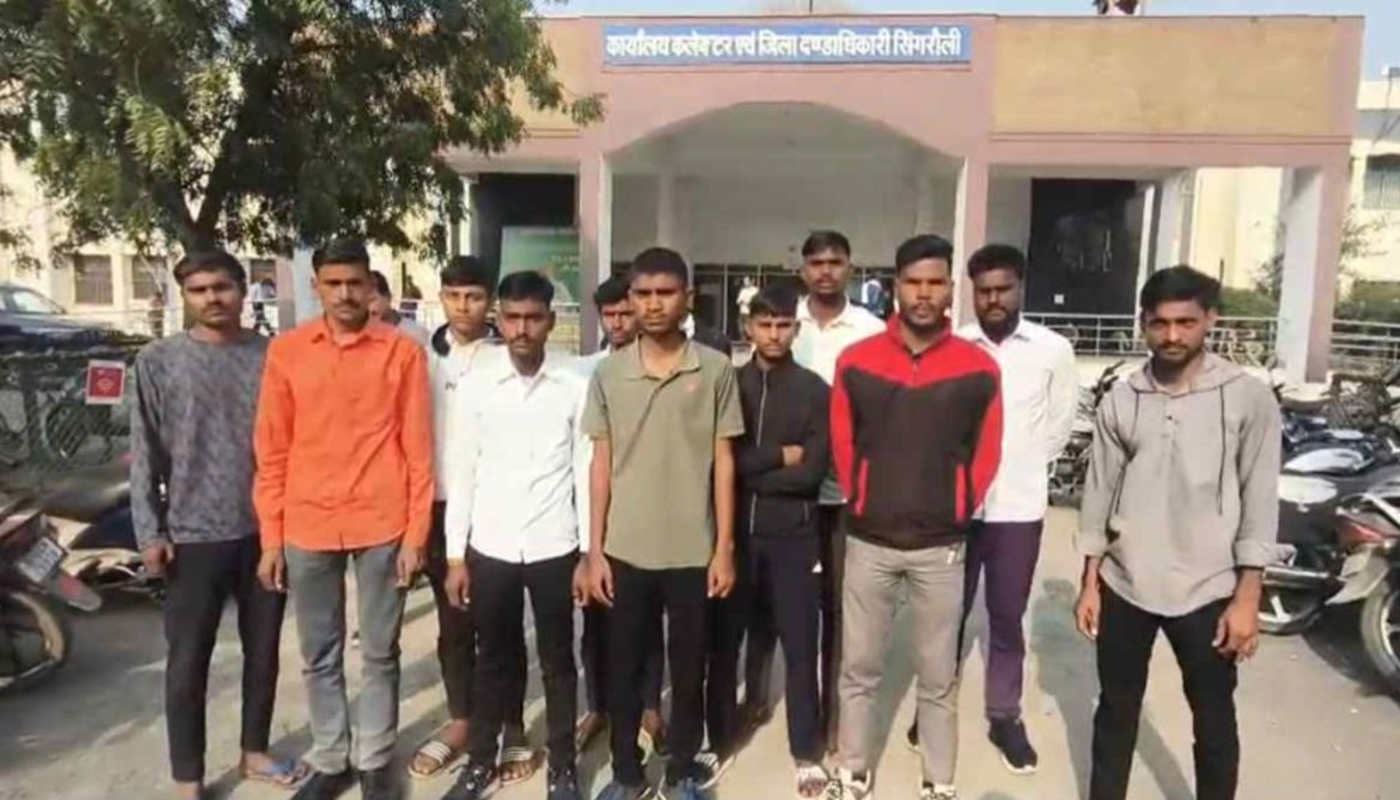
Case Summary
Minor Hindu students were forced to convert and subjected to continuous harassment by a schoolteacher in Singrauli, Madhya Pradesh. Students of the Government Higher Secondary School in Karela village filed a complaint stating that their teacher, Dashrath Saket, targeted Hindu children for practising their faith inside the school. The teacher stopped students from worshipping Maa Saraswati, punished them for taking the name of Lord Ram, broke their kalawa sacred threads, and wiped the sandalwood tilak from their foreheads. He also pressured them to avoid religious songs and Hindu cultural activities. He attempted to push the students towards Buddhism and told them that Lord Ram does not exist. When some students recorded his actions on their mobile phones, he forcibly seized the devices and deleted the video. Dozens of students and local residents approached Collector Gaurav Benal and District Education Officer S. B. Singh demanding action. The authorities stated that an inquiry committee would be formed within a week and that strict measures would be taken against anyone found guilty.
Why it is Hate Crime ?
The primary category in this case is: Predatory Proselytisation. The first subcategory under this is: Harassment, threats, coercion for conversion. Harassment covers a wide range of behaviours of an offensive nature. It is commonly understood as behaviour that demeans, humiliates, and intimidates a person, including threats and coercion. Harassment and threats, in this case, find their root on discriminatory grounds which has the effect of nullifying a person’s rights or infringing upon his freedom to exercise his right specifically owing to the victim’s religious identity. Verbal and physical threats and psychological or physical harassment are often used against Hindu victims because they choose to practice their professed religion. Religious harassment also includes forced and involuntary conversions by harassment, threats or coercion. Coercion includes intimidatory tactics like force-feeding a Hindu victim beef to convert to another religion, forceful circumcision etc. In several cases documented, non-Hindu perpetrators or those who harbour specific animosity towards Hinduism, harass victims simply based on their religious identity. Such cases often also include harassment to ensure the Hindu victim abandons his/her professed religion and adopts the religion of the perpetrator. Such cases where Hindu victims are harassed to convert to the perpetrator’s religion are rooted in animosity towards the victim’s religious identity and are therefore documented as religiously motivated hate crimes. The second subcategory in this case is: Proselytisation by grooming, brainwashing, manipulation or subtle indoctrination. The tertiary category under this is: Conversion of minor. Religious brainwashing essentially means the often subtle and forcible indoctrination to induce someone to give up their religious beliefs to accept contrasting regimented ideas. Religious grooming or brainwashing also involves propaganda and manipulation. It involves the systematic effort, driven by religious malice and indoctrination, to persuade “non-believers’ to accept allegiance, command, or doctrine to and of a contrasting faith. Cases of such grooming or brainwashing are far more nuanced than direct threats, coercion, inducement and violence. In such cases, it is often seen that there is repeated, subtle and continual manipulation of the victim to induce disaffection towards their own faith and acceptance of the contrasting faith of the perpetrator. While subtle indoctrination is widely acknowledged as predatory, an element which is often understated in such conversions or the attempts of such conversion is the role of loyalty and trust which might develop between the perpetrator and the victim. Fiduciary relationships are often abused to affect such religious conversion. For example, an educator transmitting religious doctrine of a competing faith to a Hindu student. The Hindu student is likely to accept what the teacher is transmitting owing to existence of the fiduciary relationship. The exploitation of the fiduciary relationship to religiously indoctrinate victims would also be included in this category. Since the underlying animosity towards the victim’s faith forms the basis of predatory proselytization, such cases are considered religiously motivated hate crimes. Another primary category in this case is: Attack on Hindu religious representations. The subcategory under this is: Desecration of Hindu religious symbol. Icons and symbols or a religious representation of a spiritual ideal are widely revered in Hinduism. Iconography is of vital significance in the Hindu milieu. It helps connect people’s spiritual beliefs with the real world. Iconography within the Hindu faith takes several shapes and forms. Murtis are of most significance to Hindus, to which daily rituals, prayers and offerings are done. Besides the murtis, there are several other symbols which have deep significance in the Hindu faith – the Om and Swastika for example. Since these Hindu religious symbols hold paramount importance in Hinduism, any desecration of symbols, icons, murtis, religious representations and manifestations, is driven by animosity towards the faith itself which manifests itself through these murtis, icons and symbols. Therefore, any desecration of these Hindu religious symbols and representations is considered religiously motivated hate crimes under this category. Another primary category in this case is: Attack not resulting in death. The subcategory under this is: Attacked for Hindu identity. In several cases, Hindus are attacked merely for their Hindu identity without any perceived provocation. A classic example of this category of religiously motivated hate crime is a murder in 2016. 7 ISIS terrorists were convicted for shooting a school principal in Kanpur because they got ‘triggered’ seeing the Kalava on his wrist and tilak that he had put. In this, the Hindu victim had offered no provocation except for his Hindu religious identity. The motivation for the murder was purely religious, driven by religious supremacy. Such cases where Hindus are targeted merely for their religious identity would be documented as a hate crime under this category. This case has been added to the tracker because the conduct described reflects a clear pattern of targeted hostility toward Hindu children within an institutional setting where a teacher exercised direct authority over minors. The actions reported go beyond ordinary disciplinary behaviour and display a consistent effort to suppress the students’ Hindu identity through coercion, intimidation, and humiliation. Preventing children from worshipping Maa Saraswati, punishing them for taking the name of Lord Ram, breaking their kalawa, and wiping away their tilak are not neutral acts; they are deliberate attacks on visible and deeply rooted Hindu symbols. Such behaviour indicates an intention to distance the students from their religious identity by targeting the very practices through which that identity is expressed. The teacher’s attempts to steer the children towards another religion further intensify the gravity of the incident. Statements such as “Ram does not exist” are not mere opinions in a classroom context; when paired with the suppression of Hindu practices, they become tools of ideological pressure. The teacher’s position of authority over minors amplifies the coercive nature of these actions. Children depend on teachers for guidance, evaluation, and security, which creates an inherent power imbalance. When an educator uses that power to undermine the faith of Hindu students and promote an alternative religious framework, the behaviour aligns with known patterns of grooming and subtle indoctrination. The forced deletion of video evidence and seizure of students’ mobile phones adds another layer of concern. This indicates an awareness that the actions were improper and fear of being held accountable. Such concealment suggests deliberate intent rather than a misunderstanding of rules or a momentary lapse. It reinforces the interpretation that the actions were systematic and motivated by animosity toward Hindu identity. This case also involves the desecration of Hindu symbols in a symbolic sense. The kalawa and tilak are outward representations of faith, culture, and daily practice. For many Hindus, these are expressions of devotion that also serve as markers of identity. Forcibly removing or destroying them is a direct affront to the religious sentiment of the students, and such desecration has long been recognised as a manifestation of hostility toward Hinduism. Because these actions collectively show coercion, efforts to erase Hindu identity, pressure to adopt another religious framework, and disrespect toward religious symbols, the case meets the criteria for a hate crime against Hindus. It reflects ideological hostility carried out through abuse of authority over vulnerable minors, making documentation both necessary and urgent. Disclaimer: Media reports do not specify the exact date on which the Hindu students were first harassed or coerced inside the school. Since the Hinduphobia Tracker documents incidents based on when the victim’s ordeal began rather than when the news was published, a provisional placeholder date has been used for recording purposes. Until a precise date becomes available, the incident will be logged under the date of the first media report covering the case.


Case Status
Complaint filed


Perpetrators Details
Perpetrators
Others
Perpetrators Range
One Person
Perpetrators Gender
male
 Sources




