Anti-Hindu fake news: Indian politician incites hate against Hindus by falsely claiming Bangladeshi attacker as 'Sanatani Hindu'
 Lucknow, Uttar Pradesh, India
  25 November, 2025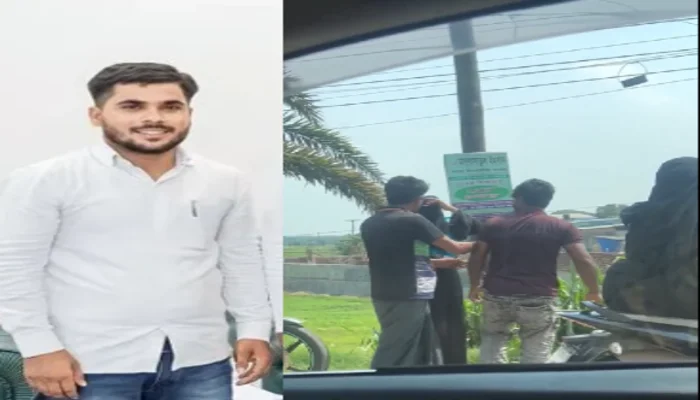
Case Summary
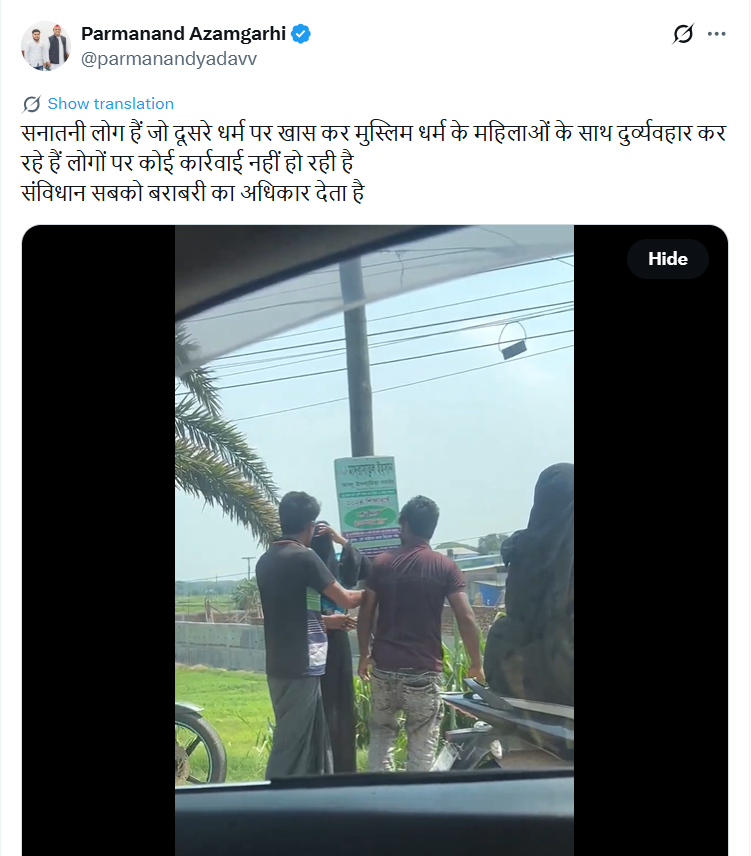
Hindus were targeted in an online hate campaign by Samajwadi Party leader Parmanand Azamgarhi, who circulated a misleading communal narrative by posting a video in which a man violently headbutted a burqa-clad woman on a roadside, falsely claiming that the man was Hindu. According to reports, the accused, Parmanand Azamgarhi, uploaded a video on his X (formerly Twitter) handle on 26th November 2025. In the video, a man in a t-shirt was seen scolding a burqa-clad woman over some matter. During the argument, he violently headbutted the woman, and she fell, knocked unconscious due to the force of the blow. The man then attempted to hit the woman again, but another person wearing a lungi stopped him and led him away. The video was shot by someone sitting in a car stopped on the road, witnessing the roadside argument. However, Parmanand Azamgarhi added a caption with the video claiming that 'Sanatani Hindus' were misbehaving with women of other religions, particularly Muslims, and that such offenders were facing no consequences. He uploaded this video targeting Hindus, though he did not present any evidence as to how he knew the man was Hindu. The video itself provided no religious markers identifying the attacker, who was dressed in an ordinary T-shirt and jeans. Furthermore, there were multiple visual identifiers in the video establishing that the video and the incident were from Bangladesh, which has a majority Muslim population. A banner in the background displayed Bengali text and the name “Madrasatul Ihsan Al Islamiya,” an Islamic institution operating in Bangladesh. A truck also appeared in a Bengali number plate with Energypac and JAC branding, available in Bangladesh but not in India. The video provided no evidence as to the religious identity of the attacker, who was most likely also Muslim, given the location and context. Despite this, Parmanand Azamgarhi used the video to present Hindus as perpetrators of religiously motivated violence, manufacturing a false communal narrative by portraying a Bangladeshi incident as misconduct by Hindus in India and thereby attempting to vilify Hindus without any evidence.
Case Images
Why it is Hate Crime ?
This case is being added to the tracker under the primary category- Hate Speech against Hindus. The subcategory selected is- Anti-Hindu subversion and prejudice. The tertiary category selected is- Mislabelling/Misrepresentation of perpetrator's religion as Hindu. Hate speech is defined as any speech, gesture, conduct, writing, or display that is prejudicial against a specific individual and/or group of people, which is leading to or may lead to violence, prejudicial action or hate against that individual and/or group. Media plays a specific and overarching reach in perpetuating prejudicial attitudes towards a community owing to unfair, untrue coverage and/or misrepresentation/misinterpretation, selective coverage and/or omission of facts of/pertaining to issues affecting a specific religious group. This type of bias can dehumanise the victim group, making it easier for others to justify harmful actions against them, which aligns with the objectives of hate speech laws aimed at preventing such harm. It is often observed that the media takes a prejudicial stand against the Hindu community driven by their need to shield the aggressor community which happens to be a numeric minority, however, is the one perpetrating violence against Hindus. For example, the media is often quick to contextualise religiously motivated crimes against Hindus, omit or misrepresent facts that point towards religiously motivated hate crimes, justify and/or downplay religiously motivated hate crimes or simply present fake news to stereotype Hindus. Such media bias leads to the denial of persecution and is often used to dehumanise Hindus, leading to justification for violence against them. For example, the media covered several fake allegations of Hindus targeting Muslims and forcing them to chant Jai Shree Ram. Most of these cases were proved false and fabricated after police investigation. These fake news reports were subsequently never retracted or clarified. Such fake news led to the justification of violence and dehumanisation of Hindus based on the argument that since Hindus targeted Muslims and forced them to chant Jai Shree Ram, the dehumanisation of Hindus and violence against them was par for the course and merely a retaliation. Such media bias leads to prejudicial portrayal of Hindus and offers a justification for violence against them and therefore, is considered hate speech under this category. This case represents a clear instance of anti-Hindu hate speech by Parmanand Azamgarhi, who circulated a misleading communal propaganda by falsely claiming that the man in the video was a "Sanatani Hindu." Instead of addressing the actual content of the video, a case of domestic dispute in Bangladesh between two individuals, he weaponised the incident to target and vilify Hindus, manufacture hostility, and create a false perception of Hindu men as habitual abusers of Muslim women. This was not a case of misinterpretation or confusion; it was a deliberate ideological act rooted in anti-Hindu bias and animosity, designed to vilify the entire Hindu community by falsely framing them as perpetrators who target others, especially Muslims, though the video provided no religious identifier as to the religion of the attacker. The core of the hate element lies in the intentional misidentification of the attacker’s religion. The man in the video had no Hindu markers whatsoever: he was wearing ordinary clothes, displayed no religious symbols, and the surroundings provided no indication of Hindu presence. Instead, multiple visual identifiers clearly established that the video was from Bangladesh, which is a Muslim majority country. Thus, it’s a high probability that the attacker was himself likely to be from the Muslim community. Furthermore, Hindus are a minority in Bangladesh, who are regularly persecuted by Muslim extremists, since the fall of the Sheikh Hasina regime in 2024. Yet, despite this, Parmanand Azamgarhi portrayed the incident as a Hindu act of violence against a Muslim woman, falsely inserting Hindus into a scenario that had nothing to do with them. Such manufactured narratives constitute hate speech against Hindus because they use misinformation to portray Hindus as violent, oppressive, and dangerous, thereby reinforcing prejudice and animosity. This can lead to an increase in hostility and violence against them by other sections of society. This form of rhetoric is rooted in ideological and religious animosity as it seeks to falsely frame Hindus as systemic perpetrators of other communities, especially Muslims. In recent times, social media has increasingly become a platform for anti-Hindu hate, with derogatory memes, videos, and messages targeting the Hindu community and their religious symbols, practices, and deities. Such content is recognised as part of a broader pattern of Hinduphobia and religious hate crimes online. In this case, the deliberate targeting of Hindus firmly establishes this act as a religiously motivated hate crime. Such deliberate distortion is not mere political commentary; it is targeted hate speech designed to spread prejudice and incite hostility against the entire Hindu community. Given that this case meets the parameters of religiously motivated hate speech, it is being added to the hate crime database of the Hinduphobia Tracker.


Case Status
Unknown


Perpetrators Details
Perpetrators
Others
Perpetrators Range
One Person
Perpetrators Gender
male
 Sources




