Hindu girls compelled to wear hijab, offer Namaz in a private school, students reveal they were also banned from wearing Kalava on their hands and Bindi on their foreheads
 Damoh, Madhya Pradesh, India
  30 May, 2023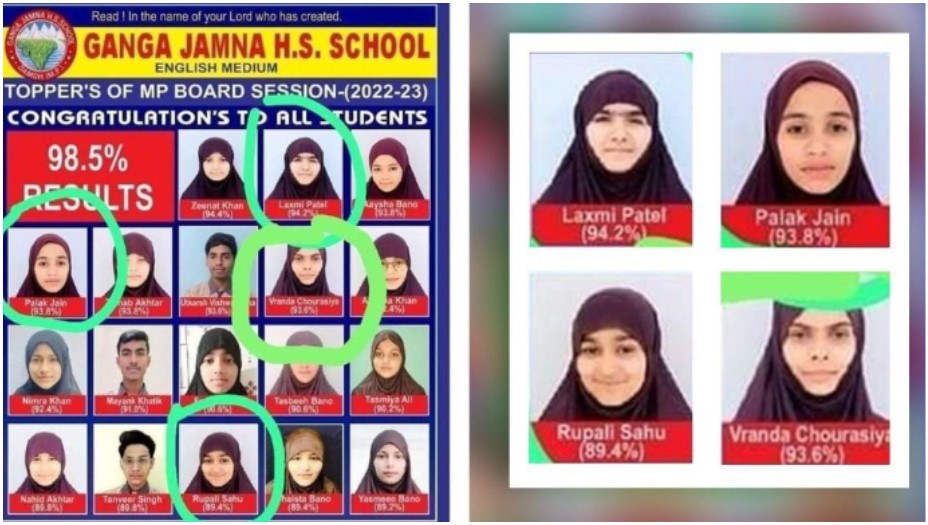
Case Summary
In the Ganga Jamuna Higher Secondary School in Damoh district, Madhya Pradesh, allegations emerged that the school was compelling students to wear hijabs. The allegation surfaced after an advertisement for the school, published on May 31, showcased accomplished students, including Hindu and Jain girls, wearing hijabs. Ganga Jamuna Higher Secondary School is a private English-medium institution situated in ward number 4 of the Futera neighbourhood in Damoh. The posters featuring the names of exceptional students, both boys and girls, gained traction on social media. Among the eighteen students, four girls from the Jain and Hindu communities were depicted wearing hijabs. In their complaint, the students also alleged that some of the teachers in the school forced them to recite the Quran. The students levelled the allegations of the imposition of restrictions on Hindu religious practices, like wearing Kalava and bindis. During the investigation, the SCPCR found that Ayats and lessons from the Quran were imprinted on every wall of the school. Every female student was made to wear a hijab and they had been taught to greet the teachers with ‘Assalam Walikum..’ and not Good Morning. The students at the school were also asked to recite three Islamic prayers followed by the National Anthem during the assembly every day. The prayer included ‘Lab pe aati hai dua..’ by Allama Muhammad Iqbal who had advocated the formation of a separate nation for Muslims in the form of Pakistan in 1930. Some of the girl students came forward on this matter and confirmed on record that they were forced to wear hijab and also offer Namaz on Fridays. Later, after the issue gained traction, three persons including the school principal were arrested by police on June 12, 2023. On August 30th, 2023, the administrators of a private school, who had been charged with compelling female students to wear Islamic headscarves, were granted bail by the Madhya Pradesh High Court. While granting bail to the accused, the High Court said that Hindu and Jain girls shall not be forced to wear hijabs anywhere on the school premises.
Why it is Hate Crime ?
Distinct elements in this particular case demonstrate that the crime was committed while harbouring a bias against the Hindu faith. As per case details, there are two prime categories under which this case has been placed in the hate tracker, namely- Restriction/ban on Hindu practices and Predatory Proselytisation. Under the first prime category, the sub-category chosen is, Restriction on expression of Hindu identity, as the Hindu students testified that they were banned from wearing Kalava on their hands and Bindi on their foreheads. An example of the state-affected prejudicial and targeted orders against the Hindu community would be a government denying the right of a Hindu or a group of Hindus to hold a religious procession owing to the animosity of non-Hindu groups. Denial of the religious right of the Hindus to assuage the non-Hindu group which harbours animosity to a point where it could lead to violence against Hindus is not only a failure of law and order but is a prejudicial order against Hindus, denying them their fundamental rights to express their religious identity. An example of a hate crime against Hindus by a non-Hindu would be a non-Hindu institution forcing its Hindu employees to abandon religious symbols that a Hindu would wear as an expression of faith owing to inherent prejudice against the faith professed by the victim or a non-Hindu group of people restricting a Hindu group from constructing a place of worship simply because the demography of the area in which the temple is being built is dominated by non-Hindus. Such actions are driven by religious animosity and/or prejudice against Hindus and their faith and would therefore be categorized as a hate crime. Further, under the second prime category, 'Proselytisation by brainwashing, manipulation or subtle indoctrination' is the sub-category that has been selected here. Religious brainwashing essentially means the often subtle and forcible indoctrination to induce someone to give up their religious beliefs to accept contrasting regimented ideas. Religious brainwashing also involves propaganda and manipulation. It involves the systematic effort, driven by religious malice and indoctrination, to persuade “non-believers’ to accept allegiance, command, or doctrine to and of a contrasting faith. Cases of such brainwashing are far more nuanced than direct threats, coercion, inducement and violence. In such cases, it is often seen that there is repeated, subtle and continual manipulation of the victim to induce disaffection towards their own faith and acceptance of the contrasting faith of the perpetrator. While subtle indoctrination is widely acknowledged as predatory, an element which is often understated in such conversions or the attempts of such conversion is the role of loyalty and trust which might develop between the perpetrator and the victim. Fiduciary relationships are often abused to affect such religious conversion. For example, an educator transmitting religious doctrine of a competing faith to a Hindu student. The Hindu student is likely to accept what the teacher is transmitting owing to the existence of the fiduciary relationship. The exploitation of the fiduciary relationship to religiously indoctrinated victims would also be included in this category. Since the underlying animosity towards the victim’s faith forms the basis of predatory proselytization, such cases are considered religiously motivated hate crimes. Here, some of the Hindu and Jain students testified that they were forced to follow Islamic principles by the school authorities. In fact, posters had also gone viral that showed Hindu and Jain girls, wearing hijabs. Besides, an investigation revealed that Ayats and lessons from the Quran were imprinted on every wall of the school. Moreover, the students were taught to greet the teachers with ‘Assalam Walikum..’ and not Good Morning and made to recite three Islamic prayers during the assembly every day. It is evident from the details of the case that the accused, who were teachers in this case, subtly tried to influence the impressionable minds of the children by making sure that the children conform to Islamic rituals and principles. They also tried to alienate the children from their own religion by forbidding them to wear Hindu religious symbols like Kalava and bindis. Here, it also becomes important to note that the victims were minors, which essentially means that the element of consent and genuine change of conscience was missing ab initio. It is a well-established fact that children are more susceptible to manipulation since they are still developing emotionally, cognitively, and socially. Their brains are not fully mature, making them more vulnerable to influence and less capable of critically evaluating information. Moreover, subtle manipulation tactics can be difficult to detect, especially when they are employed by trusted authority figures in positions of influence. This makes it challenging for parents to identify and address instances of religious manipulation in schools. Since the underlying offence in this case is against children of a specific faith and involves subtle tactics of indoctrination, which obviously stems from a bias against the Hindu faith, this case has been documented as a hate crime.


Case Status
Case sub-judice


Perpetrators Details
Perpetrators
Others
Perpetrators Range
From 2 To 5
Perpetrators Gender
both
 Sources




