Teacher at a private school in Indore slaps Hindu students, threaten them with expulsion for applying tilak
 Indore, Madhya Pradesh, India
  7 July, 2023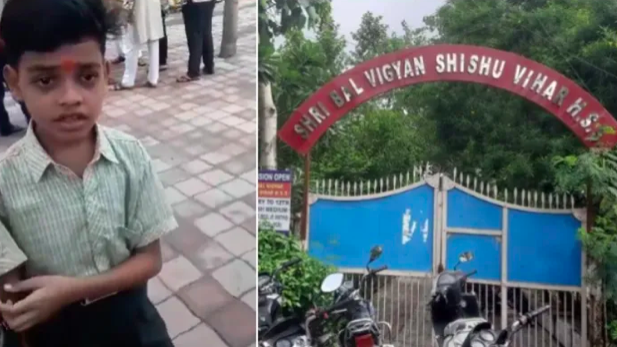
Case Summary
On July 8, 2023, in Indore, Madhya Pradesh, students from a private school were beaten for sporting tilak on their foreheads. Reports state that 6-7 students were slapped and threatened with expulsion, while one was also removed from the school premises by the teacher at Bal Vigyan Shishu Vihar Higher Secondary School. The students were also threatened with being removed and issued TC if they continued to sport tilak on the school premises. The incident caused controversy after parents learned about it and confronted Principal Omprakash Singh, who defended the teacher's actions, citing a policy against tilak on school premises. A viral video captured the teacher mentioning the school's principle of "sarva dharma sambhaav" (equality among religions). Parents protested, arguing that their children wear tilak due to religious practices. The Principal indicated that the issue would be resolved after guidance from the District Education Officer (DEO). DEO Manglesh Kumar Vyas addressed the matter, emphasising the importance of maintaining religious harmony in schools and allowing students to wear tilak on special occasions without repercussions.
Why it is Hate Crime ?
As per case specifics, it has been placed under the sub-category- 'Restriction on expression of Hindu identity', under the prime category- 'Restriction/ban on Hindu practices' of the hate tracker. An example of the state-affected prejudicial and targeted orders against the Hindu community would be a government denying the right of a Hindu or a group of Hindus to hold a religious procession owing to the animosity of non-Hindu groups. Denial of the religious right of the Hindus to assuage the non-Hindu group which harbours animosity to a point where it could lead to violence against Hindus is not only a failure of law and order but is a prejudicial order against Hindus, denying them their fundamental rights to express their religious identity. An example of a hate crime against Hindus by a non-Hindu would be a non-Hindu institution forcing its Hindu employees to abandon religious symbols that a Hindu would wear as an expression of faith owing to inherent prejudice against the faith professed by the victim or a non-Hindu group of people restricting a Hindu group from constructing a place of worship simply because the demography of the area in which the temple is being built is dominated by non-Hindus. Such actions are driven by religious animosity and/or prejudice against Hindus and their faith and would therefore be categorized as a hate crime. Here, the Hindu students faced disciplinary action and physical punishment for sporting a Tilak at a private school where they were studying. In Hinduism, the Tilak holds deep religious, cultural, and spiritual significance. It symbolizes protection, blessings, unity, and commitment to spiritual and ethical principles. Its use across various rituals and ceremonies underscores its importance in the Hindu way of life and by forcefully removing the tilak, the Missionary school insulted the Hindu faith and displayed their deep disdain towards Hinduism. Furthermore, the Hindu students were physically assaulted and threatened with expulsion for openly displaying their Hindu identity. This type of attack involves not just physical violence but also the intent to demean or suppress the student's religious identity, which is a clear violation of their right to freely express their faith. The assault and threat were motivated by prejudice against the victim's Hindu identity, indicating a deep-seated intolerance and animosity the teacher of the school harboured against the Hindu faith. Since the central motivation, in this case, is religion, this case has been added as a hate crime. Another primary category this case is being added to 'Predatory Proselytisation' under the sub-category 'Proselytisation by grooming, brainwashing, manipulation or subtle indoctrination'. The case reveals that the Hindu victims were minors, indicating a lack of consent and genuine change of conscience. It is a well-established fact that children are more susceptible to manipulation since they are still developing emotionally, cognitively, and socially. Their brains are not fully matured, making them more vulnerable to influence and less capable of critically evaluating information. Moreover, subtle manipulation tactics can be difficult to detect, especially when employed by trusted authority figures in positions of influence. This makes it challenging for parents, to identify and address instances of religious manipulation in schools. In this case, the accused, teachers in a position of trust, demonstrated a clear animosity towards Hinduism by indulging in violence against the minor students for applying Tilak - a symbol and manifestation of the students' faith. The teachers essentially covertly tried to push the children towards Christianity by distancing them from their religion and practices. This sort of harassment is rooted in animosity towards the victim’s religious identity and is therefore documented as a religiously motivated hate crime in this Hindu hate tracker.
Victim Details
Total Victim
7
Deceased
0
Gender
- Male 0
- Female 0
- Third Gender 0
- Unknown 7
Caste
- SC/ST 0
- OBC 0
- General 0
- Unknown 7
Age Group
- Minor 7
- Adult 0
- Senior Citizen 0
- Unknown 0


Case Status
Unknown


Perpetrators Details
Perpetrators
Others
Perpetrators Range
One Person
Perpetrators Gender
female
 Sources




