CNN publishes anti-Hindu articles, portrays 2020 Delhi anti-Hindu riots as attack on Muslims
 Atlanta, Georgia, United States
  30 April, 2024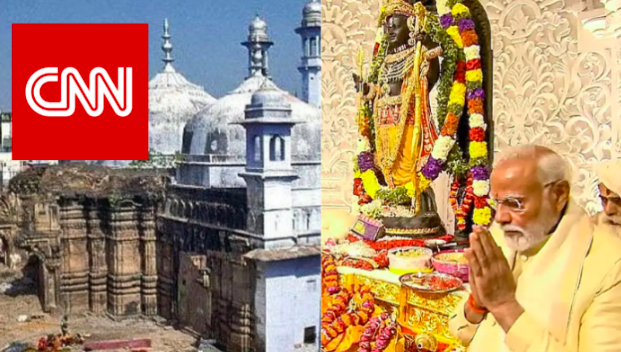
Case Summary
On May 1, 2024, CNN, a Western media house known for peddling anti-India, anti-Hindu rhetoric, published an op-ed titled "Rising Hindu nationalism leaves Muslims fearful in India’s holy city" wherein it falsely tried to present the 2020 anti-Hindu Delhi riots as an anti-Muslim pogrom. In the article, CNN went on to downplay the violence against Hindus during the 2020 Delhi riots and emphasised incidents affecting Muslims. Furthermore, CNN expressed concern over Hindus reclaiming religious sites like the Kashi Vishwanath Temple and the construction of the Ram Mandir in Ayodhya, claiming it threatens India's secular fabric. The article portrayed Muslims in Varanasi as fearful of Modi securing a third term. The article criticised the appointment of Hindu nationalists to government positions, citing Uttar Pradesh Chief Minister Yogi Adityanath. However, it failed to acknowledge the developmental strides made under Adityanath's leadership. CNN also criticised the abrogation of Article 370 in Jammu and Kashmir and the Citizenship Amendment Act (CAA). It portrayed the CAA as anti-Muslim without mentioning its provisions for persecuted religious minorities from neighbouring countries. The article thus promoted biased views and ignored historical evidence.
Why it is Hate Crime ?
This case has been added to the hate tracker under the prime category- Hate speech against Hindus. Under this, the sub-category chosen is- 'Anti Hindu subversion and prejudice', within which 'Anti-Hindu Fake News or Downplaying' has been selected as the tertiary category. Hate speech is defined as any speech, gesture, conduct, writing, or display that is prejudicial against a specific individual and/or group of people, which is leading to or may lead to violence, prejudicial action or hate against that individual and/or group. Media plays a specific and overarching reach in perpetuating prejudicial attitudes towards a community owing to unfair, untrue coverage and/or misrepresentation/misinterpretation, selective coverage and/or omission of facts of/pertaining to issues affecting a specific religious group. This type of bias can dehumanise the victim group, making it easier for others to justify harmful actions against them, which aligns with the objectives of hate speech laws aimed at preventing such harm. It is often observed that the media takes a prejudicial stand against the Hindu community driven by their need to shield the aggressor community which happens to be a numeric minority, however, is the one perpetrating violence against Hindus. For example, the media is often quick to contextualise religiously motivated crimes against Hindus, omit or misrepresent facts that point towards religiously motivated hate crimes, justify and/or downplay religiously motivated hate crimes or simply present fake news to stereotype Hindus. Such media bias leads to the denial of persecution and is often used to dehumanise Hindus, leading to justification for violence against them. For example, the media covered several fake allegations of Hindus targeting Muslims and forcing them to chant Jai Shree Ram. Most of these cases were proved false and fabricated after police investigation. These fake news reports were subsequently never retracted or clarified. Such fake news led to the justification of violence and dehumanisation of Hindus based on the argument that since Hindus targeted Muslims and forced them to chant Jai Shree Ram, the dehumanisation of Hindus and violence against them was par for the course and merely a retaliation. Such media bias leads to prejudicial portrayal of Hindus and offers a justification for violence against them and therefore, is considered hate speech under this category. The CNN op-ed titled "Rising Hindu nationalism leaves Muslims fearful in India’s holy city," published on May 1, 2024, displays prejudice against Hindus by selectively portraying events and pushing an anti-Hindu narrative. On the 24th and 25th of February 2020, India’s national capital Delhi saw large-scale anti-Hindu riots which marked the culmination of the hostility, hatred, and anger spread by the anti-CAA protests by the Islamists in Shaheen Bagh and other areas. Shahdara, Maujpur, Bhajanpura, Brahmapuri, and other parts of northeast Delhi witnessed violence perpetrated by the Islamists. 53 people died in these riots while more than 200 people were left injured. While many people wish to look at the Delhi Riots 2020 in isolation, the sequence of events starting right from the 1st of December 2019 proves otherwise. It proves that the violence was a concerted effort to push India toward anarchy. It proves that the Delhi Riots was no anti-Muslim pogrom, it was indeed, a well-oiled plan against Hindus. OpIndia had extensively covered the anti-Hindu riots, which were falsely presented by the mainstream media as an anti-Muslim pogrom, and established facts documenting tragic cries of Hindus which would otherwise have gone unheard. The damage to the property in these riots had been enormous. An Intelligence Bureau Constable was murdered in the riots along with a Head Constable of the Delhi Police. Amidst all of this, one gun-wielding man was spotted brandishing his gun at the Police and firing shots. The rioter was identified as Shahrukh. A Hindu man Dilbar Negi was burnt to death after his hands and legs were chopped off by Jihadis. CNN's article inaccurately presented the 2020 Delhi riots as an anti-Muslim pogrom while downplaying the violence inflicted on the Hindu community during the same riots. This selective reporting distorted the reality of the events and fostered a skewed narrative, portraying Muslims as the victims. Additionally, CNN’s criticism of Hindus reclaiming religious sites, such as the Kashi Vishwanath Temple and the Ram Mandir in Ayodhya, reflected a bias against Hindus asserting their religious and cultural rights. The article frames these efforts as threats to India's secularism, ignoring the historical significance of these sites and the long-standing grievances of the Hindu community. Overall, the op-ed promoted a biased and selective narrative, focusing solely on perceived threats to Muslims while ignoring historical, legal, and developmental contexts crucial to understanding India's socio-political landscape. Such biased reporting fosters animosity against the Hindu community and perpetuates harmful stereotypes. By consistently framing Hindus as aggressors and ignoring or downplaying violence or injustice against them, this type of media bias contributes to creating a hostile environment. When media outlets intentionally fuel division and provoke anti-Hindu sentiments, it crosses into the realm of incitement, which can contribute to real-world consequences such as discrimination, violence, or social exclusion of Hindus. This deliberate targeting of Hindus and their beliefs through one-sided narratives serves to malign their identity, culture, and faith, aligning with the broader scope of hate crimes that aim to marginalize or vilify a specific religious community.


Case Status
Unknown


Perpetrators Details
Perpetrators
Others
Perpetrators Range
N/A
Perpetrators Gender
unknown
 Sources




