Muslim mob attack Hindu homes during Kartik Puja celebration after accusing Hindus of committing ‘blasphemy’
 Murshidabad, West Bengal, India
  15 November, 2024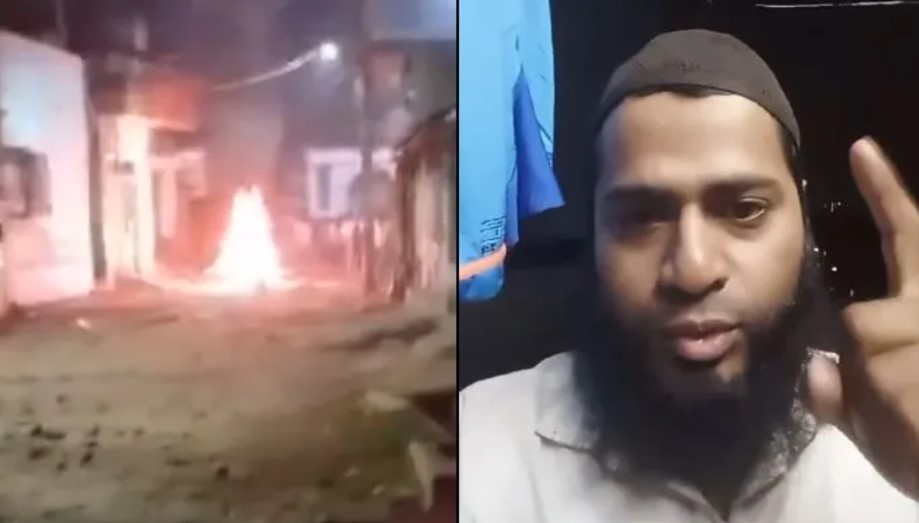
Case Summary
On 16th November, a frenzied Muslim mob unleashed attacks on Hindu homes in Beldanga town in Murshidabad district of West Bengal. The attack coincided with the Kartik Puja celebration, observed by the Hindu community across the State. The Muslim mob resorted to arson and stone pelting after accusing Hindus of committing ‘blasphemy.’ In a video that went viral, a Muslim man (sporting a skull cap) could be seen issuing threats to the Hindu community and calling upon other co-religionists to unleash havoc in Beldanga. He encouraged his fellow co-religionists to come to Beldanga and run riots in the town to avenge alleged blasphemy. “We don’t want legal justice or fines. Just hand over the blasphemer to us,” the Muslim man hinted at mob lynching. He called out other Muslims to unleash terror in Beldanga and bury the one who committed ‘blasphemy’.
Why it is Hate Crime ?
This case has been added under two prime categories of the tracker as distinct elements here demonstrate that the crime was committed while harbouring a bias against the Hindu faith. The first category under which this case has been placed is- Attack not resulting in death. Within this, the sub-category selected is- Attacked for 'blasphemy'. Blasphemy essentially refers to the desecration of anything which is held sacred/holy to a group of people. However, for religious supremacist groups, the elements of ‘blasphemy’ are ever-changing, shifting and expanding – leading to infringement on the rights of other religious groups, freedom of speech and expression, threats and even physical violence. There are instances where blasphemy is also used as a dog whistle to target Hindus owing to intrinsic animosity towards Hinduism. There are several instances where stating truths as mentioned in the non-Hindu doctrine itself has led to unmitigated violence against Hindus. There have also been instances where non-Hindus have themselves created a ‘blasphemous’ situation, like placing a Quran in a temple, to use it as an excuse to attack Hindus. Essentially, Blasphemy charges are often made up and/or are used to shut down any form of criticism of non-Hindu faiths and as a tool to target Hindus. Any physical violence over Blasphemy charges against Hindus are foundationally based on animosity for Hindus and their faith owing to religious supremacist ideologies, therefore, such attacks would be documented as religious motivated hate crimes under this category. The second prime category relevant here is- Hate speech against Hindus and under this, the sub-category selected is- Violent threats. Violent threats, explicit, implicit or implied, is the most dangerous form of hate speech since it goes beyond discriminatory and prejudicial language to express the intent of causing harm to an individual or a group of people based on their religious identity and faith. There could be several different kinds of threats that are issued to Hindus based on religious animosity. An explicit threat would mean the direct threat of violence towards an individual Hindu, a group of Hindus or Hindus at large. Physical violence, death threats, threats of destruction of property belonging to Hindus and threats of genocide would mean explicit threats against Hindus for their religious identity. Implicit threats may not be a direct threat but implied through the use of symbols of actions – for example – in the Nupur Sharma case, other than explicit threats, there were also implicit threats when Islamists took to the streets to burn and beat her effigies. It implies that they want to do the same to Nupur Sharma – thereby is considered an implicit threat. Violent threats can be delivered in person, through letters, phone calls, graffiti, or increasingly through social media and other online platforms. It would be important to understand that a threat – explicit or implicit, online or offline – to an individual who happens to be a Hindu does not qualify as a religiously motivated threat. Such a threat, while vile and dangerous, could be owing to non-religious reasons and/or personal animosity. To qualify as a religiously motivated threat, it would need to exhibit an indication that the individual is being targeted for religious reasons and/or owing to his/her religious identity as a Hindu. The violent actions against the Hindu community in Beldanga were triggered by accusations of blasphemy. This perceived offence against their religious sensibilities was used as a justification to unleash violence upon the Hindu community. As seen in several cases, this law is often used as a tool of oppression and violence, leading to false accusations, mob justice, and social ostracisation of Hindus. This law, which is sparingly used in Muslim-majority countries like Pakistan and Bangladesh to attack minority Hindus residing there, has become increasingly common in India too, where bloodthirsty Islamists often twist and use these laws to settle their scores with Hindus. The misuse of blasphemy laws against Hindus is often motivated by religious prejudice, which was evident in this case too, as the Muslim mob targeted Hindu homes during the Kartik Puja celebration, an important religious occasion, using accusations of blasphemy to justify arson and stone-pelting. Additionally, the Muslim man in the viral video explicitly issued violent threats against Hindus, reflecting deep-seated animosity towards them. By calling for terror to be unleashed in Beldanga and demanding mob justice rather than legal recourse, he openly incited violence against the Hindu community. His rhetoric, urging co-religionists to avenge alleged blasphemy and threatening mob lynching, underscores the hostility and intolerance that fueled the attack. These violent threats were not only an attempt to intimidate Hindus but also a clear expression of animosity towards their faith and identity and for these reasons, this case has been added to the tracker. Disclaimer: Here, while speaking to OpIndia, a resident of Baldanga informed us on the condition of anonymity that crude bombs were hurled and over 20 Hindus were injured, however, since official figures, as reported by the media, suggest only 6 injuries, we have added the victim count as 6 in the database.
Victim Details
Total Victim
6
Deceased
0
Gender
- Male 0
- Female 0
- Third Gender 0
- Unknown 6
Caste
- SC/ST 0
- OBC 0
- General 0
- Unknown 6
Age Group
- Minor 0
- Adult 0
- Senior Citizen 0
- Unknown 6


Case Status
Case sub-judice


Perpetrators Details
Perpetrators
Muslim Extremists
Perpetrators Range
From 10 to 100
Perpetrators Gender
unknown
 Sources




