Hindus harassed and forced to convert to Islam at Jamia Millia Islamia
 Delhi, Delhi, India
  14 November, 2024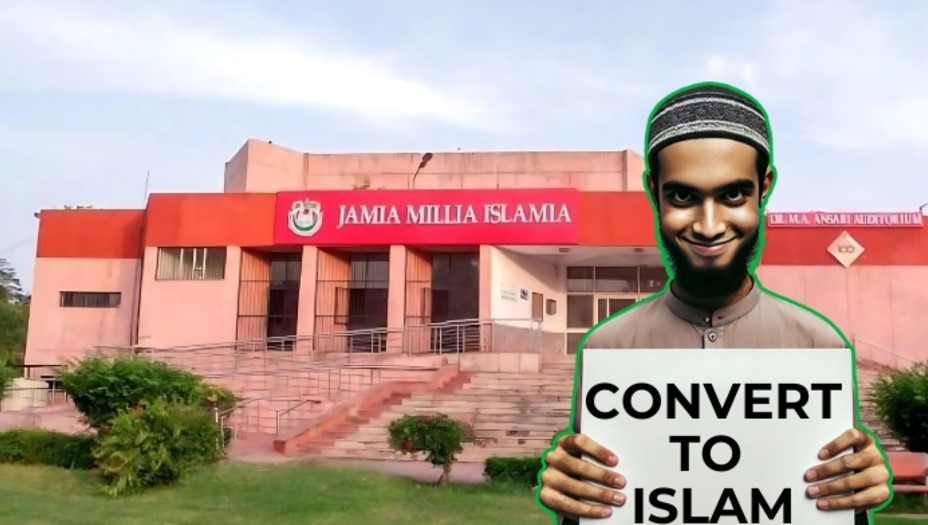
Case Summary
On November 15, a Fact-Finding Committee (FFC) formed by the Delhi-based NGO- Call for Justice, unveiled grave allegations of religious discrimination and forced conversions at Jamia Millia Islamia, a minority institution in Delhi. The committee gathered testimonies from 27 individuals, including teaching staff, non-teaching staff, students, and alumni of the university. These accounts detailed a troubling atmosphere of discrimination and alleged coercion to convert to Islam. Due to concerns about potential retaliation, the committee kept the identities of several witnesses confidential. The report shed light on instances of Hindu staff being denied promotions, students experiencing academic bias, and a pervasive culture of pressure to abandon their faith. One witness testified that she faced continuous pressure to convert to Islam. Her colleagues frequently criticised Hindu faith and customs, urging her to adopt Islam for “safety and dignity.” When she refused, incidents of harassment increased, including being overburdened with work, professional isolation, and being bypassed for opportunities. She alleged that such practices were common against non-Muslims within the university. Another revealed that a senior faculty member, Professor Amutul Halim, threatened her with acid attacks and rape if she did not embrace Islam. Yet another eyewitness testified that after joining the university, his Headmaster, Mohammed Murshalim, openly expressed surprise that a Hindu teacher had been hired. He subjected him to degrading tasks, including washing dirty cups, while abusing him with casteist slurs intended to demean him as a member of the Scheduled Caste (SC).
Why it is Hate Crime ?
The first prime category of the database within which this case has been documented is- Predatory Proselytisation. Under this, the sub-category selected is- Harassment, threat, coercion for conversion. Harassment covers a wide range of behaviours of an offensive nature. It is commonly understood as behaviour that demeans, humiliates, and intimidates a person, including threats and coercion. Harassment and threats, in this case, find their root on discriminatory grounds which has the effect of nullifying a person’s rights or infringing upon his freedom to exercise his right specifically owing to the victim’s religious identity. Verbal and physical threats and psychological or physical harassment are often used against Hindu victims because they choose to practice their professed religion. Religious harassment also includes forced and involuntary conversions by harassment, threats or coercion. Coercion includes intimidatory tactics like force-feeding a Hindu victim beef to convert to another religion, forceful circumcision etc. In several cases documented, non-Hindu perpetrators or those who harbour specific animosity towards Hinduism, harass victims simply based on their religious identity. Such cases often also include harassment to ensure the Hindu victim abandons his/her professed religion and adopts the religion of the perpetrator. In this subcategory, we would only include cases where the victim was harassed, threatened or coerced to convert. Cases where attempts were made to convert but the victim resisted would be documented in another sub-category. Such cases where Hindu victims are harassed to convert to the perpetrator’s religion are rooted in animosity towards the victim’s religious identity and are therefore documented as religiously motivated hate crimes. The second category selected here is- Attack not resulting in death and within this, the sub-category selected is- Attacked for Hindu identity. In several cases, Hindus are attacked merely for their Hindu identity without any perceived provocation. A classic example of this category of religiously motivated hate crime is a murder in 2016. 7 ISIS terrorists were convicted for shooting a school principal in Kanpur because they got ‘triggered’ seeing the Kalava on his wrist and tilak that he had put. In this, the Hindu victim had offered no provocation except for his Hindu religious identity. The motivation for the murder was purely religious, driven by religious supremacy. Such cases where Hindus are targeted merely for their religious identity would be documented as a hate crime under this category. The third category under which this case has been placed is- Hate speech against Hindus. Within this, the sub-category selected is- Anti-Hindu slurs, mocking faith. Anti-Hindu slurs and the deliberate mocking of the Hindu faith owing to religious animosity involve the usage of derogatory terms, stereotypes, or offensive references to religious practices, symbols, or figures. One of the common anti-Hindu slurs used against Hindus is “cow-worshipper” and “cow piss drinker”. The intention of using this term is to demean and mock Hindus as a group and their religious beliefs since Hindus consider the cow holy. Additionally, some symbols and the slurs attached to them have a historical context that exacerbates the insult, hate, stereotyping, dehumanisation and oppression against Hindus. Cow worship has been used for centuries to denigrate Hindus, insult their faith and oppress Hindus specifically as a religious group. There has been overwhelming documentation about how cow slaughter has been used to persecute Hindus with cow meat being thrown in temples and places of worship. There has also been overwhelming documentation where cow meat (beef) has been force-fed to Hindus to either forcefully convert them to Islam or denigrate their faith. Apart from cow worship, the Swastika – which holds deep religious significance for the Hindus – has also been misinterpreted and distorted to use as a slur against Hindus. Similarly, the worship of the Shivling has been used by supremacist ideologies and religions to denigrate Hindus owing to religious animosity. Such slurs and denigration stem out of inherent animosity and hate towards Hindus and their faith, therefore, it is categorised as hate speech targeted at Hindus specifically owing to their religious identity. This case reflects multiple facets of religious animosity that led to the harassment of Hindu students and staff at Jamia Millia Islamia. The targeted harassment, as revealed through testimonies, showcases a pattern of systematic hostility toward individuals because of their Hindu identity. The victims faced an environment where their faith and customs were criticised, and there were attempts to coerce them into abandoning their religion, often through intimidation, threats, and professional marginalisation. The specific allegations, such as acid attack threats, casteist abuse, and discriminatory practices like denying promotions or creating biased academic hurdles, underline a pervasive culture of religious intolerance. Furthermore, the use of anti-Hindu slurs and ridicule aimed at undermining their beliefs adds another layer of animosity. Here it may be argued that that a caste-specific slur is aimed at her micro identity of belonging to the Dalit section of the Hindu community and not her Hindu identity itself. However, as far as Abrahamic religions are concerned, the micro identities of caste, region, and language are secondary. It is the religious identity that drives the animosity of the perpetrator against the Hindu victim. In this case, while JMU's headmaster, Mohammed Murshalim hurled caste abuses at one of the victims, the animosity was driven by his animosity towards Hinduism and Hindus. Therefore, the fact that caste slurs were hurled at the victim by the perpetrator makes it a religiously motivated hate crime against the victim. Since the harassment was a product of religious animosity, this case is being categorised as a religiously motivated hate crime.


Case Status
Unknown


Perpetrators Details
Perpetrators
Muslim Extremists
Perpetrators Range
Unknown
Perpetrators Gender
unknown
 Sources




