Hindu family attacked in Altapur: Muslim mob assaults, woman molested, idols of Durga and Manasha desecrated
 Uttar Dinajpur district, West Bengal, India
  7 March, 2024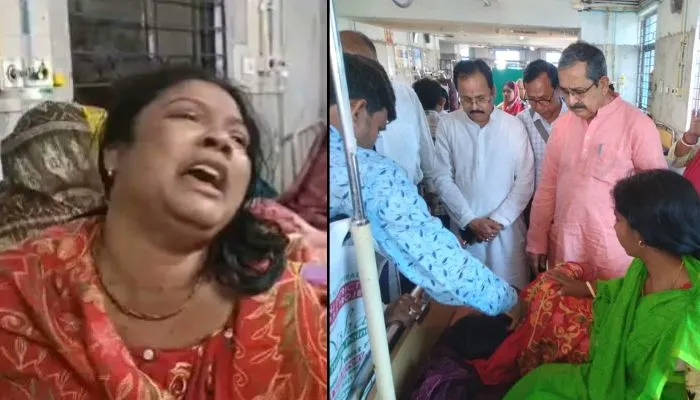
Case Summary
In Altapur village, Karandighi, Uttar Dinajpur district, West Bengal, the wife of BJP booth president Rajkumar Das was attacked by a Muslim mob. She recounted that 300-400 people surrounded her home, broke windows and doors, and looted belongings, including furniture, appliances, and utensils. The attackers also vandalised idols of Goddess Durga and Goddess Manasha. The victim narrated that her son was assaulted, resulting in a broken leg, while her daughter suffered a fractured hand. She was injured by bricks thrown at her, causing her to bleed from her ears. She reported that her clothes were torn and that the attackers targeted her family because of their political affiliation with the Bharatiya Janata Party. Her husband had gone into hiding due to threats they had received since he contested the elections. On March 9, BJP MLA Dr. Ashok Kumar Lahiri visited the victim at the Raiganj district hospital and demanded strict action against the culprits. He called the attackers "TMC-sponsored goons." BJP MP Locket Chatterjee also condemned the incident, stating that Hindu persecution was ongoing in West Bengal. The Raiganj police, however, denied any communal angle to the case four days later. The police framed the incident as an altercation and scuffle between two neighbouring families over the supply of irrigation water, resulting in injuries on both sides
Why it is Hate Crime ?
This case has been added to the tracker under the prime category- Attack not resulting in death. The sub-category relevant in this case is- Attacked for Hindu identity. In several cases, Hindus are attacked merely for their Hindu identity without any perceived provocation. A classic example of this category of religiously motivated hate crime is a murder in 2016. 7 ISIS terrorists were convicted for shooting a school principal in Kanpur because they got ‘triggered’ seeing the Kalava on his wrist and tilak that he had put. In this, the Hindu victim had offered no provocation except for his Hindu religious identity. The motivation for the murder was purely religious, driven by religious supremacy. Such cases where Hindus are targeted merely for their religious identity would be documented as a hate crime under this category. The other sub-category selected is- Communal clash/attack. Communal clash is a form of collective violence that involves clashes between groups belonging to different religious identities. For a communal clash between Hindus and non-Hindus to qualify as a religiously motivated hate crime, the trigger of the violence itself would have to be anti-Hindu in essence. For example, if there is a Hindu religious procession that comes under attack from a non-Hindu mob and after the initial attack, Hindus retaliate in self-defence, leading to a communal clash between the two religious communities. While at a later stage, both communities are involved in the clash/violence, the initial trigger of the violence was by the non-Hindu mob against the Hindus and therefore, it could safely be termed as an anti-Hindu violence. Further, the trigger would also have to be religiously motivated. In the cited example, the attack by the non-Hindu mob was against religious processions and therefore, can be concluded to be religiously motivated. In some cases, the trigger may be non-religious, however, it develops into religious violence against Hindus at a later stage. In such cases too, the foundational animosity towards Hindus becomes the motivating factor of the crime and therefore, it would be classified as a religiously motivated hate crime against Hindus under this category. The other sub-category selected is- Attacked for supporting/being part of perceived Hindu party/org or working for Hindu community. In several cases, Hindus are attacked specifically or tangentially for their association with parties or organisations perceived to be pro-Hindu and/or for working in favour of the Hindu community. One of the classic cases was the attack against a Bharatiya Janata Party Yuva Morcha (BJYM) worker Praveen Nettaru. Nettaru was attacked and hacked to death for his association with Hindu organizations and his work for the Hindu community. He was murdered by PFI, a terror organization which aimed to commit a genocide of Hindus, target Hindu leaders specifically and turn India into an Islamic Nation. In such cases, it is possible that the immediate trigger for the violence is non-religious – either according to the perpetrator or the police. However, there are surrounding circumstances from which the conclusion can be reached that the victim was attacked for his association with a Hindu organization. In a similar case, Rinku Sharma was attacked by radicals. He was a member of Bajrang Dal and regularly worked for the Hindu community. While the police cited a different non-religious trigger for the attack, it is true that he was associated to a Hindu organization and the family of Rinku Sharma specifically attributed his gruesome murder to him working for Bajrang Dal and raising Jai Shree Ram slogans. Such cases are intrinsically driven by religious hate and would therefore be documented as a hate crime under this category. The other primary category selected is- Attack on Hindu religious representations. The other sub-category selected is- Desecration of Hindu religious symbol. Icons and symbols or a religious representation of a spiritual ideal are widely revered in Hinduism. Iconography is of vital significance in the Hindu milieu. It helps connect people’s spiritual beliefs with the real world. Iconography within the Hindu faith takes several shapes and forms. Murtis are of most significance to Hindus, to which daily rituals, prayers and offerings are done. Besides the murtis, there are several other symbols which have deep significance in the Hindu faith – the Om and Swastika for example. Since these Hindu religious symbols hold paramount importance in Hinduism, any desecration of symbols, icons, murtis, religious representations and manifestations, is driven by animosity towards the faith itself which manifests itself through these murtis, icons and symbols. Therefore, any desecration of these Hindu religious symbols and representations is considered religiously motivated hate crimes under this category. In the Altapur village incident, the victim and her family were targeted explicitly because of their Hindu identity. The Muslim mob surrounded their home, vandalised property, and physically assaulted family members, leaving the son with a broken leg and the daughter with a fractured hand. The attackers also tore the woman’s clothes and hurled bricks, causing her to bleed. Importantly, no act of provocation from the victims was reported; rather, the attack stemmed from their identity as Hindus and their visibility in local politics. The violence in this case was therefore not incidental but an expression of religious and identity-based hostility, making it a clear instance of being attacked for Hindu identity. A large Muslim mob of 300–400 individuals attacked the house of one Hindu family, leaving them severely injured and their home looted. The magnitude and organisation of the assault show that this was not a mere personal quarrel but a collective targeting rooted in communal hostilities. Even if some pretext was cited to explain the violence, the intensity of the attack and the involvement of such a large group reflect communal mobilisation against Hindus. In the Altapur case, the victim’s family was targeted not only because of their Hindu identity but also because of their association with the Bharatiya Janata Party, a party widely perceived as pro-Hindu. The woman herself recounted that her family was attacked because her husband, a BJP booth president, had contested elections and was under constant threat thereafter. The mob attack was therefore not random; it was aimed at punishing the family for their political affiliation, which was seen as aligned with Hindu interests. The attackers deliberately vandalised the household idols of Goddess Durga and Goddess Manasha, an act that goes beyond personal hostility or material looting. These deities hold deep religious significance, and their desecration represents a symbolic assault on the Hindu faith itself. In Hindu tradition, murtis are not just artistic objects but sacred embodiments of divine presence, worshipped daily through rituals and offerings. The wilful destruction of such icons is a direct act of desecration and reflects hostility towards the religious identity of Hindus. By targeting the sacred symbols that embody Hindu spirituality, the attackers manifested their animosity against the religion itself, making this an incident of hate crime against Hindus. In the Altapur incident, despite the scale of the violence—where a mob of 300–400 people attacked the home of a Hindu family, looted belongings, assaulted family members, and desecrated Hindu idols—the police denied any communal angle. Instead, they framed the incident as a scuffle between two neighbouring families over the supply of irrigation water. However, testimonies from the victim’s family and local residents indicate that the attack was deliberate and targeted. The victim herself narrated that her family was attacked because of her husband’s association with the Bharatiya Janata Party and that the mob specifically vandalised the idols of Goddess Durga and Goddess Manasha, acts that clearly indicate hostility against the Hindu faith. The police, in many such cases, where the motive behind the crime is obvious but not explicitly mentioned, deny that the crime committed was in any way motivated by a religious bias or say that there was ‘no communal angle’ to the crime. Several factors are generally at play here. Many a time, the police downplay incidents of low-level communal crime because it is their jurisdiction comes under question. The police also often say that there was ‘no communal angle’ to a crime when there was one because they wish to ensure that, owing to the crime already committed, there is no further flare-up in the area. Likewise, the Left media and the leftist elite are also inclined to emphasise this "no communal angle" trope, especially wherever the victim of the crime is a Hindu. However, only a police statement or a media report, for instance, cannot be enough to determine whether there is a communal angle present in the crime that has been committed. In fact, to determine whether the crime is communal in nature or not, we need to give emphasis to the ground realities. For example, in the case of Rinku Sharma, the Bajrang Dal activist who was mercilessly stabbed in his house in front of his family members in Delhi’s Mangolpuri area in the year 2021, the leftist media and the leftist ecosystem had tried to peddle that there was no communal angle to the crime. Even the police denied that the crime was communal in nature. However, Opindia spoke to several people who are on the ground with the family of Rinku Sharma, and we were told that the communal tension in the area is palpable. The family of Rinku Sharma has said that the Muslims of the area held a grudge against Rinku ever since he celebrated the Ram Mandir verdict Like the case of Rinku Sharma, those cases where even if the police have denied a communal angle or the leftist media have gone on an overdrive to peddle the ‘no communal angle’ trope, the ground reality, like the victim’s family or relative's testimonies, make it clear that there was an obvious religious bias that led to the crime, will be documented in this tracker. The scale of the mob attack, the desecration of Hindu idols, and the targeting of a family due to their Hindu political affiliation cannot reasonably be reduced to a quarrel over irrigation water. For this reason, despite the police narrative, the ground realities and eyewitness accounts make it evident that the incident was religiously motivated, and it has therefore been included in the hate crime tracker.
Victim Details
Total Victim
3
Deceased
0
Gender
- Male 1
- Female 2
- Third Gender 0
- Unknown 0
Caste
- SC/ST 0
- OBC 0
- General 0
- Unknown 3
Age Group
- Minor 0
- Adult 1
- Senior Citizen 0
- Unknown 2


Case Status
Complaint filed


Perpetrators Details
Perpetrators
Muslim Extremists
Perpetrators Range
Unknown
Perpetrators Gender
male
 Sources




