Antique temple artefacts sold as scrap by Tamil Nadu govt officials
 Kallakkurichchi, Tamil Nadu, India
  15 December, 2024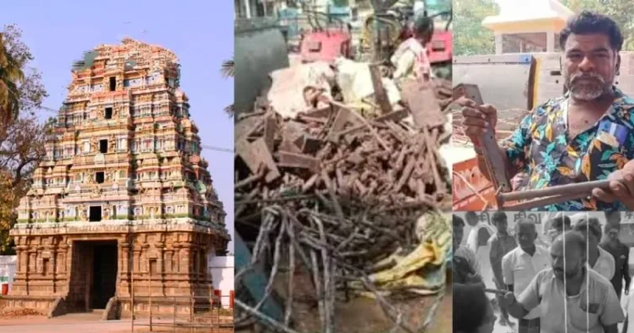
Case Summary
In Kallakurichi, a tractor, carrying items from the Thirunavalur Bhaktajaneswarar temple, was caught attempting to sell rare and antique artefacts as scrap. The items, including panchaloga artefacts, wooden doors, and pooja articles, were loaded on the tractor, which had been hired by the HR and CE department staff. The temple management had intended to dispose of iron rods and wooden items stored in a room, claiming they were scrap. However, when the tractor stopped at a scrap dealer shop in Pu Mambakkam, the public grew suspicious and questioned the tractor driver, who pointed to the shop owner, claiming the sale had been authorised by the temple Executive Officer (EO). Upon closer inspection, the public realised that valuable temple properties, including precious pooja items, were being sold under the guise of scrap. A confrontation ensued, with Madeena, a temple official, arriving at the scene. She engaged in a heated argument with the public, who had seized the tractor, and threatened them with action for preventing an official from performing her duties. Madeena defended the sale, stating it was authorised by the EO to provide salaries for the temple staff. However, the villagers remained unconvinced, and they refused to release the tractor. The public’s intervention led to a formal complaint being lodged with the Thirunavalur police against the EO, his assistant, and the tractor owner for taking and selling the temple’s valuable items. Hindu Munnani, a local group, condemned the incident, stating that several crore-worth of sacred temple artefacts were stolen and sold without the knowledge of the devotees. The incident raised serious concerns about the management of temples under the HR and CE department, which has been accused of mismanagement, embezzlement, illegal sale of temple properties, and preventing religious practices. The public outrage intensified calls for freeing temples from government control to ensure the preservation of religious and cultural heritage.
Why it is Hate Crime ?
The case has been added to the tracker under the prime category 'Attack on Hindu religious symbols'. Under this, the sub-category selected is- Desecration of Hindu religious symbol. Icons and symbols or a religious representation of a spiritual ideal are widely revered in Hinduism. Iconography is of vital significance in the Hindu milieu. It helps connect people’s spiritual beliefs with the real world. Iconography within the Hindu faith takes several shapes and forms. Murtis are of most significance to Hindus, to which daily rituals, prayers and offerings are done. Besides the murtis, there are several other symbols which have deep significance in the Hindu faith – the Om and Swastika for example. Since these Hindu religious symbols hold paramount importance in Hinduism, any desecration of symbols, icons, murtis, religious representations and manifestations, is driven by animosity towards the faith itself which manifests itself through these murtis, icons and symbols. Therefore, any desecration of these Hindu religious symbols and representations is considered religiously motivated hate crimes under this category. This case qualifies as a religiously motivated hate crime under the category 'Attack on Hindu religious symbols,' specifically the sub-category 'Desecration of Hindu religious symbols,' due to the deliberate mishandling and misappropriation of sacred artefacts belonging to the Thirunavalur Bhaktajaneswarar temple. The attempt to sell rare and antique temple items, including panchaloga artefacts, pooja articles, and wooden doors, as scrap reflects blatant disrespect for the sacredness and cultural significance of these symbols within Hinduism. These items are not merely objects but hold profound religious and historical importance, serving as representations of faith and devotion. The involvement of temple officials, particularly under the HR and CE department’s management, further exacerbates the issue, as their actions directly betray the religious community they are meant to serve. By treating these sacred artefacts as disposable commodities, the perpetrators disregarded their religious value and desecrated symbols of worship. Such acts of desecration demonstrate not only gross mismanagement but also a deeper apathy or hostility toward Hindu religious sentiments and practices, making this case worthy of being documented here, in the database.


Case Status
Complaint filed


Perpetrators Details
Perpetrators
State and Establishment
Perpetrators Range
Unknown
Perpetrators Gender
unknown
 Sources




