Hindu man lured to convert to Chrsitianity by promises of miracle cure, threatened with life when he refuses
 Sultanpur, Uttar Pradesh, India
  16 November, 2024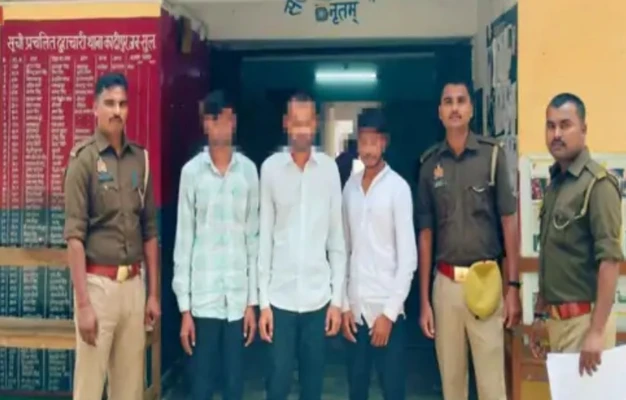
Case Summary
A Hindu man named Vijay Kumar Pandey accused three Christian evangelists of attempting to convert local Hindus to Christianity through coercion and inducements. The incident occurred in Jalalpur village within the Kadipur Kotwali area, where the accused were conducting healing rituals and promising cures for ailments as a means to persuade locals to change their religion. Vijay Kumar Pandey said that he had gone to the market for his personal work. There he came to know that some people who treat diseases by black magic had visited the residence of Usha, wife of Rajendra Prasad, in Tawakklpur Nagara village. Pandey said that individuals were performing rituals under the guise of healing but were, in fact, promoting religious conversion. When he refused, the accused threatened to kill him. Based on his complaint, the three accused, namely, Rajendra Kumar, Chandan Singh Chauhan and Anurag Prajapati were arrested under various sections including illegal religious conversion.
Why it is Hate Crime ?
This case has been added as a religiously motivated hate crime under two prime categories of the tracker. The first is- Predatory Proselytisation and under this, the sub-category chosen is- Conversion/attempts to convert by inducement. Predatory Proselytisation is not just limited to threat, harassment, force and violence, but it also has contours of stealth. In several cases, the Hindu victim is exploited to convert, with non-Hindus taking advantage of their poverty. In such cases, the Hindu victim who is suffering financially is offered monetary benefits, including lucrative offers for jobs, health treatment, education, etc, to induce the victim into changing his/her religion. In such cases, the religious identity of the victim and the aim to disenfranchise him from his faith form the heart of the crime. Also, taking advantage of and exploiting an individual’s economic vulnerabilities is widely acknowledged as exploitation, forms of which are often penalised by law. Such cases therefore are considered religiously motivated hate crimes since the victim’s religious identity forms the very heart of the crime itself. The second category under which this case has been placed is- Hate speech against Hindus and within this, the sub-category selected is- Violent threats. Violent threats, explicit, implicit or implied, is the most dangerous form of hate speech since it goes beyond discriminatory and prejudicial language to express the intent of causing harm to an individual or a group of people based on their religious identity and faith. There could be several different kinds of threats that are issued to Hindus based on religious animosity. An explicit threat would mean the direct threat of violence towards an individual Hindu, a group of Hindus or Hindus at large. Physical violence, death threats, threats of destruction of property belonging to Hindus and threats of genocide would mean explicit threats against Hindus for their religious identity. Implicit threats may not be a direct threat but implied through the use of symbols of actions – for example – in the Nupur Sharma case, other than explicit threats, there were also implicit threats when Islamists took to the streets to burn and beat her effigies. It implies that they want to do the same to Nupur Sharma – thereby is considered an implicit threat. Violent threats can be delivered in person, through letters, phone calls, graffiti, or increasingly through social media and other online platforms. It would be important to understand that a threat – explicit or implicit, online or offline – to an individual who happens to be a Hindu does not qualify as a religiously motivated threat. Such a threat, while vile and dangerous, could be owing to non-religious reasons and/or personal animosity. To qualify as a religiously motivated threat, it would need to exhibit an indication that the individual is being targeted for religious reasons and/or owing to his/her religious identity as a Hindu. Here, the Hindu man complained that the Christian evangelists were overtly trying to convert villagers by offering them cures for their ailments. This was being done in an attempt to disenfranchise the vulnerable Hindus from their professed faith and convert them to Christianity. Luring Hindus to convert to a different faith by offering money and inducements such as miracle cures for ailments is predatory in nature since the extremists manipulate the specific vulnerabilities of disadvantaged and poor Hindus to manipulate them into conversion. This stems from inherent hostility towards the victim's professed faith since Abrahamic faiths believe that any non-adherent to the faith is a subject to be dehumanised till they convert. Since such predatory actions stem from doctrinal animosity towards the Hindu faith and its adherents, this case is being documented as a religiously motivated hate crime. Further, the victim also revealed that the accused tried to coerce him into conversion by threatening him with life. Such arm-twisting tactics are commonly employed by Christian evangelists to intimidate and compel vulnerable Hindus into abandoning their faith. These methods of fear-based proselytisation often target individuals who lack the means to resist, exploiting their vulnerability to achieve religious conversion. This case constitutes a religiously motivated hate crime as such actions are driven by intolerance towards the victim's religious identity and aim to coerce them into abandoning their faith, often accompanied by threats, violence, or other forms of intimidation. In this case, the pressure to convert and the subsequent threat clearly indicate a targeted action against the individual because of his religion and because of this, the case has been categorised as a hate crime. Disclaimer: The details of this case reveal that many villagers were lured to convert by the perpetrators. However, since it is explicitly mentioned that one Hindu man filed a complaint and confirmed the allegation of conversion, we have conservatively recorded the victim count as 1 in the database for accuracy and consistency.
Victim Details
Total Victim
1
Deceased
0
Gender
- Male 1
- Female 0
- Third Gender 0
- Unknown 0
Caste
- SC/ST 0
- OBC 0
- General 1
- Unknown 0
Age Group
- Minor 0
- Adult 1
- Senior Citizen 0
- Unknown 0


Case Status
Arrested


Perpetrators Details
Perpetrators
Christian Extremists
Perpetrators Range
From 5 to 10
Perpetrators Gender
male
 Sources




