Temple renovation in India stopped by Bangladesh border guard personnel because its sight will offend Muslims
 Karimganj, Assam, India
  4 December, 2024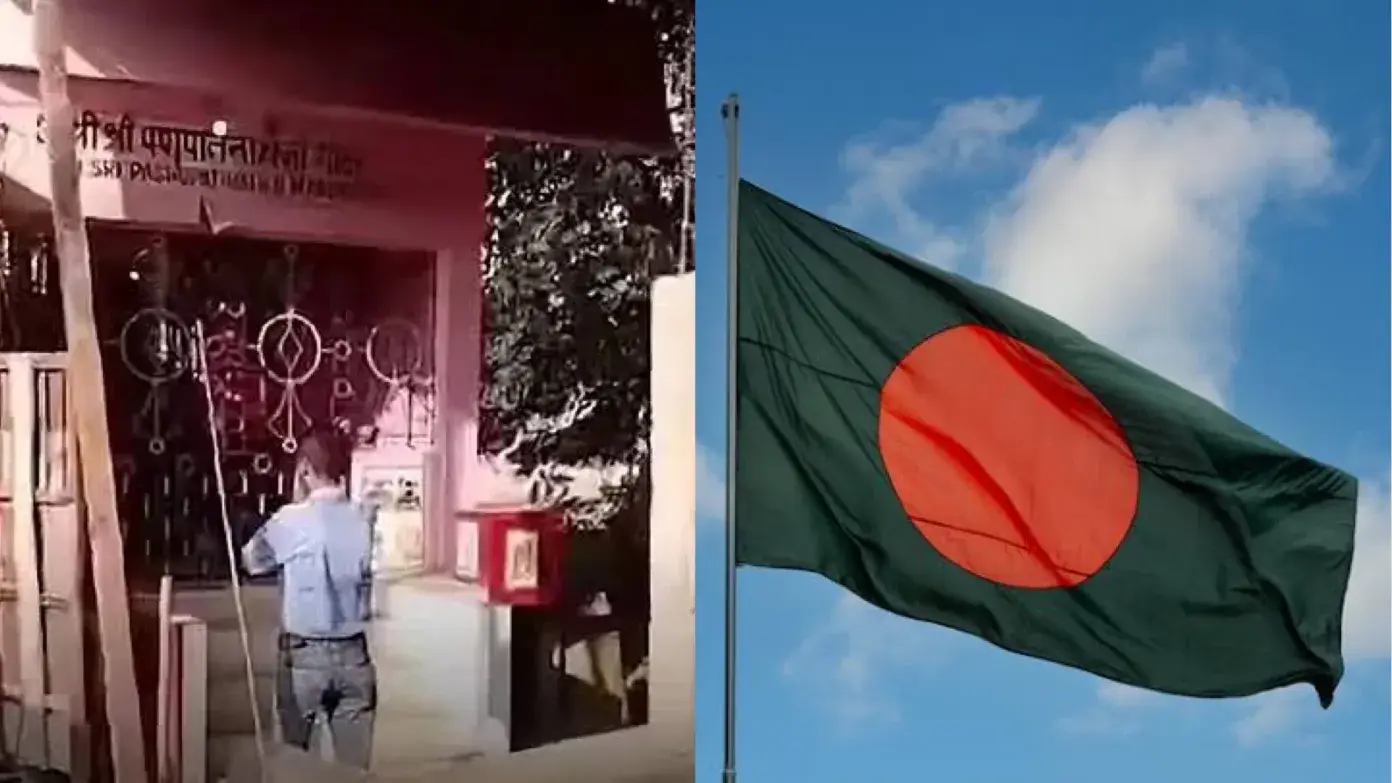
Case Summary
Few personnel from Border Guard Bangladesh (BGB) sneaked into India to stop the renovation of a Hindu temple, claiming that the sight of the temple would offend Bangladesh’s Muslims and touch off violence there. The incident took place at a temple near the Kushiyara River along the India-Bangladesh border in Assam’s Sribhumi district. The Assam government had sanctioned Rs 3 lakhs for the renovation and restoration of the Manasa Temple located at the immersion ghat at Kushiyara in Sribhumi. Some personnel belonging to the Zakinganj border outpost of the BGB crossed the river in a speedboat and confronted the workers at the temple over the restoration work, demanding an immediate halt to the construction. They also reportedly threatened the workers and local Hindu residents who had gathered at the place due to commotion. The BGB personnel also threatened to open fire from across the border if they saw the work resuming, stating that the temple’s visibility from across the river was offensive to their country’s Muslims and seeing a temple after namaz or from a mosque is “haram” as per Islam. The BSF had reportedly reached the place before the situation escalated and defused the tension between the villagers and the BGB team. The BSF team firmly told the BGB personnel that they had no authority to enter into the Indian territory and threaten Indian citizens for restoration work going on in the Indian territory. The BSF informed their BGB counterparts that the work over the temple would continue as per plan. Outnumbered and facing strong resistance from the BSF and locals, the BGB team retreated. Nevertheless, this action violated international laws and established border protocols, which mandate that the BGB must notify and obtain permission from the Border Security Force (BSF) before entering Indian territory. Additionally, these protocols prohibit both the BGB and BSF from carrying weapons while crossing into each other’s territory.
Why it is Hate Crime ?
This case has been added to two primary category - 'Attack on Hindu religious representations' and 'Restriction/Ban on Hindu practices'. Under the first primary category 'Attack on Hindu religious representations', the sub-category the case has been added to is 'attack on temples'. In Hinduism, a temple is the abode of the Deity. The Deity in the Temple is consecrated, thereby, making it a real, breathing entity. Hindus believe that not just the Deity but the temple premises itself are sacred to Hindus since Hindus hold the faith that the entire Temple space is an amalgamation of the divine energy of the deity. Given the central significance of Temples in Hindu Dharma, any attack against a Hindu Temple or its peripheral premises is an attack on the faith itself and is born out of animosity towards the faith, of which, the Temple is a central tenet. Any manner of attack against a Temple and/or its premises would therefore be considered a religiously motivated hate crime. Under the second primary category 'Restriction/Ban on Hindu practices', the sub-category this case is being added to is 'Restriction on Expression of Hindu identity'. An example of the state-affected prejudicial and targeted orders against the Hindu community would be a government denying the right of a Hindu or a group of Hindus to hold a religious procession owing to the animosity of non-Hindu groups. Denial of the religious right of the Hindus to assuage the non-Hindu group which harbours animosity to a point where it could lead to violence against Hindus is not only a failure of law and order but is a prejudicial order against Hindus, denying them their fundamental rights to express their religious identity. An example of a hate crime against Hindus by a non-Hindu would be a non-Hindu institution forcing its Hindu employees to abandon religious symbols that a Hindu would wear as an expression of faith owing to inherent prejudice against the faith professed by the victim or a non-Hindu group of people restricting a Hindu group from constructing a place of worship simply because the demography of the area in which the temple is being built is dominated by non-Hindus. Such actions are driven by religious animosity and/or prejudice against Hindus and their faith and would therefore be categorized as a hate crime. In this case, the Bangladesh border guards crossed over to India in order to stop the renovation/construction of a Temple because the very sight of the temple would offend the Muslims who consider representations of the Hindu faith as Haraam in Islam. Not only did the Bangladesh Border Guard display disregard for international laws, it also displayed hostility towards the Hindu faith. The very basis of the actions of the BBG was that the mere existence of the Temple is considered "haraam" in Islam and therefore, if renovated, it would offend the religious sentiments of Muslims. That the existence of the representation of the faith of Hindus is provocation and offence enough, is an example of the religious animosity which drove this action. Temples are an important representation of the faith of Hindus. If the existence of the article of faith offends a community, the scriptural notion then legitimises the eradication of the religious representations, the faith and its adherents as a religious mandate. This scriptural notion itself is dehumanising of non-Muslims, especially Hindus and justifies violence against them. The removal of Sheikh Hasina from power in Bangladesh on August 5 2024 has escalated the persecution and marginalisation of the Hindu minority in the predominantly Islamic nation, intensifying what can be described as a silent genocide. Since her ouster, Islamists have carried out unchecked atrocities against Hindus, including physical violence, the destruction of temples and religious symbols, and the systematic displacement of Hindus from their ancestral lands. Over 205 attacks on Hindu temples, shops, and businesses have been recorded following Sheikh Hasina's removal as Prime Minister. Many Hindus have been brutally murdered or injured in these assaults. The hostility displayed by the Bangladesh Border Guard is a manifestation of ongoing persecution of Hindus in Bangladesh which is now extending to the Bangladesh state attempting to stop all religious manifestations that would offend their Muslim population.


Case Status
Perpetrators not caught


Perpetrators Details
Perpetrators
State and Establishment
Perpetrators Range
From 10 to 100
Perpetrators Gender
male
 Sources




