Hindu students stopped from chanting "Jai Shri Ram", donning Tilak; Rakhis and Kalavas cut off by convent school missionary
 Bareilly, Uttar Pradesh, India
  30 August, 2023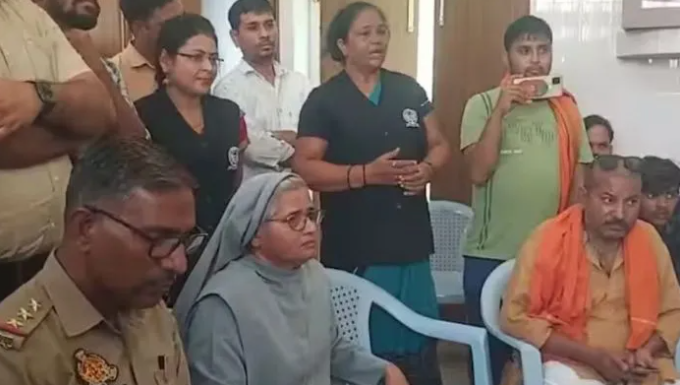
Case Summary
At Holy Family Convent School in Bareilly, Uttar Pradesh, Hindu students were prevented from celebrating Raksha Bandhan, and Rakhis tied to their wrists were cut. The students faced Hinduphobic remarks like "Hinduism shall not be preached here." The teacher's actions were criticised by local Hindu leaders and the Akhil Bharatiya Vidyarthi Parishad, who mentioned that the school, run by Christian missionaries, objected to various Hindu practices, including applying Tilak, chanting "Jai Shri Ram", and observing traditions like tying Rakhi and Kalava. In response, parents and members of Hindu organisations protested at the school. Following the outcry, the school issued a written apology for its actions.
Why it is Hate Crime ?
The first primary category the case is being added to is 'Restriction/Ban on Hindu practices' under the sub-category 'Attack on expression of Hindu identity.' Restricting religious practices by non-Hindu groups harbouring animosity towards Hindus or the State implementing targeted and/or prejudicial policies specifically against Hindus as a hate crime involves actions and/or policies that stop the religious expression in the form of processions, rituals, display of religious symbols, celebration of festivals targeted towards a specific religious group – in this case – the Hindus. Restrictive actions could include banning the expression/display of religious symbols, prohibiting certain religious practices, targeting religious gatherings, restriction on building places of worship, restrictions imposed on conducting religious rituals/puja etc and targeted and/or prejudicial policies by the state specifically against the Hindu community. International conventions and the United Nations too classify restrictions on religious practices as violation of fundamental human rights. In India, the restrictions come from multiple sources. The restriction on religious practices could come from non-Hindu religious denominations owing to their intolerance and animosity towards Hindus, Hinduism and their religious practices and/or the state itself, when it clamps down on religious processions, religious practices and rituals of Hindus for reasons like ensuring that those who harbour animosity towards Hinduism don’t get ‘provoked’ into violence. The restriction of Hindu religious practices in order to assuage the intolerance of non-Hindu communities can be viewed as the denial of the fundamental rights of the Hindu community on an individual and community level. In this category, therefore, we would document restriction/ban on Hindu religious practices not just by non-Hindu groups but also the state. The second primary category the case is being added to is 'Attack on Hindu religious representations' under the sub-category 'Desecration of Hindu religious symbols.' Icons and symbols or a religious representation of a spiritual ideal are widely revered in Hinduism. Iconography is of vital significance in the Hindu milieu. It helps connect people’s spiritual beliefs with the real world. Iconography within the Hindu faith takes several shapes and forms. Murtis are of most significance to Hindus, to which daily rituals, prayers and offerings are done. Besides the murtis, there are several other symbols which have deep significance in the Hindu faith – the Om and Swastika for example. Since these Hindu religious symbols hold paramount importance in Hinduism, any desecration of symbols, icons, murtis, religious representations and manifestations, is driven by animosity towards the faith itself which manifests itself through these murtis, icons and symbols. Therefore, any desecration of these Hindu religious symbols and representations is considered religiously motivated hate crimes under this category. In this case, a teacher of a Christian Missionary school stopped the Hindu students from celebrating Rakhi by cutting their Rakhis and Kalavas. Rakhis, tied during the festival of Raksha Bandhan, hold deep religious and cultural significance in Hinduism. The festival symbolizes the bond between brothers and sisters, where the rakhi is a sacred thread representing protection, love, and the duty of a brother towards his sister. Similarly, Kalava, in Hinduism, holds a deep religious, cultural, and spiritual significance. It symbolizes protection, blessings, unity, and commitment to spiritual and ethical principles. Its use across various rituals and ceremonies underscores its importance in the Hindu way of life and by forcefully cutting off the Rakhi and Kalava, the teachers insulted the Hindu faith and displayed their deep disdain towards the religion. The act disrupts the students' ability to freely practice and express their religious beliefs. Such acts are often seen as attempts to assert dominance or express hostility towards Hinduism, which is why this case has been added to the hate tracker. Another primary category this case is being added to is 'Predatory Proselytisation' under the sub-category 'Proselytisation by grooming, brainwashing, manipulation or subtle indoctrination'. The case reveals that the Hindu victims were minors, indicating a lack of consent and genuine change of conscience. It is a well-established fact that children are more susceptible to manipulation since they are still developing emotionally, cognitively, and socially. Their brains are not fully matured, making them more vulnerable to influence and less capable of critically evaluating information. Moreover, subtle manipulation tactics can be difficult to detect, especially when employed by trusted authority figures in positions of influence. This makes it challenging for parents, to identify and address instances of religious manipulation in schools. In this case, the accused, teachers in a position of trust, demonstrated a clear animosity towards Hinduism by cutting the rakhi and kalava on the minor students' wrist - a manifestation and symbols of their faith. The teachers essentially covertly tried to push the children towards Christianity by distancing them from their religion and practices. This sort of harassment is rooted in animosity towards the victim’s religious identity and is therefore documented as a religiously motivated hate crime in this Hinduphobia Tracker.


Case Status
Complaint not filed


Perpetrators Details
Perpetrators
Christian Extremists
Perpetrators Range
From 2 To 5
Perpetrators Gender
unknown
 Sources




