Hindu student's Kalava cut off by school teacher, brainwashed against Hindu beliefs
 Kanchipuram, Tamil Nadu, India
  23 August, 2023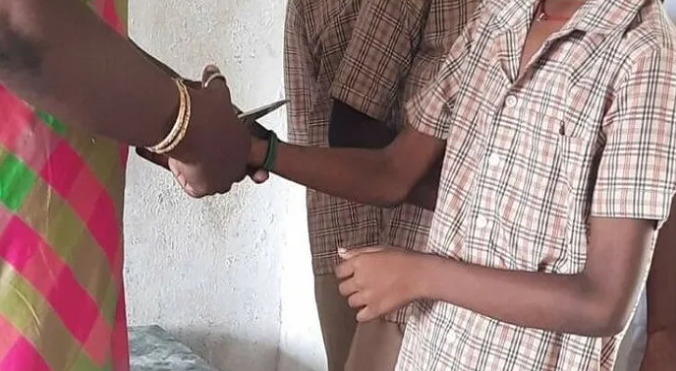
Case Summary
In Tamil Nadu's Kanchipuram, a school teacher named Udaya Lakshmi shared a social media post where she boasted about forcefully removing sacred threads (Kalavas) from Hindu students' wrists and advised them not to wear them again. She also boasted of brainwashing the minor students and claimed to have instilled the belief that they should not adorn Hindu symbols like Kalava. The post sparked massive public outrage, leading to its removal. It was shared on August 24, 2023.
Why it is Hate Crime ?
This particular case has been classified as a religiously motivated hate crime under two prime categories of the tracker because of the various distinct components that demonstrate the perpetrator's bias against the Hindu faith and their deliberate attempt to alienate the victims from their Hindu identity. Because of the case's specifics, the first prime category selected here is: Predatory Proselytisation and to narrow down the search further we have chosen the sub-category 'proselytisation by brainwashing, manipulation or subtle indoctrination. Additionally, a tertiary category called- 'Conversion of minor' has also been selected here. Religious brainwashing essentially means the often subtle and forcible indoctrination to induce someone to give up their religious beliefs to accept contrasting regimented ideas. Religious brainwashing also involves propaganda and manipulation. It involves the systematic effort, driven by religious malice and indoctrination, to persuade “non-believers’ to accept allegiance, command, or doctrine to and of a contrasting faith. Cases of such brainwashing are far more nuanced than direct threats, coercion, inducement and violence. In such cases, it is often seen that there is repeated, subtle and continual manipulation of the victim to induce disaffection towards their own faith and acceptance of the contrasting faith of the perpetrator. While subtle indoctrination is widely acknowledged as predatory, an element which is often understated in such conversions or the attempts of such conversion is the role of loyalty and trust which might develop between the perpetrator and the victim. Fiduciary relationships are often abused to affect such religious conversion. For example, an educator transmitting religious doctrine of a competing faith to a Hindu student. The Hindu student is likely to accept what the teacher is transmitting owing to existence of the fiduciary relationship. The exploitation of the fiduciary relationship to religiously indoctrinate victims would also be included in this category. Since the underlying animosity towards the victim’s faith forms the basis of predatory proselytization, such cases are considered religiously motivated hate crimes. The second category under which the case has been placed is- Attack on Hindu religious representations and under this, the sub-category- Desecration of Hindu religious symbol has been chosen. Icons and symbols or a religious representation of a spiritual ideal are widely revered in Hinduism. Iconography is of vital significance in the Hindu milieu. It helps connect people’s spiritual beliefs with the real world. Iconography within the Hindu faith takes several shapes and forms. Murtis are of most significance to Hindus, to which daily rituals, prayers and offerings are done. Besides the murtis, there are several other symbols which have deep significance in the Hindu faith – the Om and Swastika for example. Since these Hindu religious symbols hold paramount importance in Hinduism, any desecration of symbols, icons, murtis, religious representations and manifestations, is driven by animosity towards the faith itself which manifests itself through these murtis, icons and symbols. Therefore, any desecration of these Hindu religious symbols and representations is considered religiously motivated hate crimes under this category. In this case, the teacher forcefully removed sacred threads (Kalavas) from Hindu students' wrists. In Hinduism, the Kalava holds deep religious, cultural, and spiritual significance. It symbolises protection, blessings, unity, and commitment to spiritual and ethical principles. Its use across various rituals and ceremonies underscores its importance in the Hindu way of life and by forcefully cutting off the Kalava, the teacher insulted the Hindu faith and displayed her deep disdain towards the religion, which is why this case becomes worthy of being documented under this category of the hate tracker. Further, it is evident from the details that the Hindu victims here were minors which essentially means that the element of consent and genuine change of conscience was missing ab initio. It is a well-established fact that children are more susceptible to manipulation since they are still developing emotionally, cognitively, and socially. Their brains are not fully mature, making them more vulnerable to influence and less capable of critically evaluating information. Moreover, subtle manipulation tactics can be difficult to detect, especially when they are employed by trusted authority figures in positions of influence. This makes it challenging for parents, to identify and address instances of religious manipulation in schools. Since the underlying offence, in this case, is against children of a specific faith and involves subtle tactics of indoctrination, which obviously stems from a bias against the Hindu faith, this case has been documented as a hate crime under this category.


Case Status
Unknown


Perpetrators Details
Perpetrators
Others
Perpetrators Range
One Person
Perpetrators Gender
female
 Sources




