Revered Hindu deities idol desecrated my miscreants in Telangana
 Hyderabad, Telangana, India
  16 October, 2025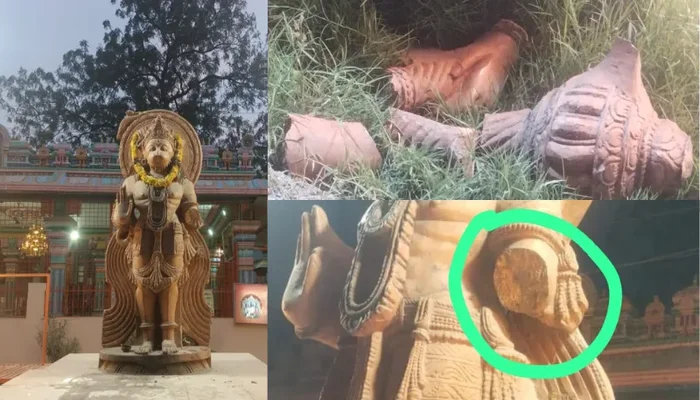
Case Summary
Murti of Bhagwan Hanuman was damaged early morning on October 17, 2025 in the Rampally locality in Hyderabad. The mace (gada) held in Bhagwan Hanuman’s left hand was found broken, immediately after which complaints were made to temple authorities and the police. The police are looking into CCTV footage to identify the culprits and have started an investigation into the case. Locals gathered around the temple area, which witnessed spontaneous protests from Hindu Devotees. Members of Vishwa Hindu Parishad and leaders from the BJP also took cognisance of the incident and condemned the sacrilege. Dr Ravinuthala Shashidhar, VHP spokesperson, stated that the act of vandalism was a targeted and planned attack on Hindu sentiments, and the perpetrators were emboldened by a casual and dismissive administrative approach in such cases. He further added that this attack was not a one-off and that there had been five such cases in the past year alone around Hyderabad.
Why it is Hate Crime ?
This case has been added to the tracker under the primary category- Attack on Hindu religious representations, with the secondary category being: Desecration of Hindu religious symbol. Icons and symbols, or a religious representation of a spiritual ideal, are widely revered in Hinduism. Iconography is of vital significance in the Hindu milieu. It helps connect people’s spiritual beliefs with the real world. Iconography within the Hindu faith takes several shapes and forms. Murtis are of most significance to Hindus, to which daily rituals, prayers and offerings are done. Besides the murtis, there are several other symbols which have deep significance in the Hindu faith – the Om and Swastika, for example. Since these Hindu religious symbols hold paramount importance in Hinduism, any desecration of symbols, icons, murtis, religious representations and manifestations, is driven by animosity towards the faith itself, which manifests itself through these murtis, icons and symbols. Therefore, any desecration of these Hindu religious symbols and representations is considered a religiously motivated hate crime under this category. Bhagwan Hanuman has a special place in the Hindu pantheon as a symbol of utmost devotion and righteousness, and desecration of his murti is a direct attack on the two emotions that embody Dharma, the soul of Hindu civilisation. Lord Hanuman is revered by all Hindu sects, irrespective of geography and culture. Deliberate vandalism of his murt reflects a deep-rooted hate for the Hindu identity and a pathological compulsion to enact that hatred through violence against Hindu symbols and deities. Beyond the physical damage, the psychological impact of such attacks is profound. For devotees, temples are places of solace, peace, and connection with the divine. When sacred temples are targeted and their idols vandalised, especially during an important festival like Diwali, it demonstrates that the perpetrators deliberately intended to insult and hurt Hindu sentiments. Such attacks disrupt the sense of security and belonging, the Hindu community finds in these institutions. The pain caused by idol desecration is not limited to tangible loss; it wounds the collective psyche of Hindus, leaving many feeling isolated, vulnerable, and marginalised. These acts are not just vandalism; they are calculated assaults on the faith, identity, and spiritual dignity of the Hindu community. It is also important to mention here that, till the last update, the miscreants were unknown; regardless, the action stemmed from hatred against Hinduism and resulted in the desecration of the sacred idols in the Hindu temple and would therefore be considered a religiously motivated hate crime. Such attacks underscore religious animosity, warranting their inclusion in the Hinduphobia Tracker under the hate crime database.


Case Status
Complaint filed


Perpetrators Details
Perpetrators
Unknown
Perpetrators Range
Unknown
Perpetrators Gender
unknown
 Sources




